






















Before getting into the meat and potatoes of the blog, I (keon) want to give a shout out to Cameron. He made a post of few days ago about the Leafs effectiveness in drafting since the 2004-05 Lockout and it was that post that inspired me to look into this topic in greater detail. The thought of which team or teams are the best at evaluating junior age talent, and vise-versa, has always intrigued me, so when Cameron broached the subject I thought maybe it was a good time to finally look into it.
While there are obviously a lot of factors that go in to ranking which team is best and which team is worst at drafting, the only evaluation method an armchair GM has at his disposal is through statistics. Using hockey-reference.com was a simple, one-stop source for compiling the statistics used in this analysis. Not only are their stats concise, but also up-to-date, providing accuracy and easy navigation.
The analysis used in this piece is broken down into two different measures, quantitative and qualitative. The quantitative measure is straight forward: how many players has each team drafted that have played at least one game in the NHL. Using the one game played approach is a reasonable one, as no matter where a player is drafted he is still not a slam dunk to make the big leagues. The rank for each team is represented by the # Scr column in the accompanying table.
To assess the quality of the draft selections each team has made, there are four categories:
- The number of players, who played one game in the NHL, divided by the total number of draft picks a team made during the eight draft years, 2005 to 2012 inclusive. This gives us a team’s success rate. The ranking is shown in the % Scr column.
- The total number of games each of these players has played in the league, divided by the number of players to play one NHL game. The rank for this average is shown in the GP Scr column.
- To increase the quality ranking, we should eliminate all players that have played just one, or only a hand full of games. To do this, let’s choose only those players who have played at least 82 games so far in their career, equivalent to a full NHL season. This tells us which teams are good at drafting not just a player who can make the pros, but a player who is good enough to contribute to a team’s success, or lack of in some cases. Each team’s ranking is represented in the > 81 Scr field.
- Finally, let’s look at the point totals. The last qualitative measure is the PPG Scr column, which is the rank each team received based on the total number of points that all the NHL players have accumulated, divided by the number of games played. This provides a point-per-game (PPG) average that the ranks are then based on.
Once each team has been ranked in each of the five categories, a score was assigned based on these rankings. A team who was the best in the league in a category was assigned a score of 30, all the way down to the worst team, which received a score of 1. Teams tying in a category received the same score, for example:
The Leafs have drafted 14 players who have played at least one game in the league over this time period. They are tied with Buffalo, Chicago, San Jose and Washington; therefore all teams were assigned a score of 11. To avoid ties in other categories such as points-per-game, averages were taken the 3rd decimal place to determine which team was better than another.
Once the scores were assigned for all 30 teams, the scores were added up in the Total Scr column and this overall score was used as the basis for determining which team rules the draft floor and which team cleans up the garbage after the last player is chosen.
As stated above, the analysis is only for the years 2005 to 2012 inclusive. Why only those years? While drafting well has always been important, since the inception of the salary cap, being able to recognize talent has gone to the next level. With teams playing their star players more and more and locking them up long term, the ability to have several young players on their entry-level deals has become paramount to balancing the budgets. Additionally, with teams only able to spend to a certain dollar amount on player salaries, most teams have increased their scouting budgets to scour the world for those hidden gems.
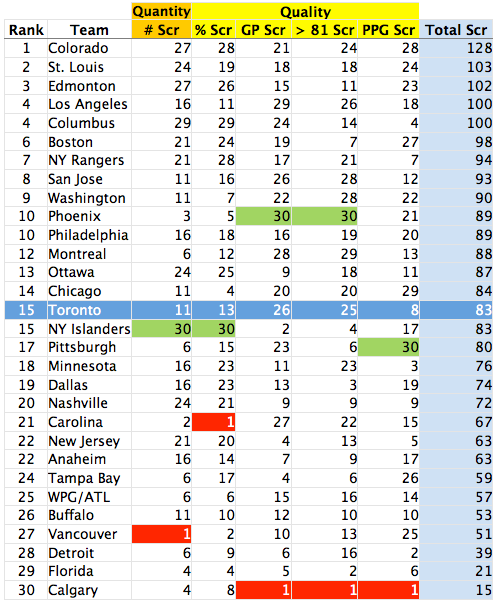
The following table shows the results of the analysis. The best-to-worst overall ranking is derived from the Total Scr for each team. A score of 30 is highlighted in green to show which team scored first in a particular category. Conversely, a score of 1 is highlighted red to indicate which team has the worst result in a certain measure.
The Good, the Mediocre and the “Thanks for showing up”
As you can see, Colorado can truly be crowned the kings of the draft. Scoring in the top 10 in every category gives them a decisive victory over the rest of the league. Their ranks are based on having:
- 19 players drafted who have played at least one NHL game
- A success rate of 33.3% (19/57 total picks)
- An average of 110 games played by each of those 19 players
- Having 9, or 47.4% of those 19 players play at least 82 games and;
- A total of 1161 points, or 0.558 PPG
Consistency is the key to their success, as it is for the top 9 teams overall. You will notice that none of the top 9 teams placed first overall in any one particular category, but with the exception of a few low scores, all ranked consistently well above average in the majority of the categories.
The average Total Scr is 76.7, leaving 17 teams above average and 13 teams below the standard.
Some interesting things from the middle of the pack teams:
- Phoenix hasn’t had much success drafting players who make the NHL, but the ones that do stick around. They scored best in games played (161/player) and players who have played more than 81 games (63.6%).
- The Islanders are the polar opposite of Phoenix, they draft players who have made it to the show (25 with a 37.9% success rate), but the quality of those players has been somewhat lacking to this point.
- Boston’s strong showing in the PPG rank is aided nicely by Phil Kessel’s 333 career points and Kris Versteeg’s 204.
- Pittsburgh’s results are buoyed by Sidney Crosby and Jordan Staal in the games played classification and of course by Crosby again in the PPG rank. Otherwise, their drafting record has been fairly abysmal.
- Most of the teams in the middle of league have one or two scores that bring down their overall rank. Montreal, Chicago, Minnesota, Dallas and New Jersey being classic examples.
As for the teams that are bringing up the rear:
- Enough said about Calgary. Ranking dead last in three categories is a recipe for disaster and we can see the results of this poor drafting in the standings every morning.
- Carolina and Vancouver are the NHL’s worst teams at drafting players who will play in the league (9 and 8) and success rate (16.7% and 17%).
- Buffalo’s record is quite poor across the board, perhaps Darcy Regier should be paying Ryan Miller even more than he is.
- Not much of a surprise that Florida is where they are in the rankings, but according to sources their fortunes are about to take an upturn with the young players they have in their system.
- Detroit is beginning to show signs of age, but they better hope their veterans can bridge the gap to their next generation of stars. Problem is, looking at the analysis; it seems a downturn in Red Wing futures may be on the horizon. Years of drafting low in 1st round or trading those picks away to stay near to the top of the standings is going to rear its ugly head sooner rather than later.
Leafs Perspective
The Leafs are one of the teams in the middle of the pack, a little above the average of 76.7 with a total score of 83. They seem to do well in evaluating talent that will not only play in the NHL, but also make a contribution judging by the number of players who have played at least 82 games, as 50% of the 14 players who have made the NHL have done so. They rank 5th in the league in games played per player at 136, Luke Schenn and the draft classes of 2005 and 2006 doing most of the damage here.
Where they struggle, however, and it’s something that no one should be surprised about, is in identifying high-end talent. They rank 23rd overall in points-per-game at 0.321 and near bottom third of the league in players who have played one game (14) and success rate, as only 25% of their 56 picks over the eight years have made it to the bigs.
In Conclusion
This was an interesting exercise and it’s fun to see how the results match up with what we see in the NHL on an almost nightly basis. Doing the analysis now also eliminated many of the bright young stars who are just making a name for themselves, such as Nail Yakupov and Justin Shultz and the Leafs‘ own Nazem Kadri and Matt Frattin. Having only been in the league a short while, they did not qualify for one category in particular – quantity of games played. It would be interesting to update these results about two years or so to see if the landscape changes. From a Leaf fan perspective, I’m betting it will.
Thanks for reading,
keon