














As we await more details on a possible Kirill Marchenko blockbuster…
In my earlier piece, I looked at why this Maple Leafs season could go in so many directions. The additions of Darren Raddysh and Gavin McKenna, hopefully healthier seasons from Auston Matthews and Chris Tanev, and a new coaching staff with a low bar to clear after last year’s debacle all offer reasons for optimism.
Questions remain about key players’ ability to stay healthy, scoring depth, and goaltending. With the preseason over and the season opener approaching, let’s turn to a few early signs of how the 2026-27 Leafs might play and what I’ll be watching for when the real games start on Tuesday night.
Notes
– It’s hard to give a full breakdown of structural or systemic changes based on the preseason. The Leafs haven’t had much time to implement their system, and it’s preseason anyway. One thing that did stand out, and that Jim Hiller has referenced a number of times, is the forwards getting more involved defensively. The six defensemen get a lot of attention, but the forwards are just as involved in team defense. They tracked back well against Ottawa, and it was a clear point of emphasis. It’s something the Leafs have worked on in practice, too. Early last season in particular, they were horrible at defending off the rush, often because their forwards were nowhere to be found.
– For all the talk of Hiller and the 1-3-1 in LA, the Leafs played a fairly standard 1-2-2 against Ottawa with nearly their full lineup. The first forward wasn’t particularly aggressive in the neutral zone, but the second layer was active and made it difficult for the Senators to even reach the Leafs’ defense with the puck still on their sticks.
– The Leafs were essentially dumping the puck in only as a last resort. That will sound great after how mind-numbing last season was, but the best teams in the league generally dump the puck in and forecheck well. The past few Cup winners in Carolina and Florida were among the league leaders in this area. When the hockey tightens up, it’s often your only choice. That said, it makes sense to start this way and adjust as the season goes along.
– One thing to monitor as the season starts is how McKenna and Nylander play off each other. Both are puck-dominant players, but there’s only one puck, and they’re on the same line. Nylander was clearly going through the motions in the preseason, and McKenna was more than happy to get the touches. That changes this week. How will it look when Nylander’s play elevates and he’s all over the puck, too?
– It’s preseason, so who knows how much time Ottawa has had to practice its penalty kill, but the natural instinct to close off Raddysh and Matthews left a ton of space down low. Before Jack Roslovic scored on a rebound from a Tavares shot, look how much room Tavares had when he received the puck. I’m looking forward to the big shot up top and the two shooters on the flanks, but the Leafs had better have some plays down low ready to make teams pay.
Quotes

“I think he’s just going to be that guy. That’s what we all hope he turns into: a guy who plays on the power play, plays on the penalty kill, can play in your top six, can play on your checking line, and push good teams back. We’ve talked about that.
“I’m not saying he’s going to be out on the penalty kill to start the season, but we wanted to give him a good run. He showed us that he’s got a lot there to his game.”
— Jim Hiller on what allowed him to trust Easton Cowan on the penalty kill in the preseason
Cowan was a really good penalty killer for the London Knights but played only seven seconds shorthanded last season, which was probably the result of a late line change. In the preseason, he got reps and showed well. He has an active stick, anticipates lanes, and has the work rate to win battles, recover pucks, and get them out. With Steven Lorentz sent down and Dakota Joshua hurt, there are openings on the penalty kill after Teddy Blueger, Brandon Duhaime, and Colton Sissons. Cowan took some reps with Matthew Knies, and they were an intriguing duo. It was far less about counterattacking than it was when Nylander was there, but they can still turn a puck up ice and make a play.
“My game kind of excels when there’s a lot more predictability, more north-south, playing hard and that’s what you find in regular season. I’m just trying to get my feet under me, good puck touches and play to my strengths.
“This is a shorter pre-season, so I want to get better as fast as possible. Regular season is a different beast and that’s just where I play my best.”
— Matthew Knies on his preseason
He’s not entirely wrong. Preseason hockey is far more freewheeling, and skilled forwards can take on defenders one-on-one with more success.
Yes, you would have liked to see more from Knies, but the conversation is probably going a bit too far when the season hasn’t even started. The irony is that he improved his scoring last season despite losing a 100-point linemate, Auston Matthews’ injury and generally underwhelming play, and Knies playing through an injury of his own. I’m not worried about his ability to produce. The bigger question is whether he can establish himself as a proper physical presence, which he has yet to really do through three seasons, even as he alludes to that north-south, hard style of play.
“Speed was a big thing for me all summer. It’s a fast league and that’s something I pride myself in, being more deceptive with it.”
— Gavin McKenna on improving his skating
I wouldn’t go so far as to call his skating a criticism during the draft process, but it certainly wasn’t considered a plus, either. It’s early, and McKenna hasn’t played a game against an actual NHL roster yet, but so far his skating doesn’t appear to be an issue at all. In fact, he pulled away from defenders at times and had no trouble arriving at the puck first. The hands and vision were obvious, but his skating has been noticeable in a good way. The other area for him to improve as he gets older and stronger is his shot, as is the case for nearly every young NHLer who can’t already rip it like a Matthews or Patrik Laine.
Tweets
With Blankenburg signed for 1.4M, #Leafsforever are 3.808M projected over the cap. They can submit an opening roster with Domi (3.75M) and Villeneuve (68K SOIR) on LTIR and come within $10K of an optimal LTIR capture. https://t.co/gG2oRpjZ3A
Read more:… https://t.co/pmCarqtbGy pic.twitter.com/3q7ouZRHuN
— PuckPedia (@PuckPedia) September 27, 2026
I highly doubt Nick Blankenburg came to camp on a genuine PTO, just as Max Pacioretty did not come to camp and then “make” the team a few years ago. Early in camp, Hiller was asked about Blankenburg and essentially brushed off the idea that he needed a closer look at him: He already knew who Blankenburg was in this league. So why the PTO? It let the Leafs assess their group at the end of the preseason and see how much they needed to pay him to maximize their LTIR space because of Max Domi’s injury. That number changed slightly when Steven Lorentz was sent down and Zack MacEwen and Bo Groulx, who started camp with the B group, made the team. It’s a clever, effective way to sort out the roster while preserving salary-cap flexibility, instead of locking in a number they’d have to work around.
KIDS: Nick Blankenburg scored the OT winner for Nashville this weekend, on the ice with Filip Forsberg and Steven Stamkos.
This was his journey to the NHL:
Age 17 – High school hockey in Michigan
Age 18 – 18u Tier 1 AAA
Age 19 – AJHL (Tier 2 junior in Canada)
Age 20 – Freshman… pic.twitter.com/wdZ7AhIy2f— Topher Scott (@HockeyThinkTank) December 23, 2024
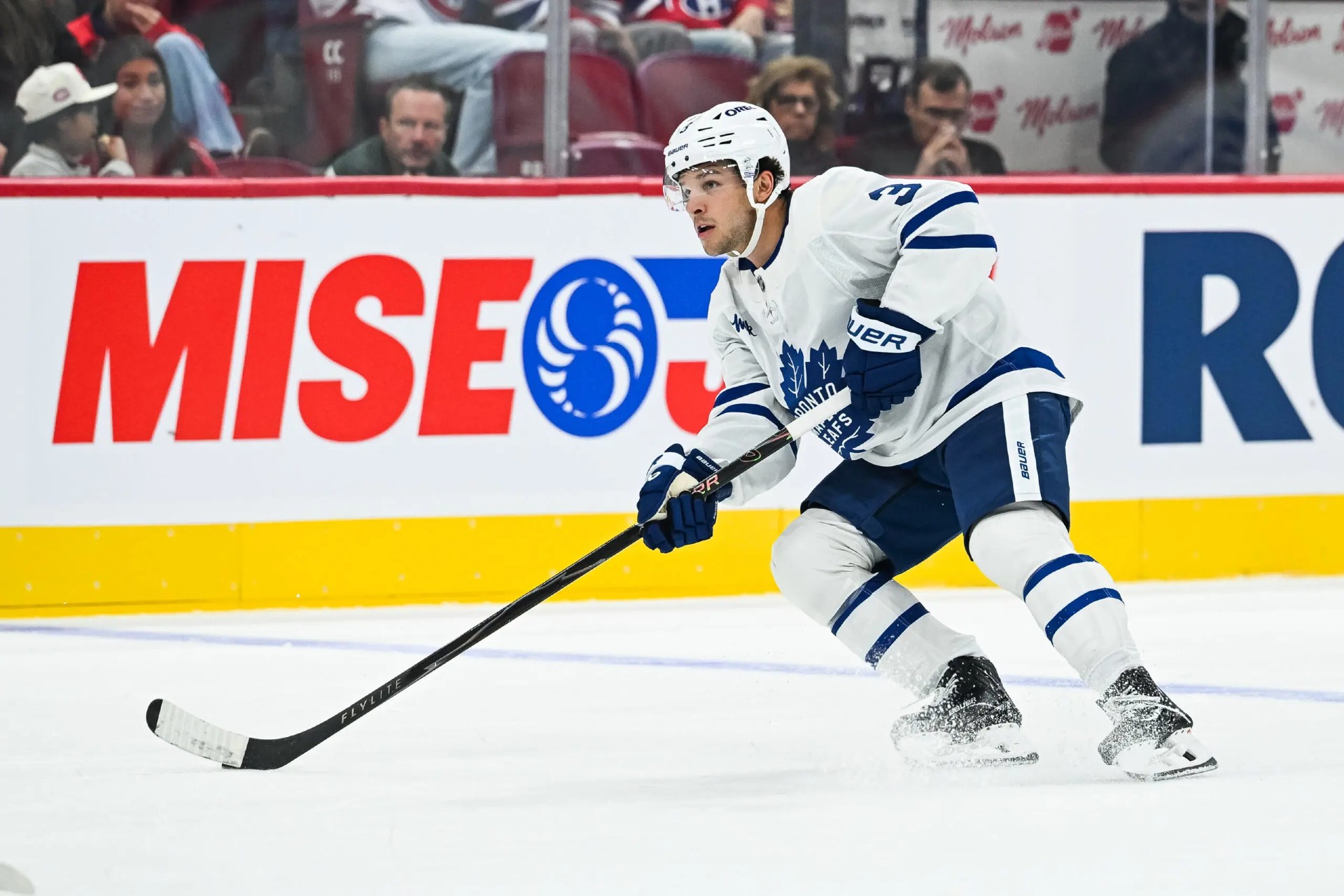
Blankenburg himself is a really cool underdog story: He continues to battle for everything he gets. He’s an easy guy to root for, and on top of that, he has been pretty good over the past few seasons. He has played 121 NHL games and put up 40 points over the past two seasons, although 13 of those points came on the power play. Regular power-play time will be hard to come by on this team barring injury. Blankenburg has been an effective five-on-five player, and that’s where he’ll have to make his mark in Toronto.
The Leafs head into the season with four lefties and four righties on defense, and all eight are NHL defensemen, before even considering anyone with the Marlies. There are questions about the quality at the top, but there is legitimate depth. They should be able to maneuver around their options to achieve some proper results on defense.
Before the Maple Leafs practised today at Arizona State, they visited with the Mayich family.
Here are the hats and t-shirts they are wearing at the rink. Really well-done pic.twitter.com/aXbXRn6hSH
— Elliotte Friedman (@FriedgeHNIC) September 26, 2026
An awesome gesture by the Leafs to show their support here.
I know the Arizona trip prompted some conversation, but a few things stood out. Half this team has turned over, along with the coaching staff and management group. Getting away from the noise of the market and the demands everyone has at home gave them a chance to bond, especially with a four-game homestand to start the season. I also thought it was cool that Matthews hosted the entire team at his place. He should be doing that, and I’m sure it was a great time.
Five Things I Think I’d Do

1. Nick Paul appears like he’s good to go for opening night, but he misses any time to start the season—the Leafs start with a back-to-back—it makes sense to have Bo Groulx on the third line with Sissons and Cowan. Groulx is a capable shooter who gives Cowan someone to make plays with, and he’s an honest player who can play a credible two-way game.
2. I think if Paul is good to go for both games of the first back-to-back, I’d prefer to see Groulx on the fourth line with Blueger and Duhaime. It wouldn’t change the utility of that line, but Groulx is capable of moving up the lineup, is far more likely to score than Zack MacEwen, and offers special-teams utility, which you can never have enough of. If Paul has a setback during a game, Groulx would give them a reasonable option to move up the lineup.
3. I think the starting six on defense is pretty clear at this point, with OEL–Stecher as the third pairing, but managing the group will be a bit tricky. Ideally, you want the younger players in Blankenburg and Andrae getting regular ice time. They are the only defensemen on the team under 30. Injuries will eventually happen, so they’re going to play, but they can’t exactly wait for that. I’d consider some load management not just for the 36-year-old Tanev, but for the 35-year-old OEL as well. Even if Stecher comes out right away, I’d look to rotate in at least one option during the opening back-to-back.
4. I think what I’m looking for most this week is how the flow of play tilts. The product was awful last season, and the Leafs were routinely dominated. Even in their opening win against Montreal, they were outchanced, outshot, and out-attempted at five-on-five. The game-winning goal came on a sequence where a Hab broke his stick. In their next game, they were out-attempted 57–35 at five-on-five by the mediocre Detroit Red Wings. I’d like to see far more time in the offensive zone and a more aggressive approach in the defensive zone—one that actively works to get the puck back instead of retreating and looking like a penalty kill. They start with a four-game homestand and obviously need results from it, but establishing a proper process and formula for how they play should be the priority. If they do that, the results will follow.
5. I think it’s exciting to be back! It was a long offseason—far too long—and a lot happened. I can’t wait to get this season going and see where it takes us.