










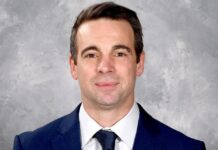


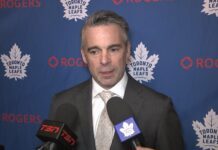







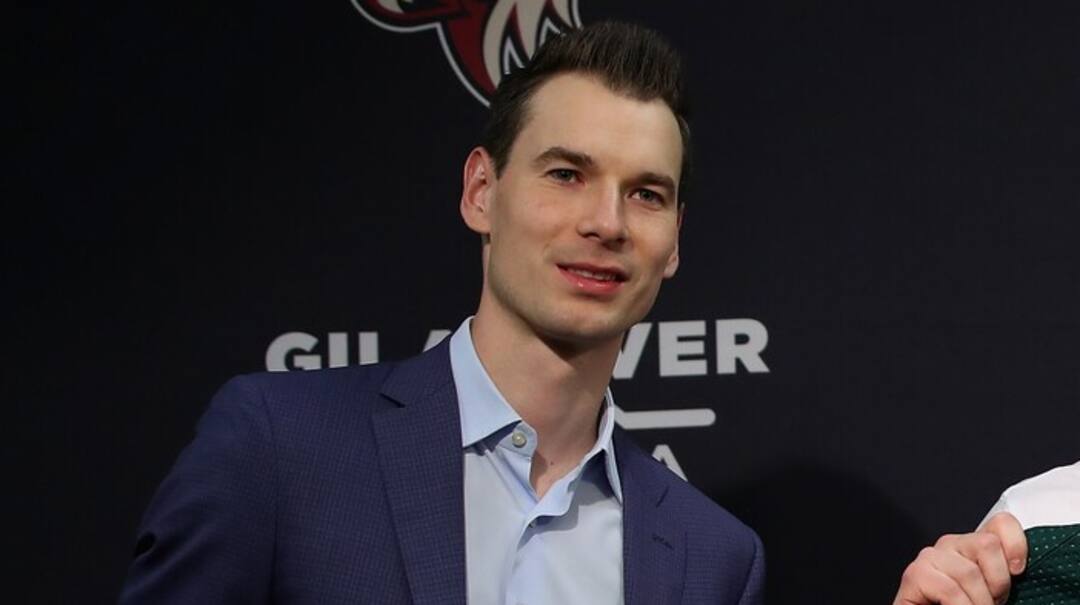
The worst-kept secret in hockey is now confirmed, as the Toronto Maple Leafs have officially hired Mats Sundin and John Chayka into senior management positions.
Chayka will become the 19th General Manager in Leafs history, while Sundin will come on board as the Senior Executive Advisor of Hockey Operations. Regarding the power structure, Elliotte Friedman reported that Chayka will report to Keith Pelley and head the Leafs’ hockey operations.
We discussed the idea of Chayka as a candidate weeks ago, at which time I wrote:
– I feel like I’m living in an alternate universe anytime John Chayka’s name surfaces. Did everyone forget what he did in Arizona? Put aside anything he may have done with the NHL roster; this is about his off-ice conduct. Greg Wyshynski outlined it here, but to summarize: While with the Coyotes, a new owner in Alex Meruelo finally offered him the financial flexibility needed to build a contending organization, and Chayka was rewarded with a contract extension. An NHL owner then called Meruelo asking for permission to speak with Chayka. Meruelo denied the request, as is his right, but Chayka reportedly went to Meruelo seeking permission to speak with the owner under the premise that it wasn’t a job interview, making the argument that previous Coyotes owners would have permitted the conversation, as it was intended to “build relationships with owners in hockey” and “get market knowledge.” Well, it turned out to be a job interview, and then all hell broke loose, culminating in Chayka resigning right before his team was about to start the COVID play-in tournament.
The old saying applies here: When someone shows you who they are, believe them. To have a contract in hand, seek to leverage it, effectively lie to your boss, and then, after all of that, quit on the team at the most inopportune time possible is deplorable behaviour. Plenty of people around the hockey world don’t think he’ll ever work for an NHL team, given those events. It’s stunning to me that the Leafs even interviewed him. I couldn’t care less about the moves he made with the Coyotes; this is not someone you should ever do business with.
It’s not a position I will suddenly soften on now that Chayka has been hired, but we will explore it in more detail.
Chayka became Assistant General Manager of the Arizona Coyotes at the ripe age of 25 and served in the role for one year before becoming the youngest GM in North American pro sports history. He held that position for just under four seasons, with the Coyotes qualifying for the playoffs only once in his tenure, in his final season.
In fairness to Chayka, he inherited a weak team to begin with. They finished tied for 24th in the season before he was promoted to GM. That was the same season the Leafs finished last and drafted Auston Matthews.
Chayka’s first draft was arguably his best piece of work, as he took a swing on Clayton Keller at seventh overall (the next five picks were Alex Nylander, Mikhail Sergachev, Tyson Jost, Logan Brown, and Michael McLeod). Then, he orchestrated a trade with the Detroit Red Wings to move up four spots from 20th overall to 16th overall, where the Coyotes selected Jakob Chychrun. Later that summer, Chayka also took on Dave Bolland’s contract and acquired Lawson Crouse for a second and a third. All savvy pieces of business.
The next season did not get much better on the ice, though. The Coyotes dropped to a tie for 27th in the league, with eight fewer points. Only one player on the entire team scored more than 39 (!) points (Radim Vrbata). Their reward was the seventh-overall pick, which Chayka flipped along with Tony DeAngelo, for Derek Stepan and Antti Raanta. The Rangers used the pick to select Lias Andersson.
While Stepan held up his end of the bargain with 56 points in his first season with the Coyotes — second on the team in scoring — the team once again struggled, finishing third last. With the fifth overall pick in the draft, they reached on Barrett Hayton. Arguably, Chayka’s draft record peaked just a few weeks into his tenure as GM in 2016 and got progressively worse with each passing season.
In Chayka’s third year with the team, the Coyotes finally made some notable improvements on the ice. The team finished 39-35-8, placing 18th in the league. They didn’t have a single 50-point player, but Chayka’s trade for Darcy Kuemper toward the end of the previous season solidified their goaltending, and they iced a deep roster with contributors up and down their lineup.
The following season, the Coyotes’ points percentage improved slightly from .524 to .529, but they were sitting 22nd in the standings when the season was cut short due to the COVID-19 outbreak. It was good enough to get them into the play-in tournament, where they actually won the first round to technically “make the playoffs.”
But Chayka wasn’t there for their playoff appearance. He resigned right before the play-in tournament began due to a fractured relationship with new owner Alex Meruelo. Meruelo was surely no angel, and the league effectively took the team away from him, but he was at odds with Chayka over Chayka’s meeting with the New Jersey Devils, and ultimately, Chayka resigned. After Chayka’s resignation, Meruelo asked Bettman to adjudicate the divorce, prompting the NHL to suspend Chayka for the rest of the calendar year.
Commissioner Gary Bettman made the ruling Monday and circulated a memo to all teams that stated Chayka engaged in “conduct detrimental to the league and game.” Bettman’s ruling also said Chayka “breached his obligation to the club.”
The suspension is tied to Chayka’s pursuing other opportunities while under contract with the Coyotes and terminating his contract with three years remaining on it, a source said.
The league never heard from Chayka again — until now.
There is no two ways around the resume to date. We’re talking about — at best — a GM who built a team that only won a play-in round, and he wasn’t even the GM by then. The Coyotes struggled for resources, but Andrew Barroway owned the team for three of Chayka’s four years and, by Chayka’s own account, gave Chayka full autonomy. While the Meruelo fiasco has many layers, the Coyotes were also among the top spenders that season.
Make no mistake, though, Chayka is failing up into this position. He has been out of the league for five years, and when he was in it, he achieved virtually zero success. In fact, given that he was 25 when he joined Arizona, he has not been part of any winning program in any hockey league, ever.
There will likely be lots of discussion about whether Chayka had the resources and infrastructure around him in Arizona to succeed. That might be a valid point, but there are some similarities to the narrative surrounding Brad Treliving when he was hired:
The Maple Leafs are getting a classy, good person. Brad really treated people well here.
I was always curious what Treliving would do if he worked for a franchise that invested more in plyr development, analytics, etc & was more progressive. Looks like we'll find out. #Flames
— Salim Nadim Valji (@salimvalji) May 31, 2023
At the time, I wrote of Treliving:
“At the same time, the Flames ultimately won two playoff rounds in nine seasons with Treliving as GM. Losing Johnny Gaudreau for free is inexcusable, and if that happens with any of Auston Matthews, Mitch Marner, or William Nylander, it’s a fireable offense, to put it bluntly.
Perhaps Treliving learned from that experience and will handle it differently moving forward, but ideally, the Leafs would be betting on a history of strong gambles and decisions instead of only hoping their GM has benefited from a learning experience.”
We won’t revisit Treliving’s tenure at this point, but the proof is in the pudding.
On the flip side, one can at least feasibly argue that the Leafs have hired a number of experienced executives over the years with past success on their resumes — Brian Burke, Lou Lamoriello, Pat Quinn — and ultimately, they didn’t win it all, either. Ideally, though, you’d like the GM of the Maple Leafs to have some experience contributing to a successful hockey program, even if it’s in a smaller capacity.
For Chayka specifically, it’s not as if he went back into hockey between his Arizona tenure and now. He supported his wife, Kathryn, who is the CEO of JKC Restaurants. They are clearly very successful, and you can’t criticize someone for making money, but he didn’t exactly take a step back and humble himself by learning under another leader around the league while preparing himself for his next opportunity.
Some of that might not have been his own doing, though. A number of teams were not interested in Chayka as a front-office candidate due to his time and exit in Arizona:
“A few years ago, the popular former Maple Leaf Tie Domi contacted me and asked if I was interested in having lunch with Chayka, who was looking to get back to the NHL in an executive capacity.”
While Steve Simmons is a controversial figure to many, he’s retelling his own personal experience in this case. It’s a rather telling attempt to generate some positive PR for the executive who found himself out of the league altogether for half a decade.
That does not necessarily mean Chayka will do a bad job moving forward, but it’s all part of what the Leafs have effectively decided to get into bed with now.
And then there is the addition of Mats Sundin, officially hired as the Senior Executive Advisor of Hockey Operations. But given that Chayka reports to Pelley directly and is the GM, how much actual sway or impact Sundin has or will have is anyone’s guess at this point. That’s before we get into any sort of understanding of his management chops — his hockey opinions, talent evaluation abilities, so on and so forth — given that he is a complete rookie.
Personally, I am a fan of Mats Sundin and love that he has a genuine passion for the franchise and city. But to many in Toronto, Sundin is a controversial figure, given how his time in Toronto ended during his playing career, and he has no experience. It is a complete wildcard and, optically, it arguably looks like an attempt to generate some positive PR without giving him the responsibility to drive real change.
The absence of a President of Hockey Operations will also speak volumes for the time being, and how much Keith Pelley — who swears he’s not involved and doesn’t want to be! — is still in the picture moving forward will be fascinating to track.
If nothing else, as Pelley said himself, “This is the most important decision that I will likely make in my tenure at MLSE.” He is right. And he is taking a huge gamble on a relatively unproven, outcast executive with this momentous decision. Every Leafs partisan hopes it works out, but in Pelley’s case, he won’t survive it if it doesn’t.
Additional Thoughts
– The Leafs made it clear they wanted a data-driven individual, and Chayka technically meets that criteria with his background with Stathletes. The first test will come rather quickly, given that a decision still has to be made on Craig Berube. The team has ranked at or near the bottom of the league in possession for two seasons under Berube, including his first year, when they had a fully healthy, good team on paper. There’s no data-centric argument to be made for keeping Berube behind the bench.
– Chayka has some connections in the organization already. He worked with current assistant coach Steve Sullivan, who took over in the Coyotes’ front office after Chayka resigned. He had Max Domi on his team and traded him. He had OEL in Arizona as well. He drafted Matias Maccelli. So there will be some familiarity there.
– I believe there is truth to the reporting that Tie Domi influenced Keith Pelley and advocated on behalf of John Chayka, given they have had a relationship pre-dating Domi’s time in the NHL. If there is any thought that Chayka would trade Max Domi because he has already done it once, it is hard to imagine it now, given the context leading up to this hiring. If anything, Chayka did Domi a favour by getting him out of Arizona at the time.
– Of note moving forward is what other shakeups transpire within the Leafs management group. It’s hard to imagine Shane Doan, already granted permission to interview with Vancouver, will stay, given his history with Chayka and the way Doan exited the Arizona organization. Are they really keeping the core of their management group moving forward? It’s hard to imagine these are the only changes.
– One thing going for Chayka compared to Brad Treliving: Chayka completed a lot of trades while with the Coyotes. He made 24 trades in just under four seasons as GM. Not all of them worked out, obviously, but this Leafs roster currently has eight forwards, six defensemen, and three goalies all signed, as well as a number of RFAs who would be full-time players if qualified and signed. They will need to make actual trades, which Treliving seemed unable to accomplish, and Chayka, if nothing else, is a wheeler-and-dealer.
– In reading about Chayka’s past, I thought this quote was particularly interesting:
And while most everything in Arizona is done through an analytical lens, it’s best if reason leaves the room here and there. “Sometimes logic isn’t your friend,” Chayka says. “A lot of entrepreneurs, they’re not reasonable people at all times. They take huge risks that just really don’t add up. And when it looks like it has no chance of working, you just kind of put your head down and keep working at it. You’ve got a strategy, you’ve got a plan, you believe in it: Dig in and get it done.”
The MLSE higher-ups clearly have zero interest in moving Auston Matthews or William Nylander. They want to try to win with them in Toronto. The Leafs are coming off a season in which they finished fifth-last; they own little draft capital, and the UFA market is weak. There’s a level of irrationality in believing this can be turned around immediately. Maybe I’m just referencing a very old quote Chayka no longer believes, but it made me think of the two.
– Chayka has had an impressive corporate career; hockey aside, we can see how he would be effective at dealing with business executives like Pelley and the MLSE board at large. That doesn’t mean anything in terms of building an actual hockey team that can win, but it is (sadly) part of this Leafs job.