


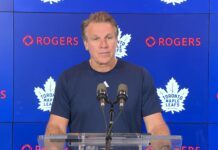







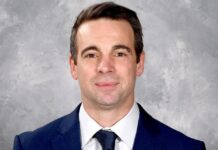

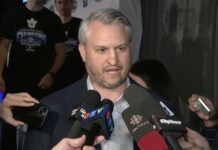







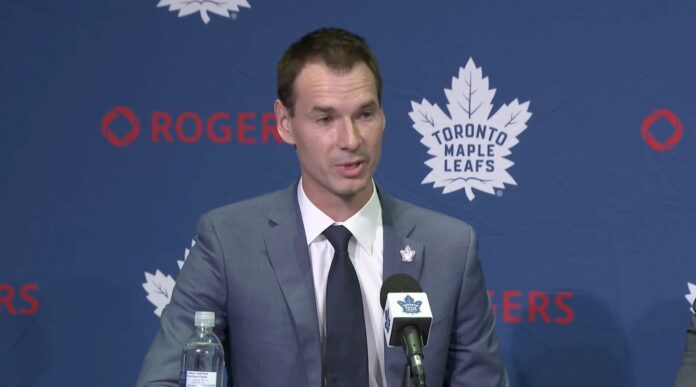
The newest General Manager of the Toronto Maple Leafs, John Chayka, discussed his childhood connection to the franchise, the interview process, his controversial exit from Arizona, and his plans for the first few weeks on the job.
Opening Statements
Chayka: This is not just a job. Being the General Manager of the Toronto Maple Leafs carries an enormous obligation to the team, the community, the alumni, our players, our partners, and the millions of fans across the world. I don’t say that in an abstract way. I’ve witnessed it and lived it since I was a kid. I grew up about 45 minutes from here in Jordan Station. My dad took me to games at the Maple Leaf Gardens, where I fell in love with the game.
I sat in the stands at the Air Canada Centre and rooted for #13, our captain. Mats, it will be an honour to work with you.
I understand precisely how much this organization matters to our city and country. I understand the wait of our long wait. To Leafs Nation: This is your team. I share your passion for hockey, for this team, and for its history.
That said, I am not here to romanticize this opportunity. I am here to build something that delivers. There is no avoiding the realities of the challenges ahead. This is one of the most coveted roles in sports and also one of the most demanding. You don’t meet a challenge like this by chasing moments. You meet it by building an organization that consistently creates them.
Great teams beat talented teams, but great organizations beat great teams. That is the standard that we must meet at every level of the organization.
I am a realist. I want to address an element of my past up front. I understand there will be lots of questions about my path, my time away from the game, and my time in Arizona. That experience shaped me. It required creativity, discipline, and resilience. I’ve made decisions I am proud of, and I also have made mistakes I’ve learned from. I am human. I own all of it, and I am better because of it.
I would also say this: The game has evolved since I left the Coyotes. I view that shift as a positive. I didn’t live off the grid. I stayed obsessed with the game, our league, the role of process, data, and integrated decision-making. These are no longer emerging ideas. They are essential to how elite NHL organizations operate. That alignment between where the game stands today and how I believe in building teams is part of what makes this opportunity so incredibly compelling.
I also understand another reality: Nothing I say here today earns credibility in this market. That will come from how we operate, the decisions we make, the consistency of our approach, and ultimately, the results we achieve on the ice. What we are building here must be more than a great roster. It must be an organization that is aligned, integrated, and accountable. Every function, from hockey ops, scouting, development, performance, medical, analytics, and technology, must work toward a single objective: to build an environment where players improve faster here than anywhere else in the league.
That is the goal, and it starts with the culture: high standards, high talent density, and a mindset where the best idea wins. That requires alignment from the entire organization, from ownership to front office, right down to the bench. It requires honesty, discipline, and a willingness to challenge each other.
Our fans bring pride and passion to this game every day. They deserve to see that reflected on the ice. Our players deserve the same from us. They need to know that when we enter the locker room, we share their commitment down to our DNA. They need to know we will be honest with them and challenge them. We will give them every resource necessary to succeed. That standard is non-negotiable.
Players are at the center of everything we do, and we will treat them that way. Our responsibility is to create an environment where they can perform at their best and at the highest level.
There are real decisions in front of us: roster construction, coaching alignment, development, and performance infrastructure. We will approach those decisions and every decision with clarity and intent. At the same time, we want to build something that lasts. That requires consistency, conviction, and decisive leadership.
I know what this team means to people. I know what has been invested. I know what is expected. The city has been waiting a long time for its 14th championship. Our responsibility is to build something worthy of that patience.
Toronto, I say this with every ounce of conviction in my heart: It is time. Let’s get to work.
Thank you.
Q&A
You mentioned that you remained in contact with everything going on in the league, but it is a full-time job to be a GM in the league. GMs will tell us that is all they do every moment of every day. Yet you had a full-time job. Is there a concern that there will be a window where you have to catch up to the other GMs who have been in and around the league since you have been away?
Chayka: While I had a full-time job, part of that job was involved in sports as well. It was a different side of sports on the capital side, going around and meeting different organizations across the globe, seeing what a world-class organization looks like, how they’re structured and resourced, and how they create competitive advantages right from ownership through to the players. It was an incredibly valuable lens.
If I had not been a GM previously, that would be more of a concern for me, but the fact that I have sat in the chair and now have a different lens as well has been a real positive to learn, grow, and become more diverse in my thoughts and opinions. I think it will be a real asset for me, actually.
Can you explain, from your point of view, what happened with the combine testing, your exit, and the suspension that followed in Arizona?
Chayka: I’d just say that Arizona was a really complicated situation. It was the biggest challenge I’ve ever taken on in my life. It was honestly the hardest thing I’ve ever done, and also, in a lot of ways, the most rewarding.
I took it on at a very young age. I met a lot of great people. We were really proud, that group, of keeping the Coyotes in Arizona during my tenure. That was through a lot of hard work from a lot of people who had been there for a long time, as well as league support.
As I move forward, it really teaches me the value of stability. Through no one’s fault, there was a lot of work being done to try to find a new arena, new ownership, etc. As those things happened, there is a lot that gets missed. The value of stability and alignment is two key tenets I take from that.
Realistically, how far away is this team from contending for a Stanley Cup? What season do you think you can get there?
Chayka: The way I would think about it is that there is a gap between where we are and where we would like to be. It is on us to go collect information and understand that better.
The optimistic, hopeful side is that this team has a lot of latent upside. A lot of the players underperformed. I think there is a lot of opportunity to get in there and find ways to do a better job with the internal group.
Having said that, it is a reality that we will have to make some changes and fill some holes. There are some fundamental ways in which we’re going to have to change the team. That is what our goal is.
Every season is sacred to our fans, players, and ownership. It is incumbent on us to put the best team on the ice we can. It is going to take a high hit rate, it is going to have to take some creativity, and we are going to have to have some things go our way, but we certainly feel like we are well-positioned with a core group. We have some players who are some of the best in the world who wear this sweater. It is upon us — Mats and I — to put in place the structure, the principles, and give them the resources to go out and accomplish their goals.
What are your plans for coach Craig Berube?
Chayka: I talked to Craig last night. He is a guy who has been a respected leader for decades in the National Hockey League. I think he is a tremendous coach, a Stanley Cup coach, and a good person.
We had a good conversation. It was brief. We will get together later this week with Mats and go through it all. Mats and I are coming in as outsiders. He spent the past few years with the team. We want to listen, learn, understand his perspective, and go forward from there.
Do you feel like you need to sell a competitive vision to Auston Matthews, knowing he is two years away from free agency?
Chayka: It is a fair question.
I’ll start by saying that in my experience with Auston in Arizona — I was the GM there when he was coming up, before he was drafted even — and from watching him live, you see his passion for the game and the quality of player and person he is. I was very fortunate to get to know his dad, Brian, and his mom, Ema, and his sisters, family, and agent. You get a really good perspective on who Auston is and the type of people he surrounds himself with.
He is one of the top goal-scorers in the last decade, if not the top goal scorer. He is a 200-foot centerman. He plays the game the right way. I just came from an organization where we spent our entire existence looking for that exact player.
We are incredibly fortunate to have Auston. It is our job to sell him on what we are capable of in terms of reaching the ultimate goal. I know that is what is most important to him.
How we do that is not a sales job. It is more about what the vision is, what the plan is, and what the concrete steps are we’re going to take to get the team to where he wants it to be. We share the same common goal.
What do your next couple of weeks look like? Do you have plans to talk to as many players as you can?
Chayka: I’ve already started reaching out to most of the players. We’ll reach out to them in the coming days.
As I’ve said, I think our players are our partners. We’ll be getting together with them and learning and hearing their insights. They always have the best insights, quite honestly. Mats, Keith, and I can come up with lots of ideas, but hearing it from them is the most important part.
We are going to get together with Coach Berube. We’re going to have a very detailed plan. We are trying to catch a moving train here. We have scouting meetings coming up in the next two weeks — amateur and pro — and we have the combine, followed by the draft and free agency.
Really, the first order of business is connecting with the players and getting feedback.
Could you describe the process by which you were hired? Who called whom? How long did it take?
Chayka: I got called by Neil Glasberg, who was running the search. It was both an exhaustive and frankly exhausting process for me, a bit, but at the same time, I went through a series of interviews with different people and different formats — everything from verbal answers to assignments and everything in between. That was my process.