























Canada can exhale again.
Following a nervy come-from-behind win in the quarterfinal against Czechia, I thought Team Canada would have learned its lesson and taken control of this game early, so as not to put itself in a similar situation again. Apparently not.
It was a different style of play, though, and it appeared to challenge Canada’s handle on and flow within the game. The Czechs, playing Canada for the second time, came out aggressively, ready to fight fire with fire; the Finns came out prepared to slow this game down into a slog.
Canada initially started the game physically and on their toes. Tom Wilson was flying around, hitting everything that moved. Connor McDavid took a good early run, and the physicality was clearly amped up across the board, with a mandate to get pucks deep and take the body.
While the general strategy is understandable, it can be hard to execute against a team that won’t really engage. The Finns were far more focused on diligent checking and staying in the right spots on the ice defensively. The only opportunity Canada really created early on was a give-and-go play between Macklin Celebrini and McDavid. Otherwise, it was a real slog.
Canada attempted to force their way through, and it eventually boiled over. When Bennett cut through the neutral zone and put a shot on net, he was presumably looking for a rebound, and his Florida teammate, Niko Mikkola, tried holding him up. Bennett promptly tossed Mikkola into his own goalie. In theory, I didn’t mind the penalty, but it’s a tough one to take in a tight-checking, low-scoring game.
It took Finland only two seconds to score on the power play. They snapped the draw back to Mikko Rantanen, who ripped it home. Curiously, the Canadian coaching staff trotted out Bo Horvat for the faceoff on his offside instead of the right-handed Nick Suzuki, who also kills penalties. Horvat is a stronger faceoff taker than Suzuki, but on his offside on a penalty kill, Horvat got absolutely rinsed, leading to a near freebie for Finland.
The shots were 8-8 by the end of the period. It was really the only period in the game when Finland successfully played to their identity, frustrating Canada by trapping and forcing them to play the type of patient game they didn’t want to play.
Canada reset at intermission and calmed down to some degree, but it was tough to create anything early in the middle frame. They received a gift of a power play when Wilson went down rather easily as Sebastian Aho tied him up in front of the net, giving Canada a man-advantage opportunity to tie the game. Instead, Finland extended their lead shorthanded.
Sam Reinhart made a poor play on the entry, turning it over on the half-wall, leading to a quick chip that caught Canada out. Erik Haula went on a breakaway seemingly out of nowhere and made a forehand-backhand move before elevating it in tight. It was a great finish by Haula, opening up a shocking 2-0 Finland advantage not even 25 minutes into the game.
Canada essentially dominated from that point forward. In the second period, they outshot Finland 14-3 and heavily tilted the ice, but the Finns were causing headaches by protecting the house and making it difficult for Canada to get inside. It was only further exacerbated by the smaller-than-usual ice surface, and it really demanded more from the points.
The Canadian pressure didn’t yield many quality chances, but it eventually led to Brad Marchand drawing a high-sticking penalty, giving Canada another power-play opportunity to go to work. It felt like a pivotal moment in the game, and Canada broke through.
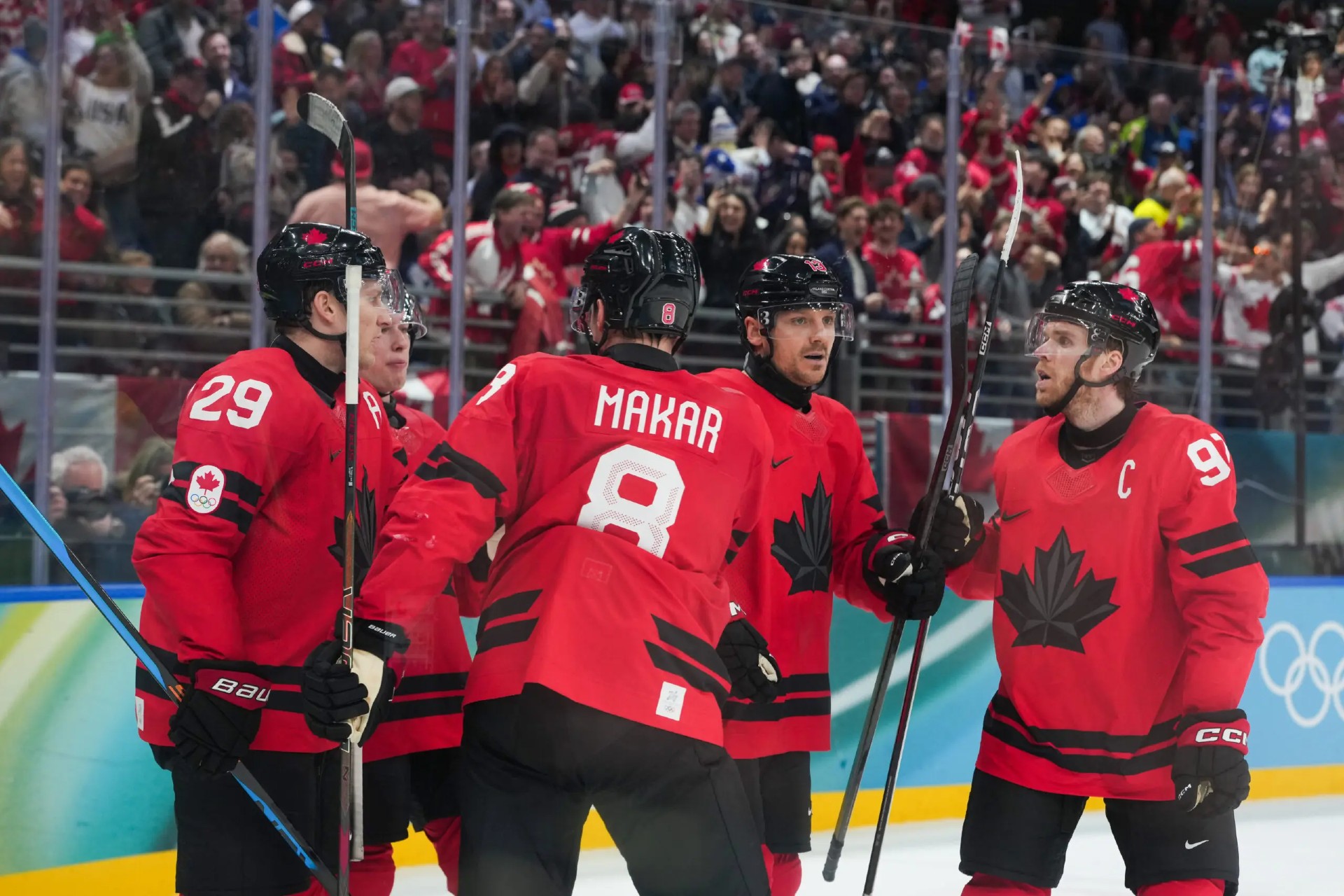
The Canadian power play was humming, and the threat of the McDavid-Celebrini-Reinhart tic-tac-toe play down low caused Finland to collapse and sell out. When the puck worked its way to Makar on the point, there was ample room to walk in and shoot. Reinhart tipped the puck across the net — perhaps inadvertently — and Canada finally broke the ice.
It felt like a matter of time until they tied it. Canada tilted the ice heavily, while Finland was all in on a one-goal lead and Juuse Saros’ ability to stand on his head.
With 🇫🇮Finland defending a 1-goal lead going into the 3rd, you knew the stats would be wonky…and they were. 🇨🇦Canada got it done.
3rd Period…
OZ Time: 10:25-5:52🇨🇦
Shot Attempts: 30-11🇨🇦
Shots: 17-4🇨🇦
Slot Shots: 5-2🇨🇦
Puck Battle Wins: 60%-40%🇨🇦
Goals: 2-0🇨🇦
Via @Sportlogiq— Mike Kelly (@MikeKellyNHL) February 20, 2026
Eventually, the pressure broke through after an offensive-zone faceoff won cleanly by Sam Bennett. It led to a good shift of zone time where Canada worked the puck low to high with tons of traffic, throwing rubber to the net and recovering pucks repeatedly. In a bit of a broken sequence, a shot bounced all the way back out to the point, where Travis Sanheim passed it into Shea Theodore’s wheelhouse to blast a one-timer in the net. Before the shot, there was contact between Marchand and Saros, but Marchand was shoved into the goalie, and Finland ultimately decided not to challenge it.
When trailing and dominating as Canada was, a tying goal changes the dynamics of the game completely. There were a few nervy moments for Canada when Finland mustered a little pushback, including a Sebastian Aho chance in the slot that Binnington aggressively challenged and stood tall on.
But Canada reset again and created multiple chances to score the next goal, a few from the McDavid line and another via Mitch Marner, who sliced through some traffic. The pressure eventually led to a Finnish high-sticking penalty and a late Canada power play.
The man advantage created multiple Grade As, but Saros was standing on his head in an attempt to force the game to overtime. Finally, the dam broke when McDavid collected it on the half-wall with options to choose from between Makar at the point or a cross-ice pass to MacKinnon. McDavid chose the latter, and MacKinnon one-timed home the winner.
The entire Canadian unit was clearly exhausted — the line played a 2:30+ shift leading up to that goal — and MacKinnon could barely hold his hands up to celebrate the winner with 30 seconds to go.
Finland challenged it for offside — and it was very, very close — but it would have been impossible to overturn based on the replay angles available. It was a super dicey challenge by Finland; if I were them, I would have preferred the 6v5. The lost challenge results in a penalty, so they forfeited the opportunity. Finland did create one late chance off the rush for Aho — one that never should have happened from Canada’s perspective — but with over a second left, Bennett cleaned out the draw, and Canada punched its ticket to the gold medal game.
Post-Game Notes
– It’s getting a bit ridiculous to witness how top-heavy Canada has become. Celebrini played 25:53 and launched a ridiculous eight shots on net. McDavid played 25:20, while MacKinnon finished at 21:51. The next highest forward was Suzuki’s 14:36. Hagel, Reinhart, and Jarvis all played well under 10 minutes, and Horvat played exactly 10 minutes. Canada has largely become a one-line threat, and while those three players are all incredible, the final opponent is a proper three-line USA squad.
– Canada did put together a Marchand-Bennett-Wilson line that really stepped up and created the tying goal. It was Marchand’s best game by far, and the line knew its role and played to it. This line might have staying power, especially against a physical USA team. The Stone-Suzuki-Marner trio created a few moments but was generally invisible, just as they were in the game before (Marner scored at 3v3, and Suzuki scored on a solo effort while the other two weren’t even on the ice). Every other Canadian forward has essentially been a passenger, although Reinhart finally got on the board (that said, I don’t know how much he knew about the tip).
– Makar played a monster 25:14, and his partner, Toews, played 22:14. The next highest was Colton Parayko at 15:12.
– Ironically, in a game where the first goal came off a point shot and the second goal was scored by a defenseman, it feels like one issue holding Canada back is that Makar is really their only truly dynamic defenseman on the point. Both Harley and Theodore own great shots, but they aren’t super adept at creating space and time to open up lanes and conduct the blue line. Makar is their only defenseman truly capable of it, and Canada struggled to get pucks through. It came with six men on the ice, but of course, Czechia scored on a blocked shot that was turned the other way. Necas went on a breakaway to nearly end Canada’s Olympic tournament on another blocked shot.
– A major storyline in this game was Canada’s struggles in the faceoff circle through two periods. They were losing roughly 70% of the draws to that point, with one leading directly to a goal against and several others leading to a loss of momentum, including at the start of the power play where they conceded a shorthanded goal. Period-by-period faceoff stats are difficult to come by with this tournament, but the broadcast mentioned Canada was 10/15 at one point in the third period, and they won a number of big ones down the stretch: Bennett’s win ahead of the Theodore goal, Bennett’s win to end the game, and the power-play faceoff. After the Rantanen goal, the coaching staff stopped deploying Horvat on the right-side draws, too.
– While Canada ultimately squeaked out the win on the scoreboard, we should be clear that they dominated this game. The shots were 39-17, and the comeback mostly felt like a matter of time. In that light, it’s interesting to hear some of the Finnish comments after the game:
Finland’s🇫🇮 Joel Armia after losing to Canada🇨🇦 in the semifinals⬇️
“Five-on-five, they got one goal. That was goalie interference.” pic.twitter.com/o9UN2Sn4cy
— Mollie Walker (@MollieeWalkerr) February 20, 2026
If this game is replayed 100 times, Canada probably wins 90+ of them.
– Not to make everything about the Toronto Maple Leafs, but the Leafs often play as Finland did with the lead: park the bus, bank on goaltending, stop making plays. Finland partly did it because of the talent disparity, whereas the Leafs generally do it because of their coaching strategy.