
























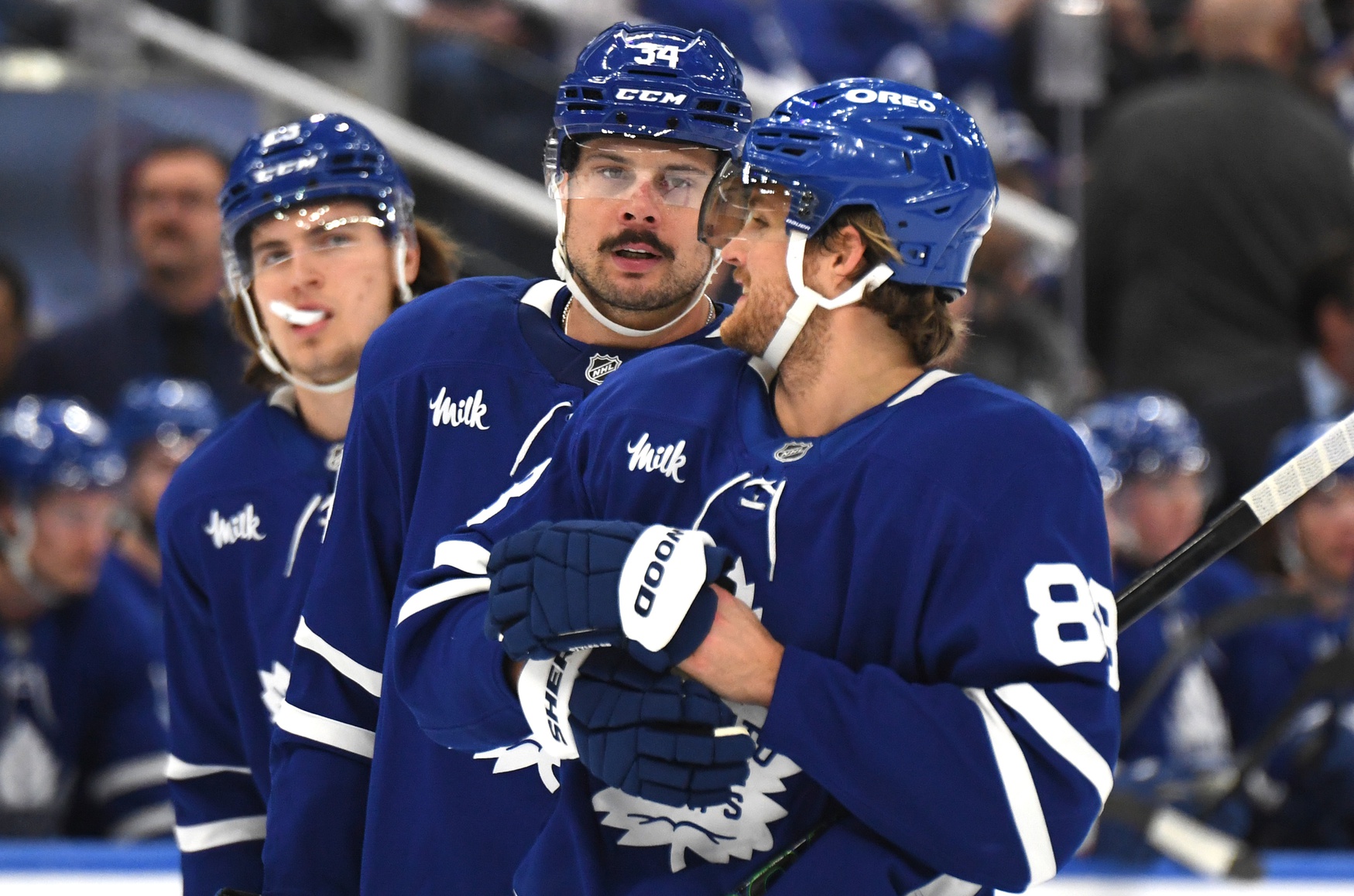
The Toronto Maple Leafs have won the 2026 NHL Draft Lottery, securing the right to draft first overall in the upcoming NHL Entry Draft.
In one moment, all the vibes around a franchise in turmoil changed on Tuesday night as the Maple Leafs struck gold with just an 8.5% probability. For a franchise that was reeling on the heels of a disastrous regular season, this was a much-needed stroke of luck. Suddenly, the Leafs have gone from a team with a very grim future outlook to one that is far more interesting.
In the immediate aftermath of the lottery, debate immediately began to rage across Leaf land. Gavin McKenna or Ivar Stenberg? What about a defenseman like Chase Reid? Or a center like Caleb Malhotra? There will be plenty of time in the next ~seven weeks to debate and analyze the prospects, but it’s also worth first taking a step back and realizing how much this development changes for the entire Leafs organization, especially the project that John Chayka and Mats Sundin are undertaking.
Thoughts on keeping the pick and the franchise direction
Anthony, Alec, and Nick talked quite a bit about the decision to tank or not to tank during the later months of the 2025-26 season, but I never weighed in on it much, so I’ll give my overarching take. The question of whether you wanted to keep this 2026 first-round draft pick by tanking into the bottom five or give it up to Boston hinged on whether you saw this season as a blip or the beginning of an imminent decline for the franchise. If you believe the team can bounce right back into contention next season, tanking to keep the pick should always have been the goal.
I was fairly wishy-washy on that. The Leafs are a better team than they showed this past season, and I remain firmly aligned with this site’s view on Craig Berube’s inability to put systems in place that fit this roster. With a better coach, I think better results are possible. But the team’s age is worrisome, suggesting more injuries are likely, and the new front office will have to be creative. Tanking to keep the pick and thus losing your next two firsts, while you have an aging team that may be on the decline, is risky.
The more I thought about it during the season, the more I came to believe that the Leafs would ideally either give up their pick or keep it if it’s in the top two. Essentially, either get a player who has a credible shot to be a future franchise player, or rip the band-aid off and get closer to taking back control of your own future. Sticking at fifth and drafting a defenseman who may be two or three years away and — in the favorable outcomes — is more likely to be a top-pairing defender than a Norris Trophy-winning star wasn’t an appetizing proposition in my view, at least compared to the freedom and flexibility of getting your pick back.
That was just my perspective, and others are fair to disagree, but the debate between drafting fifth and thus kicking the can down the road vs. losing the pick now had no “right” answer in my mind. The only right answer was to get lucky — that the ~17% chance of moving up to the top two would come to fruition, and specifically, the 8.5% chance of winning the lottery. Leafs Nation was in need of a minor miracle, and the fated lucky #12 ball brought it to life.
The lottery win sets the franchise’s broad direction. Without a first-round pick of their own for the next two seasons, the Maple Leafs know they have zero incentive to tank or begin a rebuild. The goal should be to persuade Auston Matthews and William Nylander to stick around and begin conducting some surgery around them to build a better team. That almost certainly should begin with making a change at head coach, but that is a discussion for another time.
Moreover, the draft lottery win also puts the Boston Bruins in a far worse position than they may have thought. The draft pick they received for Brandon Carlo will not be conveyed for three years after the trade, meaning (outside of maybe trading it) it will do little to add talent around Charlie McAvoy and David Pastrnak while they are still in their primes. Additionally, if the Leafs are able to revamp their team and jump back into the playoffs by 2027-28, the expected value of a draft pick that very nearly came in at sixth overall, compared to the expected value of a pick somewhere around 20th overall, is gigantic.
Any way you slice it, this is a tremendous development for the Toronto Maple Leafs and a possibly bitter blow for the Boston Bruins (though that part hinges on how Toronto’s re-tool goes). I didn’t want the Leafs to keep the pick if they couldn’t get a potential franchise-changing piece out of it. They now have a potential franchise-changing piece in tow, whoever that player ends up being. That alone is cause for Leafs fans everywhere to smile and feel a bit of satisfaction after an incredibly gloomy last year for the franchise. But it should also lead to some re-examination of the franchise’s priorities, too.
The big picture question: Who’s the franchise player now?
This is the question that was the real reason I wrote this piece, because I don’t feel like it has been discussed enough in the aftermath of the lottery win. Winning the NHL Draft Lottery isn’t just a moment for celebration; it’s a moment to examine the team you’re building and where the priorities should be placed. Without getting too deep into the weeds of prospecting, I don’t believe this to be a draft like 2023 or 2015, where the consensus is that a no-doubt, slam-dunk future superstar is awaiting the winner of the lottery. But I don’t perceive it as similar to 2021, either.
As someone who covers college hockey in the Big Ten Conference, I watched every game Owen Power played in his draft-eligible year at the University of Michigan (the same for Matty Beniers), and I felt very confident that neither would be a franchise-altering player. I have also watched a good number of Gavin McKenna’s games from his draft-eligible season at Penn State University and can say with a good deal of confidence that his upside is far higher than either of those players’. The risks are also real, which is why I don’t think he should be put in the McDavid or Bedard tiers (though we underrated some of the risks with Bedard, in hindsight). But his upside is humongous.
In other words, this may not be the best year to win the draft lottery, but it doesn’t appear to be an obviously poor one, either. I have not looked at Ivar Stenberg enough to have a take on him yet, but McKenna remains the top prospect on most draft boards, as he has been for the entire cycle, and at this point, he seems most likely to end up as a Toronto Maple Leaf. And as someone who has watched Gavin McKenna a lot, I think the big-picture question of who the core of the team is and who the Leafs ought to build around is a legitimate one.
This is not to argue that the Leafs should toss Auston Matthews overboard because there is a new hot prospect in town. Instead, it acknowledges that, if developed correctly, Gavin McKenna (again using him as the placeholder assumption) is more essential to the Toronto Maple Leafs’ long-term success. Matthews’ health is a complicating factor in his long-term projection, but all-time great players generally age fairly well. If he were to stick around, Matthews should remain a highly useful and productive player.
But we also should be level-headed here. Matthews turns 29 in September, and the Leafs ought to already be familiar with the aging curves of great centermen, since John Tavares has been on the team for the past eight years. Alex Ovechkin finally won the Stanley Cup at 32, but there eventually reaches a point at which all-time greats are no longer good enough to be the singular centerpiece of a team.
Which is where first overall comes into play. Alec made the apt comparison the other day to Tomas Hertl arriving later to help the 2010s Sharks core reach a Stanley Cup Final, or to Brayden Point arriving later for the Lightning. I like that framework, but there are two important caveats. The obvious one is that McKenna’s potential is higher than either of those players. Not that he will certainly get there, but just the potential, if developed properly. This is still a player whose WHL scoring was compared to the very best players who ever played Canadian major junior hockey, and despite the warts in his profile (I plan to write about them in the future), he scored 33 points in his last 18 college games. His raw gifts are exceptional in a way that exceeds even a tremendous player like Brayden Point.
Secondly — and this is relevant to McKenna’s potential — those players weren’t picked first overall. They developed on their own and joined the NHL when they were ready to help contending teams, coming in Hertl’s D+2 season and Point’s D+3 season. The overriding assumption is that either McKenna or Stenberg will be in the NHL next season. That makes the pro club, including its head coach, an essential instrument in that player’s development. It’s not a responsibility that should be taken lightly.
My biggest fear with this pick is that management prioritizes its existing core over the player picked at first overall, derailing the player’s development and ultimately leading to an outcome far below the player’s true potential. I’ve seen similar chatter online quite a bit throughout this cycle because Leafs fans have only lived in the mindset of this core. Back when the thought of the Leafs sticking at fifth overall was legitimate, I saw commentary along the lines of, “We need to pick Keaton Verhoeff because the Matthews era has lacked a great RHD like him.” That kind of thinking — expecting an 18-year-old defenseman to step in and immediately play 20 minutes a night for a contending team because that’s what the team needs — is the fastest way to ruin a kid’s career.
As a college hockey observer, McKenna is much closer to NHL-ready than Verhoeff, but the same thinking applies. I would love it if McKenna could have a rookie year akin to Patrick Kane in 2007-08, sliding next to Matthews and immediately replacing Mitch Marner. After watching him at Penn State, I’m not sure that’s what I would expect. Playing against NHL physicality will present him with challenges at five-on-five. And Leafs fans have to be ready to accept that, knowing the NHL hasn’t been the most forgiving to rookies in recent years. Even Bedard didn’t hit the ground as smoothly as anticipated, and Jack Hughes massively struggled as a rookie, scoring only 21 points in 61 games.
But Hughes eventually figured it out and has scored at a 100 points-per-82-game pace over the last four seasons. The worst-case scenario is what happened to Alexis Lafreniere, a prospect with tons of upside who joined a Rangers team that was intent on winning now but fell far short of his stated potential. Lafreniere was placed on a team with star forward Artemi Panarin and an established power play that denied him opportunities early in his career. It’s impossible to say whether this “ruined” Lafreniere, but when you put it next to the chronic issues that the Rangers have had developing prospects, it’s hard not to think the two were at least somewhat related.
The Leafs should be aware of these past case studies and prepare for a range of outcomes with McKenna’s (or Stenberg’s) rookie year, aware that providing whatever help is necessary to develop his talents should come above all else. I want to win a Stanley Cup with Auston Matthews as much as the next guy, but the incredible opportunity that winning this draft lottery provides is the chance to grab a possible new franchise player to build around, one who may be able to avert a painful rebuild post-Matthews. Developing *that* player and building a team responsive to his needs, including finding a coach with whom he works well, should be at the top of the priority list for Chayka & Sundin.
For the first time, a post-Peak Matthews world that doesn’t look apocalyptic has appeared, and it’s all due to that #12 lottery ball. The question, put simply, is this: Who is more important to the future of the franchise, the soon-to-be-old 29-year-old coming off two down years and injury worries, or the 18-year-old who some compare to Patrick Kane and Nikita Kucherov?
Ideally, a balance will be struck between the two, one where Matthews has a winning team around him, and McKenna is able to be a big part of it, producing points while getting bigger, stronger, and better in his off-puck game. But in situations where the two priorities come into conflict, I would lean toward McKenna, at least until it’s proven that his potential was a red herring. So long as a possible 100+ scorer who could win Art Ross Trophies and play on Team Canada’s top power play in the 2030s is in that body, priority #1 should be developing it.
Likewise, this logic applies to the thought process surrounding the draft pick. The player picked first overall should be the one with the most potential. Many perceive Stenberg as more “pro-ready” because he has played against men in the SHL. That’s the wrong logic for this pick. You should pick Stenberg if you think he will be a better NHLer at 25 or 30 than McKenna, not because he’ll be a better NHLer at 19. And the same thing is true with picking a defender. Go with the most elite upside because that upside can usually only be found at the top of NHL Drafts, as Kevin Papetti put in a tweet during the Olympics:
Point leaders in the round robin..
1st Overall Pick
1st Overall Pick
1st Overall Pick
1st Overall Pick
1st Overall Pick
1st Overall Pick pic.twitter.com/vgroMNvsuK— Kevin Papetti (@KPapetti) February 16, 2026
You can teach skilled guys to check, but it’s really hard to teach checkers how to think the game and move the puck like Patrick Kane. Take the player with the highest upside, always.
The desire to win now is palpable and has dominated this franchise for close to a decade. The draft lottery win, for the first time, should change the calculus some. Maybe we shouldn’t trade every pick at every deadline if our new franchise player is 19 and not 29? As much as this ownership group wants to win now, they should also realize that this stroke of luck is a ticket to potentially avoid a long, painful rebuild that once seemed inevitable. For the “we’re not rebuilding” people at MLSE, that should be good news.
John Chayka has an interesting task ahead of him to bridge these two cores, but hope is finally on the horizon for Leafs fans. Drafting first overall in a year like 2026 is a tremendous opportunity, a chance to do something that was once seemingly unthinkable by injecting an elite young talent into the team with superstar upside. The task at hand now is simple, but harder than it seems: don’t mess it up.
In just under 50 days’ time, in all likelihood, one of Gavin McKenna or Ivar Stenberg will be the most valuable asset in the Toronto Maple Leafs organization. Every bit of work this summer should be done with that in mind.