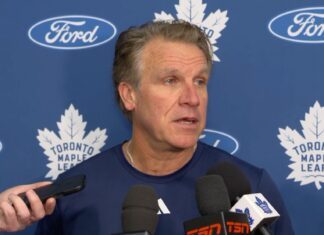



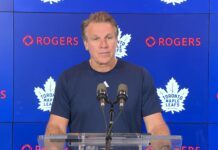








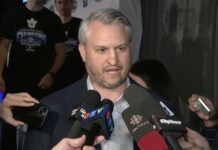







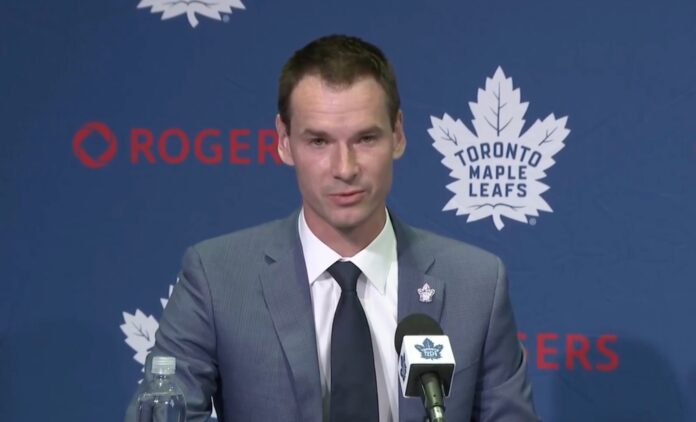
Maple Leafs GM John Chayka joined Elliotte Friedman to discuss the tampering accusations on day one of the job, his reception and reputation around the league, the challenge facing him in Toronto, his belief in Auston Matthews and William Nylander, and the areas in need of change on the roster.
On the first day of the job, there is already a tampering story. Can you explain exactly what the league contacted the Leafs about?
Chayka: It is a tough one for me to comment on. I don’t think there is any merit to any of that. As far as I understand, it has been dismissed. It was just an allegation of some sort.
Does this show the challenge you’re facing, that there is not a lot of grace from the other managers here, and that they’re upset about your history and your resurfacing in this spot? Will it make the challenge for you even greater? How do you feel about it?
Chayka: There is a combination of things. There is that part you are talking about, and then I also think there is the part of the Toronto Maple Leafs. I don’t think the league is going to do us any favours writ large. We want to get the job done here. We are not worried about the outside. We are going to focus on our team and what we can control.
In terms of me personally, I’ve always tried to act as professionally as I can, be a good communicator, and work with people to understand what they’re trying to do in terms of transactions. If I can continue to do that, my history has been that I’ve been able to make good transactions for the team. That is my focus.
Was there any point, after some of the stories and allegations resurfaced, that any part of you said, “This isn’t for me?”
Chayka: No. Not a spec of that from my side.
Can you work with the other GMs in this league? You’ve got to make deals. You’ve got to go on group chats with them. You’ve got to get things done. Are you concerned at all that you can’t do that?
Chayka: I’d just point to my history. We were very successful in transacting in Arizona. I think I have great relationships. I really do. There are still a lot of GMs who reached out to me after my announcement. A lot of them I have interacted with and dealt with in the past. It is a pretty good overlap still in the league.
I’ve sat in the chair. I’ve made those transactions. I have those relationships. I have zero reservations about my ability to do that part of the job.
How have you changed since Arizona?
Chayka: Well, when I took the first role, I was dating my wife, whom I am now married to. I had no kids. Now I have three. Like any 26-year-old, a decade later, a lot of things change.
I’ve always been big on professional development. I’ve always been big on seeking out the best and learning from them. Really, it’s understanding sports and how to integrate decisions with data with the human element and what that means. The human connection side of things is incredibly important.
As we think about trying to get the job done here in Toronto, it is going to be hard. That part of the team is going to have to be really strong.
What is the biggest thing you learned — something you have to do now that you didn’t do then, or didn’t know then?
Chayka: It is not that I didn’t know anything, but going to Arizona, there was a lot of instability. I don’t think it was anyone’s fault, but there was the reality of trying to get a new arena done and trying to find an ownership group that could get that done. We had a lot of changes on the executive side of the business. The hockey side was pivoting around trying to match all of that change. It can be challenging.
The value of stability in any organization across any sport is a key tenet to its success, and the alignment. As you are switching pieces, things shift, move, and change. I think we did our best to try to be adaptable, but ultimately, a strong owner and CEO through to the hockey department, down to the bench, are key variables.
What about managing people? What did you learn?
Chayka: I’ve been managing people from a very young age. I founded Stathletes at a very young age. I went right into Arizona and thought I was going to be assistant GM. That lasted a year. I ended up being a GM and managing people there. My wife and I have large holdings of assets. We have 5,000 employees. We do several hundred million dollars of revenue in that as well.
Through all of those experiences, you are always learning and growing. It is important to have really structured communication. As a leader, there are always several things going on during any given day. Really, it’s taking time to pause and think about the humans involved, and making sure you’re connecting with people on an individual level consistently and meeting them where they are. Everyone has a life. They have lots of things going on. Being considerate of that and building relationships… I just think you can’t do enough of it.
You came into the job young, and you had to prove you could run an organization with a lot of veterans in it. It was almost like that was your focus: “I have to prove I can do it,” and it kind of affected the way you handled things. Would you say that is fair?
Chayka: Maybe. Yeah, I think that is fair. I would just add that, again, it was a stressed situation. We didn’t have a lot of margin for error. I wore that, I would say. It was important for that franchise to survive, to get a bigger arena, and there were these bigger, existential factors I was involved in. I think that also contributed to some of that.
Is there an understanding that there is no margin for error? People are looking for reasons to come after you.
Chayka: I just think there is no margin for error in this market to get the job done of winning a Stanley Cup. Again, I am less focused on myself as an individual and am really focused on the organization and achieving our goals. It is the most competitive job in sports, and it is also the hardest. I took this job with eyes wide open that this is the case.
When you look at the team, what has to change?
Chayka: Good question.
I’ll start with what needs to stay. I think you can only win with world-class talent and world-class people. I think we have some of that. It’s my job to take that and surround it with the best and the brightest. I want to build the best front office we can possibly build and make sure we are supporting our players, they know we have our backs, there is good communication, and they feel valued. If we can do that, their performance will continue to improve.
In terms of what needs to change, I think we need to do our best to change the mix on the backend. If you look at how this group defended, we defended for too long. We didn’t break the puck well enough. We didn’t join the rush well enough. A lot of that starts on the backend. That is a key priority for us and something we’ll be focused on.
Are there options where you think you can reasonably accomplish that?
Chayka: Yeah. Again, I don’t have a crystal ball, so I don’t know what the options are and what is going to come, but in talking to some of the scouts already, there is a belief that we can get some momentum back in this group. I think momentum is a funny thing in sports. If we can do that, I think it will take care of itself.
At some point, you will meet with Auston Matthews. First of all, what is your relationship with him?
Chayka: I was lucky to be GM when Auston was coming up before his draft year, even. Just to see him in that community, and seeing him engaging with people — the skill level is obvious at that age, even, but the type of person he is really stood out. He was friends with a lot of our players and was always around. I just got to know him through that.
I was also lucky to spend some time with his family. Wonderful people. World-class people. It really tells a story of how Auston was raised. I think that matters when you are talking about a challenge like Toronto.
As time has gone by, I have known Judd (Moldaver) and his dad. I have spent a lot of time around the group. I’d say this is a different position. He is the captain of the Toronto Maple Leafs. He holds a big stake in everything we do. I want to go, listen, and hear what he has to say.
In a lot of the interviews for this job, it was very clear that people felt that if they were to succeed here, Auston Matthews must be convinced to stay. The organization wants that, too, correct?
Chayka: Correct.
How do you convince Matthews that you’re on the right path here?
Chayka: I think Auston’s ultimate goal is the same as ours. It is a shared goal and a common goal. It is both Mats’s and my job to meet with him and understand his perspective.
Again, we are joining. He has been here. He is the captain. He has a good feel for things. We want to hear his view, hear how he thinks about things, and hear what he thinks needs to be improved. We are going to share our vision as well.
Mats and I have a lot of ideas on things — Mats from being the captain of the Maple Leafs, being in the locker room, being a successful NHL player, the hardest-working guy, the leader, and the most humble. On my side, a lot of thoughts around roster construction and team building, not just for one day, one move, or one season. We want to show him a long-term vision that can get him excited.
In a perfect world, if you had a vision of what this team would look like, what would it be?
Chayka: It is important, once you get into the playoffs, that you have a lot of versatility. The teams that are winning now can play games in a lot of different ways. I think they all have the same principles and fundamentals: really strong goaltending, great backend, and game-breakers up front are kind of the table stakes.
A lot of these things that are talked about, whether it is the speed of the game, heaviness, grit, snarl, or snot — whatever you want to call it — are all elements you need in your game, but as you get through these playoff matchups, you need some versatility in order to match up well and ultimately get onto the next round.
How do you see Mats’ role? Technically, you’re above him in the hierarchy.
Chayka: I don’t really see it that way. From my perspective, my job as GM is to generally manage. That means that every day, there are lots of decisions made, and there is not one person making those decisions. It is important to have an amazing group that collaborates and puts all the information on the table. No ego. The best idea should win. If that is my idea, that is great, but oftentimes, it won’t be, and if it is, we have a problem.
Mats has a big voice. He has a lot of thoughts on what he thinks needs to be done. I will listen to that and take it extremely seriously, and vice versa. I think we have a lot of respect for each other. We’ll bounce ideas off each other with the end goal of what is best for the organization.
If you have an idea and Mats says, “I think that is a bad idea,” what happens?
Chayka: We don’t do it.
That simple?
Chayka: That simple.
On Craig Berube, you spoke to him. If he is going to return, what does he need to say to you? How does it work?
Chayka: We are going to get together in person and walk through everything. It will be very important to understand his thoughts on the roster and his vision of what he sees in the future. It was obviously a tough season. He knows that. He said it himself. He has ideas and ways he wants to get better. I want to hear what those ideas are. I want to understand.
In a tough season, there are good times and bad times. What does he do when the times are bad? What did he try? What worked? What didn’t work? Those are all ideas we should spend some time on together.
I’d also say that I view the coaching relationship with the front office as a real collaboration. The coach is an organizational role. I just want to talk to him and hear his view on how it was integrated and his view on all of the different resources available to the Leafs and how we can maybe do a better job with all of that.
Do you see William Nylander as a key cornerstone of the Maple Leafs?
Chayka: I do. Yeah, I think he is a world-class talent. He could be one of the most talented players in the world. Mats has a special relationship with his dad and the Swedish background. I think we need to find a way to get more out of our entire group. William Nylander is in that.
The front office was told that there would be more changes to come. Is that fair?
Chayka: I would say there is usually an organic change that occurs in any front office. I don’t have any pre-ordained plans. I will meet with everybody. I am going to get to know what they do, give them some thoughts on my vision, and make sure it is a mutual sharing of thoughts. I am sure, at some point, we will make some decisions. At this stage, there are no plans.
You’ve heard a lot said. There has been a lot of criticism and noise. If you could address everybody and say one thing to them about John Chayka as GM of the Maple Leafs, what would it be?
Chayka: I would say I am very mission-driven in anything I’ve taken on. As I said, the mission for the Coyotes was to keep them in Arizona. The mission for my businesses is to give back to my community and build an asset that will last. Here, the mission is to win the Stanley Cup. I am very committed to that. I will pour my heart and soul into that. Ultimately, I know I will be judged on that basis.