




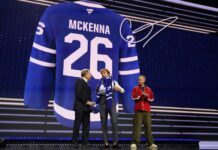





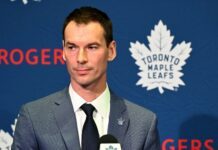



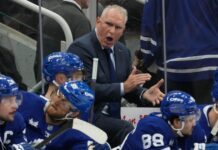

At the 2026 NHL Draft Combine, GM John Chayka discussed his visits with Gavin McKenna and Ivan Stenberg, his coaching search, Max Domi’s health situation, his meetings with Auston Matthews, the hiring of Freddie Hamilton as Chief of Staff, and much more.
What is this experience like for you in anticipation of the first-overall pick?
Chayka: It is a lot of fun. It is not every day that you get a chance to make the first-overall selection. To do it in a market like Toronto — with the tradition, the history, and the expectation of excellence — makes it really unique. All of the scouts, the front office, and player development are approaching it like, “How lucky are we to have this opportunity?”
It is a privilege, but it is also a responsibility. We’ve been very focused on the process, making sure we have a diligent approach and going through everything again and again to make sure we get it right.
What have you learned about Gavin McKenna so far?
Chayka: A lot. I spent a lot of time with him and his family now, just going through that process and making sure that we get the person right, first and foremost. Everyone who has seen him play knows the skill level and the talent, but as we think about being a Toronto Maple Leaf and what it means, it’s just really digging into that part.
Is that why it was important to go visit Whitehorse?
Chayka: It was important in a lot of ways that we visit a lot of players in their homes, get to know who they are, and get to know their families. That is a big part of our process as we decide on the first overall pick. We thought it was appropriate. For us, it is about getting the right person. In a market like this, I don’t think you can miss on that.
What kind of a person is Gavin McKenna?
Chayka: A really nice young man from a really quality family. I spent some quality time with them and got to know them. He is a small-town kid. It is a remote area of the world — very peaceful, but beautiful. Within that, I think there is some real resolve around who he is and what his career means to him and his family. I find it impressive.
Mark Leach mentioned that you didn’t get into the incident at the bar. Is that because he was defending his mom? Did you leave that out of the conversation?
Chayka: We’ve gone through everything with every player and with every possibility, and instances they’ve participated in. I have personally talked to everyone involved, including Gavin. We understand the situation. We are comfortable.
Were there one or two things that struck you when you visited with McKenna?
Chayka: I don’t think he had a skating coach until he was 13. He didn’t have a skills coach until he was 13. I am not sure he had touched a weight until around that time. Obviously, the brain and talent are evident. His instincts and raw ability are interesting.
Again, the quality of the family and the quality of the people, and how important his family is to him and his roots — with how important it is for him to give back to his community — are all really interesting things.
What have you learned about Ivan Stenberg?
Chayka: A lot. Obviously, I’ve relied on Mats a lot with that one. He has had a good book on him over several years now. He’s spent time with him in Sweden as well, getting the full background and full history. We were able to interview him here. We spent some more time with him.
Look, he is a smart, competitive player. He had an amazing Worlds. He is a really high-quality person and a high-quality player. We’re really fond of him.
Does position enter into the equation at all when looking at #1? Is it about finding the best player available regardless of position?
Chayka: We will go with the best player available.
Are you more likely to use or trade the pick? What is the interest in it around the league?
Chayka: It is a good probabilistic question. I would say the probability is that we make the pick, realistically. We have had discussions. We’ll continue to have discussions. Obviously, everything is for sale at the right price, but to date, there is nothing we are seriously considering. But there is still time.
What is your likelihood of making a trade at or leading into the draft?
Chayka: I’m not certain on a timeline, but certainly, as we look at our team, we have to fill some holes. Again, there are equal parts free agency and internal improvement. Hopefully, there are some trades that make sense where we can line up some things we’re looking to do with another team.
I’d expect we will do some things. The timing of it, I am not sure about. It depends on the counterparty, too. We are looking to improve the team and fill some holes.
How much have you been able to watch these top prospects while you were out of the league?
Chayka: No catch-up. I have certainly been watching the players and following them. I always have and always will. Ultimately, between Mark Leach and now Judd Brackett, we certainly feel that we have a lot of coverage and a lot of scouting power.
Again, this is really a two-year evaluation. These guys have been tracking them, getting to know them, seeing how they react to different situations and adversities. I really rely on those guys, and the broader staff as well, to get us the proper information. Ultimately, we’ll make a decision based on that.
Are there particular player traits you value above others when it comes to drafting players?
Chayka: Ultimately, it is about trying to find the proper blend of different elements at different parts of the draft, perhaps. Obviously, Judd and Mark have a philosophy. We’re involved in that as we get to know each other.
Again, as we think about who a Toronto Maple Leaf is, certainly, having smart, competitive players who have a pride to play in Toronto are all things that are important to us.
How many players do you have in the top tier?
Chayka: Probably five or six, realistically. I think there is a nice mix of different players of different styles at a few different positions. It is a good year. It is nice for it to be hard. I think there is a tier there that we think really highly of and are all potentially worthy of the first overall pick, but we’ll have to get one.
Are there any surprises among players who might’ve worked their way into that tier?
Chayka: It is kind of a two-year process, so I don’t think there are any surprises. Certainly, as you get through the process, you learn more. We’re still learning things. We will continue to evaluate it. But no surprises.
You have your philosophy on the kind of player who works for the Leafs. How does that mesh with what Mark Leach looks for and his philosophy? How aligned are you? Are there any differences where you like something different?
Chayka: I don’t think it is about any individual evaluation. We have an organizational view. I would say some of that is evolving. It is never stagnant.
Mark has done it for a long time. He is a smart evaluator. We have a great opportunity with Judd to also have another perspective in the mix that we value.
I would say there is a lot of alignment. I wouldn’t say there is any debate about the things we value and how we evaluate those things.
As I said, it is an evolving thing as well.
Do you find it challenging to go through this process without a coach in place yet?
Chayka: Not at all. Organizationally, we want to be aligned. That alignment starts right at the top of ownership, down through the CEO, myself, Mats, and on from there. Certainly, as we think about hiring a coach, we want to be aligned in that vision, what it means, and the types of people and players we are trying to integrate into the organization more broadly than just this pick. As I think about that, the structure starts at the top.
How far along are you in the coach hiring process?
Chayka: We are not as focused on some artificial timeline. We are focused on conviction. I think it has been a long time since there has been a full search for this organization. I think it is important for us to take our time and get it right. This is the next leader of the Toronto Maple Leafs.
We have gone through a very thorough process. There were about 55 people we either spoke to or reached out to. We had this initial first round that we just finished up recently. Now, we are starting to get into the next layer of it.
No timeline. No time constraints. When it is right, we will make the decision, but we are going to be patient and get it right.
How many of the 55 conversations were in-depth as opposed to just reaching out?
Chayka: It’s probably about 20 with whom we had some in-depth conversations on Zooms or in person. We want to make sure we are not missing anything. We cast a wide net. Of those 20, not all are legitimate candidates for the next round, but a lot of really good people.
We learned a lot. It is good, coming into our position, to hear different perspectives, and to get a coaching perspective and breakdown of things with our style of play and where we stand. It has been a really good process so far.
Where do things stand with Auston Matthews right now?
Chayka: We have had several conversations with him and his reps. What I saw was a happy captain, someone who has a lot of pride in being the captain of the Maple Leafs, and someone who wants to win in Toronto, which aligns with how we are thinking about it.
We will spend time with all of our players. We have spent the better part of these three weeks getting to know everybody, getting some FaceTime, and connecting with them. We’re listening, honestly, a lot, and we’re hearing about how the season went and the trends or things we think are opportunities. We’re collaborating on that a bit.
It is no different with Auston. We continue to have those conversations.
How is Max Domi doing in his recovery?
Chayka: Max is in a tough situation. He is a special person. He loves the Leafs. We love him.
He had a procedure, and it didn’t go the way we had hoped. He played through some injuries. That part seems to be genetics, to play through things. Tough kid.
Ultimately, we will get to training camp and assess him from there. He is making great progress every day, which is the main thing. We’ll get to training camp, continue to assess him, and go from there.
How is Max holding up on a personal level?
Chayka: For Max, there are no bad days. Special person. He has dealt with diabetes his whole life as well, or since he was a young kid. He overcame the odds.
He embodies being a Toronto Maple Leaf. He cares and really wants to be here for the good times. We’ll support him, like all of our players, and make sure he is in a good spot.
Have you decided whether you will qualify Matias Maccelli and Nick Robertson?
Chayka: No decisions yet. It is always a bigger picture thing, but those are two good players who have been productive players in the NHL. Certainly, we value them.
When you hired Chief of Staff Freddie Hamilton, how did you decide you wanted to add that position?
Chayka: I think MLSE is a big machine. If it is not the biggest, it will be the biggest conglomerate of sports assets. The Toronto Maple Leafs are a large business itself that plugs into that.
Spending time around the team and understanding how the different components interact with each other, I thought it was helpful to have someone in the role who could help interact, integrate, and work through big projects.
My job is on the hockey side. Maintaining focus on hockey, building out the roster, and working with coaches, players, and agents is a full-time job. At the same time, keeping things organized and making sure the business and hockey sides are aligned is also an important aspect of management.
As we think about building out an entire operation, I felt it was a good hire. I certainly know Freddie. He played for me. He has a unique background and skill set. We felt it was a good fit.