




















The irony of all the moves the Maple Leafs made this offseason is that they positioned themselves to do not only what should have been done last season, but quite literally what they said they were going to do.
Here was Brad Treliving last offseason, in a quote we referenced regularly:
“I have used the analogy of Winnipeg. No team is perfect, but that is a pretty darn good team that won the President’s Trophy. When you look down the middle of the ice, you have Scheifele as the #1. On paper, you have Namestnikov as #2 and Lowry as #3, but again, it all comes down to deployment.
“When you look at our roster now, you have Nic Roy, who can take a lot of defensive heavy lifting with defensive-zone starts, defensive faceoffs, and matchups. When you put those into a pot, it allows you to not necessarily get lost on your 1-2-3 but spread out matchups and situational play that could free up different people when we talk about Auston, John, and Scotty Laughton.”
It’s actually painful to read that quote and then review what ultimately happened in 2025-26.
What Treliving outlined about the 2024-25 Jets looked like this in practice:
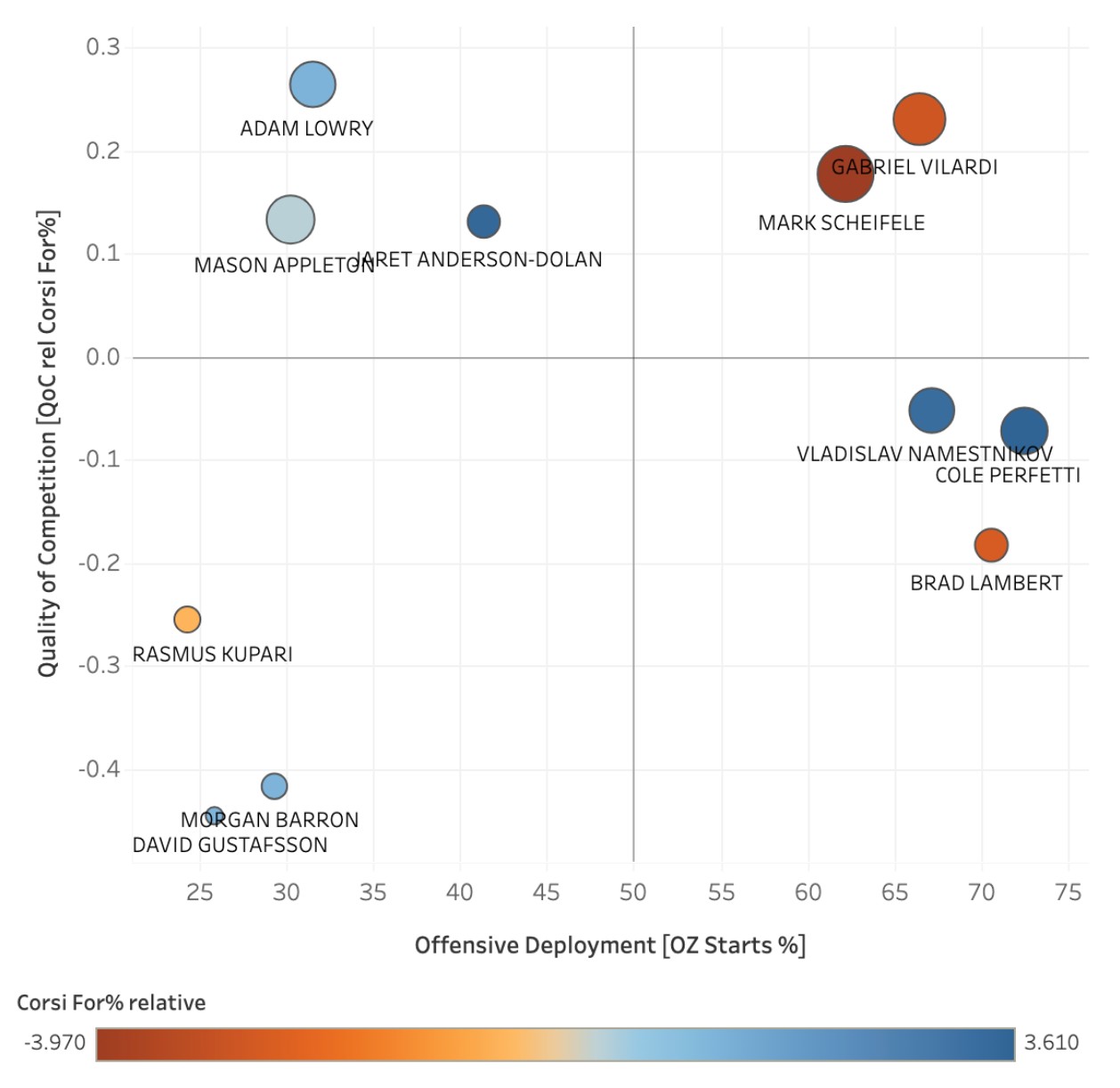
You can see Lowry in the top-left corner — a steady diet of tough matchups and defensive deployment. Scheifele’s line also received difficult matchups, but with a heavier offensive slant, which is the natural deployment for a top line. You’re never going to avoid difficult competition altogether with elite players; you’re simply trying to find advantages within those minutes. The Jets’ actually sheltered “second” line, exactly as Treliving referenced, received both easier zone starts and softer matchups in an effort to feast offensively.
It’s easy to draw parallels to what that should have looked like for the Leafs: Matthews in the top-right corner, going head-to-head with offensive deployments; Tavares receiving easy matchups and opportunities to maximize his scoring; and some combination of Scott Laughton and Nic Roy — perhaps even together — handling the difficult defensive assignments alongside the Leafs’ collection of checking wingers such as Dakota Joshua, Steven Lorentz, and Calle Järnkrok.
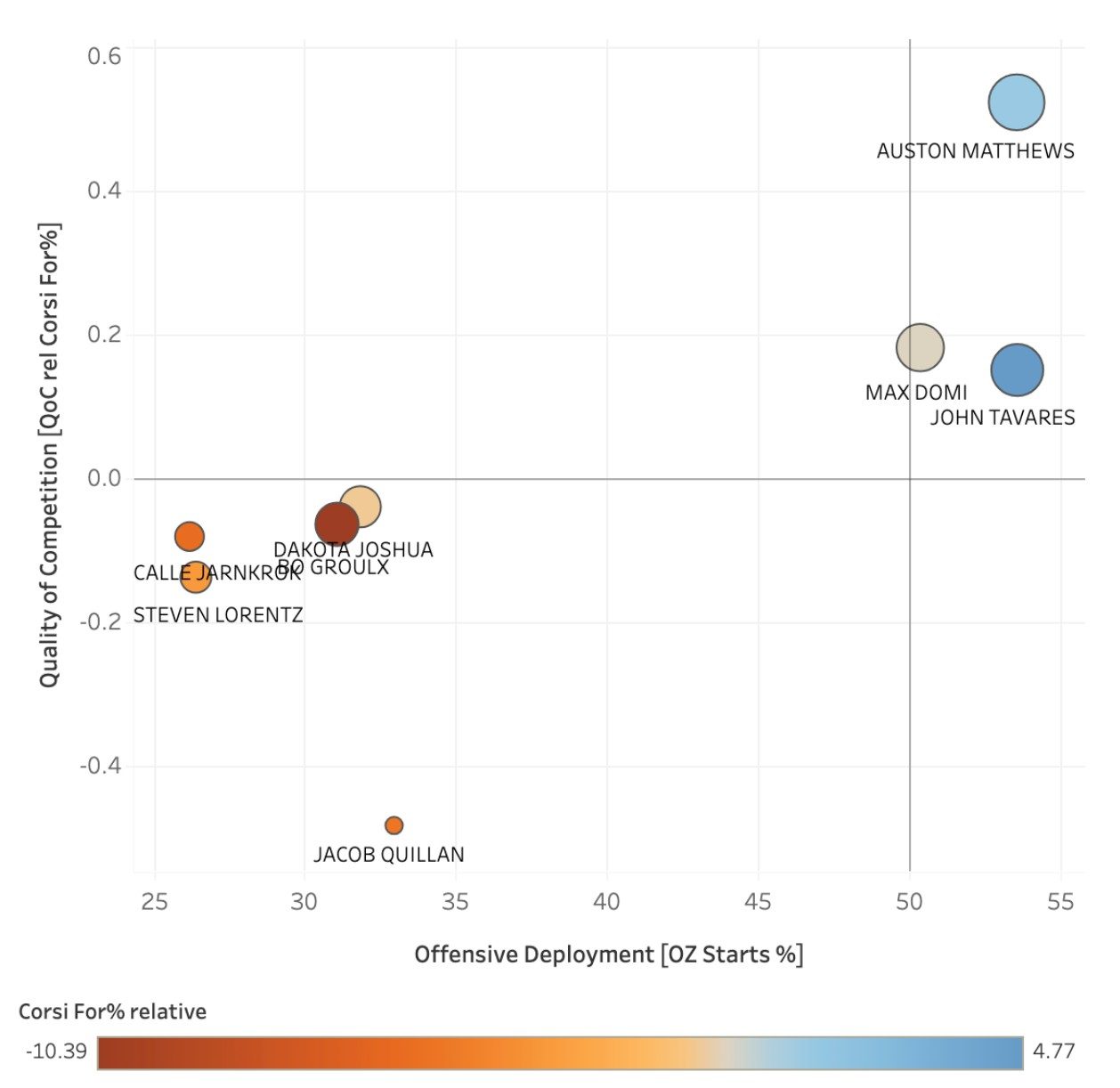
Instead, Matthews received by far the hardest minutes on the team, albeit with some offensive slant, while Tavares received the second-hardest workload. The coaching staff then simply buried the bottom six against the opposition’s bottom six.
Philosophically, what was the advantage created on a nightly basis?
The Leafs essentially played top six versus top six every game, asking Matthews not only to survive those matchups but to do so alongside wingers like Max Domi and Matias Maccelli, without a true No. 1 defenseman behind him, and still win his minutes. Meanwhile, 35-year-old John Tavares wasn’t particularly sheltered or consistently deployed to hunt advantageous offensive opportunities. The bottom six was filled with checkers and limited offensive talent, and they were tasked with budget-checking the other team’s bottom six anyway. They never forced opposing coaches into uncomfortable matchup decisions. If anything, they made life easier for them.
Taken one step further, here’s where Matthews ranked among every NHL center who played at least 20 games last season:
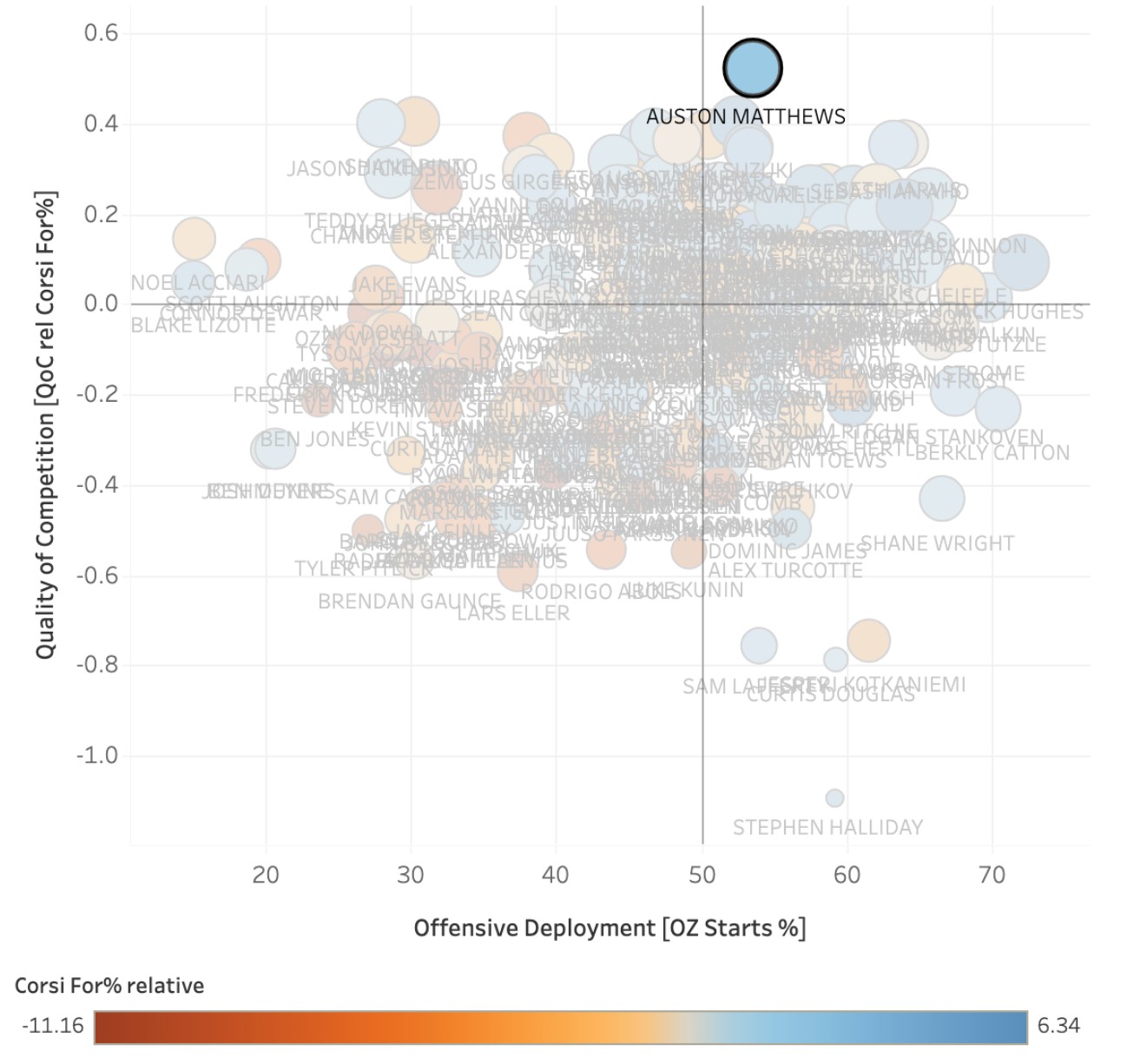
He stands head and shoulders above everyone else.
Craig Berube and Brad Treliving both said all the right things publicly about their relationship, but it’s fair to wonder whether they were ever truly on the same page. Did either one actually know how the other intended to deploy this roster?
The offseason change at forward
It’s fair to ask whether the Leafs’ new additions up front, Brandon Duhaime, Colton Sissons, and Teddy Blueger, are actually better players overall than Scott Laughton, Nic Roy, and Calle Järnkrok. The Leafs made so many acquisitions that there seems to be some combination of the cheerleader effect and shiny-new-toy syndrome at play. Laughton and Roy are probably still the two safest bets to be the most productive players in that entire group. Bobby McMann alone scored more goals last season than Sissons, Blueger, Nick Paul, and Duhaime combined.
But deployment and usage matter. The real question is whether the Leafs will finally do a better job in those areas.
Since arriving, John Chayka has repeatedly referenced “latent upside.” Plenty of players on last season’s roster underperformed, and the simplest way to unlock that upside is to put them in positions to succeed through better linemates and smarter deployment. In that sense, there is plenty of low-hanging fruit available, and the Leafs have at least built a roster that should allow them to capitalize on it.
Anecdotally, I also wonder how many players actually embraced the checking roles they were assigned last season.
In the four-and-a-half seasons before the Leafs acquired Scott Laughton, he produced 159 points in 329 games — a 0.48 points-per-game pace over a substantial sample. Yet he was immediately buried on the fourth line beside Steven Lorentz and Calle Järnkrok, all while knowing exactly what his hometown team had paid to acquire him. Was he really thrilled to spend every night eating fourth-line minutes, knowing that even when he played well he wasn’t rewarded with better linemates or more opportunity?
Nic Roy recorded the lowest offensive-zone faceoff percentage of his career and posted career lows in both goals per game and points per game over a full season. Even Calle Järnkrok scored in each of his first three games, didn’t score in the fourth, was immediately made a healthy scratch — something he openly admitted confused him — and was essentially stapled to the fourth line after that. Was he really bought in and happy in that role?
I imagine a lot of players, from Matthews on down, looked at their assignments and wondered why.
If nothing else, most of the Leafs’ new additions shouldn’t have any illusions about who they are at this stage of their careers. Brandon Duhaime is a bona fide checking winger. He excelled in that role for a Capitals team that won the President’s Trophy. Colton Sissons and Teddy Blueger have both reached the Stanley Cup Final while playing similar roles and have spent most of their NHL careers doing exactly that. They are bottom-six players, and they know it.
The Leafs also paid a pretty penny to assemble that group.
Sissons signed at a $4.25 million AAV after an 11-point season. He can play center, kills penalties at a high level, and the Leafs clearly wanted another right shot, but that’s still a hefty price for someone who projects much more comfortably as a full-time fourth-liner than a legitimate third-line player. AFP Analytics projected him at just over $1.5 million annually on a two-year deal. Who exactly were the Leafs competing against with that offer?
Conversely, AFP projected Blueger at three years and $2.7 million annually, while Duhaime was projected at just under $1.9 million over two years. Combined, those two contracts land only slightly above AFP’s projections, so I’m generally comfortable calling them a wash. The only aspect that stands out is Duhaime’s term. He’s a good checking winger who plays physically, agitates opponents, and willingly drops the gloves, but we’ve seen plenty of examples where players of that mold receive long-term security and gradually lose a bit of the edge that made them effective. That’s not to say it will happen here, but it’s something worth monitoring.
Overall, the direction is fairly understandable. The Leafs needed to properly fill out their bottom six with legitimate checking forwards so that, if nothing else, we don’t have to watch Matthews and Matthew Knies take regular shifts on the penalty kill while Matthews simultaneously drowns in highly difficult five-on-five matchups every night.
The bigger question — and it’s a perfectly fair one — is whether some combination of the money committed to Sissons and Jack Roslovic could instead have been allocated toward a more bona fide top-six forward.
In Part 3 of the 2026 Offseason Review series, we’ll dive into the Maple Leafs’ roster changes on defense.