















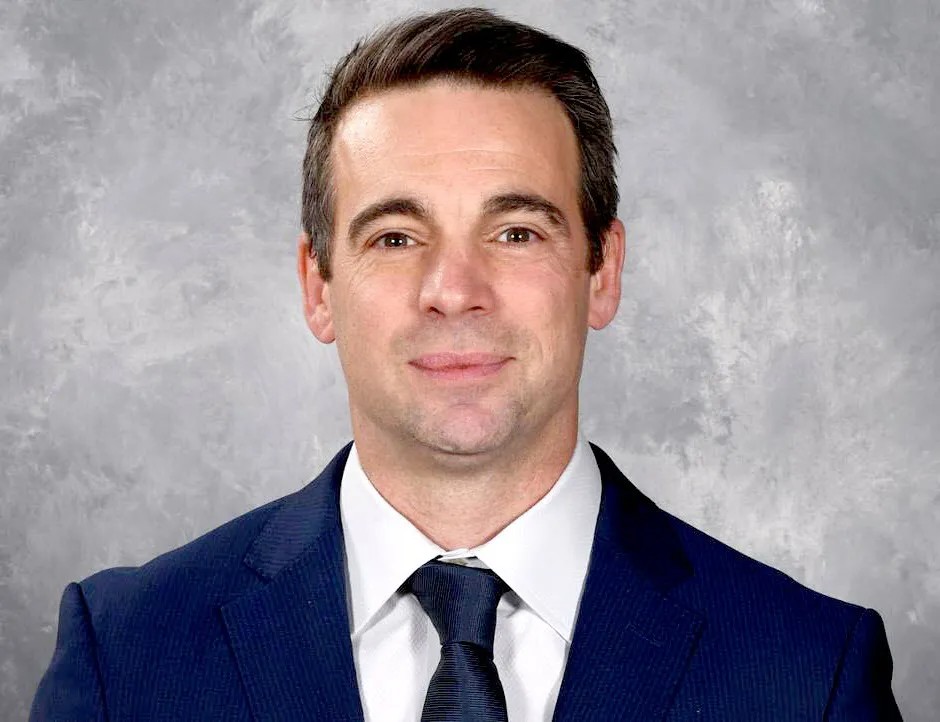
Steve Sullivan is sticking around the Maple Leafs organization, taking over as head coach of the Toronto Marlies after John Gruden officially joined the Maple Leafs’ staff earlier this week.
Sullivan becomes the ninth head coach in Marlies history.
“Steve has earned this opportunity through his work with both the Maple Leafs and Marlies and has built strong relationships with our young players throughout the organization. His experience as both a player and coach, combined with his commitment to player development, makes him the right person to lead the next generation of Marlies.”
– Maple Leafs AGM and Marlies GM Ryan Hardy
As part of the announcement, it was confirmed that Mark Giordano (formerly a coaching advisor) has been elevated to assistant coach, rounding out the staff alongside goaltending coach Hannu Toivonen and video coach Nick Biamonte. The continuity of keeping much of the same staff, alongside an internal replacement in the head coaching role as Gruden moves up to the Leafs’ bench, obviously makes a lot of sense given the Marlies’ championship success this season.
Mentioning the collection of coaches Sullivan played under is closer to a fun anecdote than a testament to his actual qualifications as a coach, but it does include a murderer’s row of the game’s all-time greats: Ted Nolan in the Soo, Jacques Lemaire in New Jersey (who convinced Sullivan his best role was as a right-shot left winger in the NHL, not at center), Pat Quinn in Toronto, and Barry Trotz in Nashville.
There is also the fact that the “Timmins Tornado” forged such a long, productive NHL career — more than 1,000 games and nearly 750 points — as a 5’9″, 160-pound player. Especially in his era, this simply doesn’t happen without a really good head for the game. It also involved overcoming a major back injury that wiped out his entire 2007-08 season, and he earned the Masterton Trophy after making his successful return in 2008-09.
Off the ice, it’s been a long, circuitous path that Sullivan has taken to landing this Marlies coaching job. He has, in his own words, “gone through every job possible with an organization.” He’s been the AGM with the Coyotes, working alongside current Leafs GM John Chayka, and the GM of Tucson in the AHL. He later took over the interim GM role at the NHL level with the Coyotes when Chayka resigned ahead of the “bubble” playoffs. When he left the tumultuous Coyotes organization to coach his son at the minor hockey level during the pandemic, it gave him the itch to pursue coaching with greater vigor. In 2024, he was hired onto Gruden’s staff on the Marlies’ bench, was then unexpectedly promoted to the Leafs’ bench midseason in late 2025, and now he’s the head coach of the Marlies as of the summer of ’26.
“I have a true obsession with the game. I truly believe I am a student of the game. I love to, with so much accessibility of all of the games and platforms to watch the games now, look for patterns and where the game is trending toward. I truly love that aspect of it.”
– Steve Sullivan
When we consider that Sullivan was originally a Ryan Hardy/John Gruden hire in Toronto, and that Chayka — now running the Leafs — is also very familiar with him and a firm believer in him from their shared time in Arizona, it makes a lot of sense that we’re sitting here today with Sullivan remaining in the Leafs organization and taking over the Marlies’ job.
The most important part of the job description as Marlies’ head coach is the player development component. Sullivan’s background in player development is extensive, dating back to his time as the player development director and AHL GM in Arizona with the Coyotes, as well as his time spent coaching and working in skills development at the junior level.
There was also evidence during Sullivan’s first NHL coaching stint with the Leafs this past season that he is a competent communicator and tactician behind the bench.
The Leafs went from far and away dead last on the power play (13.5%) at the time of Marc Savard’s firing just before Christmas — Dallas’ Wyatt Johnston had more power-play goals than the entire Leafs roster (12) at the time — to the third-best unit in the league after Sullivan’s hiring. When they went on an immediate heater after the coaching change and clicked at around 40%, it wasn’t just that the shooting luck rebounded — the overall process improved. Even during their initial hot streak post-Savard, the Leafs weren’t even in the top 10 in power-play shooting percentage; their shot-attempt and high-danger shot-attempt rates increased significantly.
The unit was obviously talented enough to rightfully rank among the league’s best, but it looked rudderless and clueless before the coaching change, and Sullivan helped get everyone back on the same page almost immediately. Sullivan has talked about the importance of decision-making away from the puck, of being predictable to each other but unpredictable to the other team, and of his players understanding where options one, two, and three are at all times. The Leafs’ on- and off-the-puck movement on the power-play units improved dramatically under his watch, and they suddenly became much more dynamic again.
Now, with the Marlies, the main focus shifts from simply the bottom-line results — wins, losses, and power-play percentages — to developing young players into better pros and future NHLers for the Maple Leafs.