

















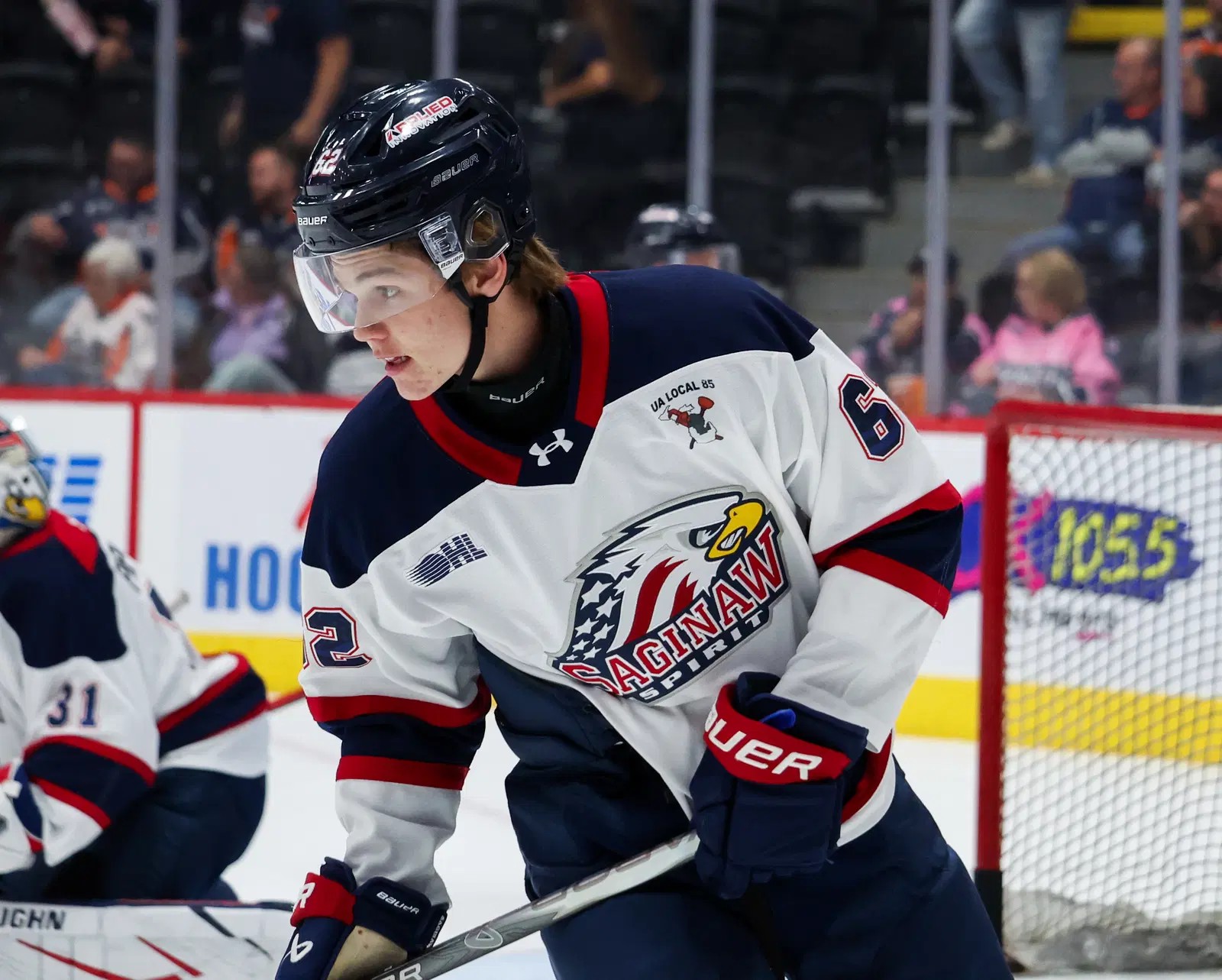
It’s been a whirlwind year for Brody Pepoy.
The Michigan native capitalized on the new NCAA eligibility rules to sign with Saginaw as a free agent out of the Pittsburgh Penguins Elite AAA program a year ago. After a solid season in an offensive support role with the Spirit as an OHL rookie, he is now an NHL draft selection of the Toronto Maple Leafs.
Pepoy was one of my favourite “sleeper” prospects available in the draft this year. The production wasn’t outstanding, nor was it consistent. His “Weasel Boys” line — consisting of Carson Harmer, Jacob Cloutier, and Pepoy himself — saw limited special-teams opportunities and inconsistent even-strength usage due to how heavily the outstanding first line of Nikita Klepov, Egor Barabanov, and Dima Zhilkin was leaned on. Coach Chris Lazary riding that unit hard resulted in uneven offensive production from the rest of the team’s forwards.
However, beyond the stat line, Pepoy has an intriguing set of tools that could help him develop into a middle-six NHL player: a solid frame, power-forward tendencies, a quality shot, a high work rate, and developing skill. How it all comes together consistently remains to be seen, but the upside is present.
Skating
Pepoy’s skating projects as neither a clear strength nor a weakness. It is not something that should hold him back from becoming an NHL player.
He has a solid top speed, allowing him to find success driving the net and applying pressure in puck pursuit. His long strides help him chew up space quickly, and he can find success playing up-tempo.
The strength of Pepoy’s skating profile might actually be his confidence and stability on his edges. He has power when working laterally, which allows him to cut to the middle or evade sticks through the neutral zone. His slightly wider stride helps him protect the puck well, especially when paired with his ability to be evasive on net drives by using sharp cuts or linear crossovers.
The area of weakness is his first-step quickness. There is room for Pepoy to become more explosive, which would allow him to create separation more consistently, especially in tighter spaces. Continued work in the weight room should help in this area.
Shot
Pepoy is best described currently as a catch-and-release shooter. He does not have a heavy one-timer or clapper in his arsenal, and he is unlikely to develop into a deadly perimeter shooter or power-play option from the flank. He is comfortable finishing off plays near the crease or in the slot on a single touch, but those instances are not especially common.
The majority of Pepoy’s goals come from his wrist shot. He generates good velocity and can pick corners. As mentioned in the skating section, he likes to work off his edges, cut into the slot, and create openings to get his shot off.
The issue for Pepoy is that his release will need to get quicker. He can have trouble getting shots through or on target under heavy pressure, and the longer load time in his wrist shot allows goaltenders to get set. To become a goal scorer at higher levels, he will need to get pucks off his stick quicker.
Leafs draft Brody Pepoy in the 6th round.
He was 65th in the OHL in Even Strength Goals Per 60 in his rookie OHL season. pic.twitter.com/B6znLLzdIH— Rink Rat Report (@RinkRatReport) June 27, 2026
Speaking of Brody Pepoy…@SpiritHockey | #NHLDraft https://t.co/BsO9XG30Md pic.twitter.com/1qsGDANFvx
— Ontario Hockey League (@OHLHockey) December 14, 2025
Skills
This area of Pepoy’s game flashes significant upside. He handles the puck well at full speed and protects it effectively through traffic, allowing him to find success driving the net. He can beat defenders one-on-one and create extra time and space for himself, whether with an inside-out move or a toe drag.
Pepoy also has soft hands, which he uses to cleanly catch passes, redirect pucks near the crease, or finish off plays in tight to the netminder. He is strong on the puck and can control the wall while working the cycle game with the “Weasel Boys.”
The skill should not be questioned. The application of that skill is where the work will need to be put in. This brings us to our next category.
One draft eligible player from the OHL who has really elevated their game the last month or so is Saginaw forward Brody Pepoy. Is gaining a ton of confidence with the puck, while still playing with energy/tenacity.
Here's a collection of highlights from just the last 5 games. pic.twitter.com/buLPaxwsY9
— Brock Otten (@BrockOtten) December 18, 2025
Spirit fans are running out of hats!
Brody Pepoy becomes the second member of the @SpiritHockey to record a hat-trick tonight! pic.twitter.com/J5uzY9WwrO
— Ontario Hockey League (@OHLHockey) February 14, 2026
Smarts
Pepoy’s application of his skills is best described as inconsistent, and it is the area of his game that needs the most growth.
The transition from U.S. AAA to the OHL is a significant jump, and there were bound to be growing pains. Pepoy’s game with the puck can currently be classified as too high-risk. For every solid net drive or defender he beats one-on-one, there is a failed attempt that results in an offensive-zone turnover. The term “hero puck” applies here.
He needs to learn to pick his spots better — when to attack defenders, how to recognize when he can exploit them, and when a simple chip-and-chase or dump-in will suffice. Additionally, learning to control pace would help. Pepoy is almost always in attack mode, working downhill. It is an admirable trait, but it can make him predictable. Learning to play at a slower pace by utilizing delays or pivots to scan the ice for passing options is a necessary next step. His passing ability and vision are not currently as strong as his scoring instincts and finishing ability.
Given that Pepoy’s projection is that of a middle-six or even checking-line support player, improving his two-way efficiency and awareness will also be key. It is not a glaring weakness — he is a high-energy player — but there is room for him to improve his positioning, board work, and passing anticipation in the neutral and defensive zones.
Brody Pepoy makes a perfect pass😮💨
He sends a one-handed feed to Carson Harmer who ties things at one!@SpiritHockey | #NHLDraft pic.twitter.com/UAaBrzfdRt
— Ontario Hockey League (@OHLHockey) March 18, 2026
Physicality/Compete
Pepoy excels as a high-energy player, but there is also greater upside for him to impact the game physically. He is a hard worker in puck pursuit and can be effective on both the forecheck and backcheck. He consistently drives the net and is comfortable operating as a net-front presence.
He is a willing physical combatant who will compete to win battles or hold pucks along the wall, and he can be effective on the cycle. However, there is a clear need to get stronger to become more consistent in this area. Pepoy’s 45 percent puck-battle win rate was among the lowest of any Saginaw forward last year. The will is there, though, and that is promising.
The upside here lies in Pepoy’s inconsistent power game. He can really surprise defenders physically and will run through them to make a play. He can hit hard and make a profound impact on the game physically, but he’s just not consistent. There is not yet full commitment to that power-forward approach, and he can even be too passive at times. That said, this is an area of his game that should grow as he improves his strength and conditioning.
What Does the Future Hold?
Pepoy will presumably — I have heard nothing suggesting otherwise — return to Saginaw next season before fulfilling his NCAA commitment the following year. He is currently committed to Lindenwood University, a smaller school in Missouri with a large contingent of former OHL players on its roster. If this commitment holds, Pepoy would be the only NHL-drafted player on the roster for 2027-28. Is it possible his commitment flips? Definitely, but it would not be fair to the program or Pepoy to make that insinuation.
In Saginaw this coming season, Pepoy will almost certainly receive increased ice time and responsibility. Klepov and Barabanov have moved on to the NCAA, opening the door for Pepoy. Coach Lazary could choose to keep the “Weasel Boys” together, or he could pair Pepoy with potential top 2027 prospect Dima Zhilkin. At minimum, you can expect them to be together on the power play.
As far as Pepoy’s NHL projection is concerned, that remains to be seen. As suggested throughout this piece, Pepoy has an intriguing but still developing and unrefined skill set. If his decision-making, skating, and playmaking abilities improve, there is a chance he could become a quality middle-six piece and complementary goal scorer. If his strength and physicality become more consistent while the offensive tools plateau, he could still carve out a role as a high-energy checking-line player.
Of course, like any sixth-round selection, there is also a chance the tools never come together consistently and he tops out as a lower-level pro following his time in the NCAA. That said, Pepoy was one of my favourite later-round gambles by any NHL organization in this past draft, and I do feel he can — and will — develop into a quality NHL prospect.
Quotables
“Speaking of inconsistent, at least in terms of offensive effectiveness, insert Pepoy. I find him to be one of the most fascinating players eligible from Ontario this year. You never seem to know what you’re going to get from him. I think he’s one of those classic cases of a player possessing all the tools, but whose application of said tools is wildly inconsistent; perhaps because he doesn’t quite understand how to utilize them. Pepoy flashes some real creativity with the puck; he doesn’t lack confidence in his ability to make plays. However, this sometimes leads to a reckless game in the offensive end and turnovers. When it works, Pepoy looks great. When it doesn’t, Pepoy looks like a liability. But, this is a winger with a good frame, a strong shot, and the puck skill to be a difference maker and play driver. What’s more consistent is Pepoy’s work rate and boards play. His effort away from the puck, in the offensive end anyway, should not be questioned. He could stand to get a little quicker, but I don’t see the skating holding him back at all. I mean, if you’re stat watching, Pepoy probably doesn’t catch your eye. But the way Saginaw employs its top players, the second and third line just doesn’t see as much responsibility. Pepoy’s time will come and that will give him a real chance to improve his decision making and understanding of how to best utilize his skill set. Like mentioned with Zurawski, this is the type of player you take in the mid rounds because Pepoy’s potential will be greater than his draft slot.”
“Brody Pepoy is a 6’1, 176-pound right-shot forward who brings a projectable frame, forechecking presence, and flashes of offensive skill, but his current production and underlying metrics show a longer development trajectory rather than a clear NHL projection. In 67 OHL games (16-13-29), his output is quite notable, especially given his limited usage (13:52 TOI, minimal PP/PK). He generates a solid 1.6 scoring chances per game with a respectable 12% conversion rate, and his overall puck management is low-risk. His strengths remain aligned with prior Neutral Zone evaluations as he has a long reach, can protect pucks effectively, and shows flashes of being able to drive the net and create offense through effort and positioning, while his straight-line speed and forechecking ability allow him to disrupt plays and generate turnovers. He also has a capable shot and can finish when given time and space, but needs to continue working on his release. His skating is still developing true explosiveness, and his playmaking impact is minimal (0.36 pre-shot passes/game, 79% pass completion). He is not yet consistently driving offense at a high level. While he shows willingness to engage physically (1.0 hits/game), he does not consistently impose himself despite having a frame that could support it with added strength. Overall, Pepoy has intriguing physical tools and a foundation as a two-way, effort-based winger, but without meaningful improvement in pace, puck protection, and consistent assertiveness to get to the net, I do not project him to become an NHL player. But with time in the gym and on the turf, I feel he is a longer-term development prospect with bottom-six upside.”
“This one is a no-brainer for me: Brody Pepoy to the Toronto Maple Leafs at 169. One of my favourite prospects to watch all season, Pepoy has tremendously exciting flashes that kept me coming back, hoping to see more. He could be a real breakout candidate next season in Saginaw, and I love that the Leafs bet hard on upside — albeit raw — with their final pick of the draft.”