


















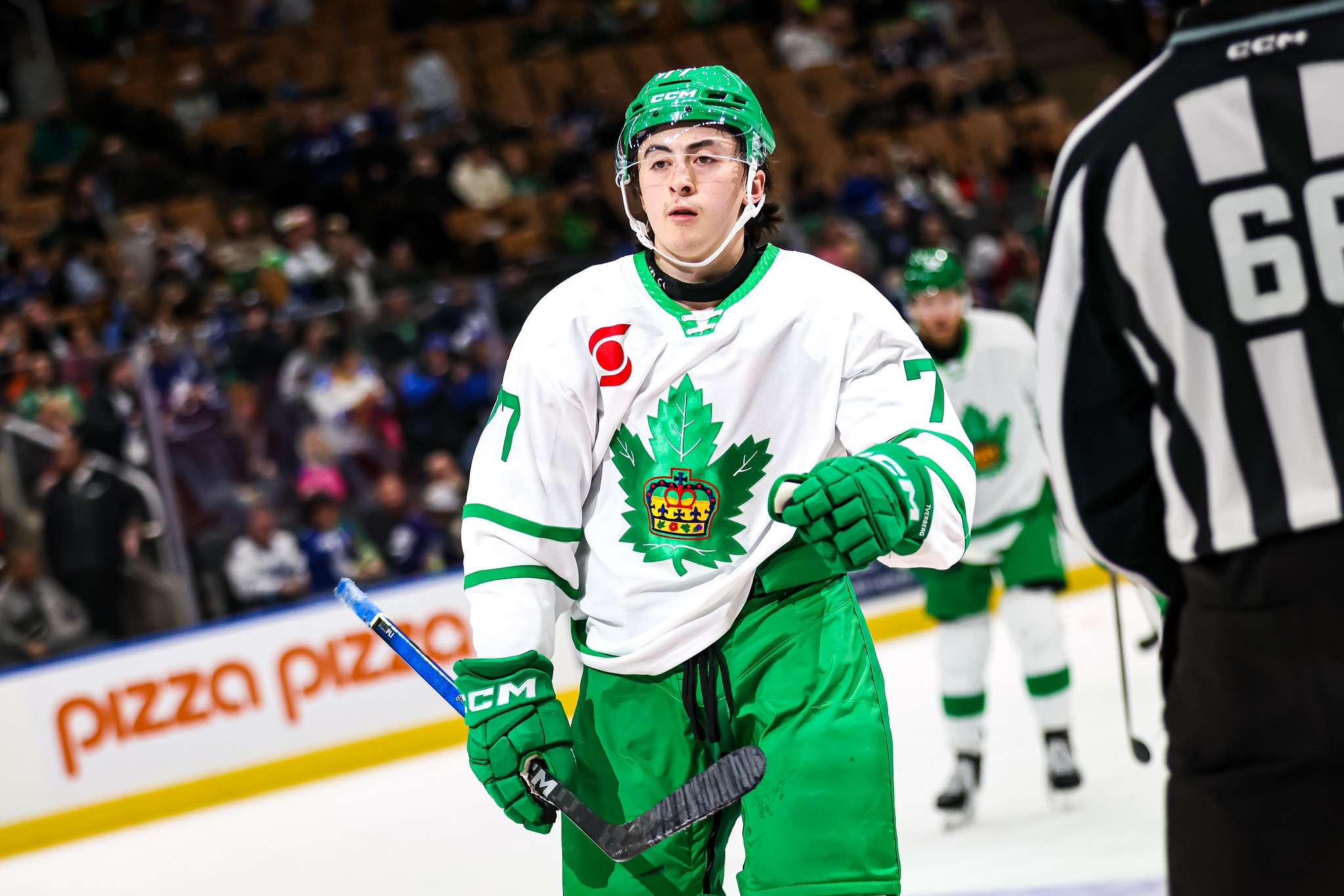
Two weeks after helping the Toronto Marlies win a Calder Cup championship, Ryan Tverberg signed a new deal with the Toronto Maple Leafs.
As per PuckPedia, it’s a one-year, two-way contract worth $850,000 at the NHL level, with a guaranteed salary of $350,000 for the 24-year-old.
A seventh-round selection in the 2020 NHL Draft, the Richmond Hill native has experienced three years of contrasting fortunes at the pro level.
It all began with a rookie campaign in which he enjoyed offensive success alongside Kieffer Bellows. The pair developed instant chemistry and complemented each other’s games well. Expectations were raised for his sophomore campaign after he recorded 32 points (9G, 23A) in 46 games as a rookie.
But the 2024-25 season could not have gone much worse for Tverberg, who was ravaged by injuries for long stretches. When he returned to the lineup, he never looked comfortable or capable of reproducing the form he showed during his first season. In the same number of games, the forward managed just 11 points.
A player who is easy to move up and down the lineup because of his versatility and willingness to do whatever the team asks, Tverberg struggled to produce much offense through the first half of last season. Stapled to the bottom six and receiving limited power-play time, making an offensive impact looked beyond him at that stage.
It was only when injuries and call-ups forced John Gruden’s hand that the rest of the league found out what I had known for a little while.
A promotion to the top line on the right wing immediately sparked Tverberg’s offensive production. He didn’t remain on the first line for the rest of the season, but the move kept him in the top six, where he continued to produce. Over the final 27 regular-season games, the 24-year-old recorded 25 points (10G, 15A), going a long way toward making it the most productive season of his professional career to date.
During the 2025-26 regular season, Tverberg tied for second on the Toronto Marlies in five-on-five points (11G, 18A) and carried that production into the postseason. Let’s not forget he spent more than half the season in the bottom six.
Setting aside the three-game series against Rochester, Tverberg finished third on the team in five-on-five playoff scoring (3G, 5A), rarely receiving the recognition his performances deserved as the spotlight shifted to Easton Cowan and company.
I’d go as far as to suggest Tverberg is one of, if not the best, transition players on the Marlies. He always keeps his feet moving, plays with pace, and his willingness to carry the puck across the blue line was often the catalyst for sustained offensive-zone possessions or even goals for which he wasn’t ultimately credited on the scoresheet. While finishing isn’t the strongest part of his game, this is the type of play Tverberg is capable of as a transition threat:
WATCH OUT… RHYNO COMING THROUGH!!! 🦏
Ryan Tverberg scores to give us the 3-1 lead! | @cocacola_ca pic.twitter.com/a8NJDm7ISQ
— Toronto Marlies (@TorontoMarlies) June 19, 2026
The biggest concern surrounding Tverberg was his smaller stature and how easily he could be separated from the puck. That was a legitimate issue during his rookie season and remained one throughout 2024-25. Not so much anymore. Improved physical strength, combined with a more tenacious approach, now allows him to win his fair share of battles along the boards and in the dirty areas of the ice. His relentless style of play below the goal line is easy to appreciate, and it leads to a healthy number of turnovers on the forecheck.
Not only does he possess above-average defensive instincts, but he also regularly creates chances off the rush by using his speed and anticipation to break up plays/passes and turn them into offense.
Those same skills have allowed Tverberg to become a legitimate penalty-killing threat. He’s worked his way into becoming an integral part of the Marlies’ first penalty-kill unit, usually alongside Bo Groulx.
It’d be as a hard-working two-way player — a reliable checker with a bit of skill to produce — that Tverberg would ultimately earn an NHL roster spot or establish himself as a reliable first call-up. Given the additions John Chayka has made this summer, opportunities will be very limited in training camp, but I’d never fully count out the relentless former seventh-rounder who has had to fight for every opportunity throughout his professional career.
A one-year “show me” deal is fair for both sides, especially with a $350k guaranteed salary for Tverberg, who will likely become a Group 6 UFA after the season. If he doesn’t make the Maple Leafs out of camp, I’d expect a highly motivated Tverberg to return to the AHL, where he could quickly become impossible to ignore if he picks up where he left off and dominates the league the way he did down the stretch last season.