

















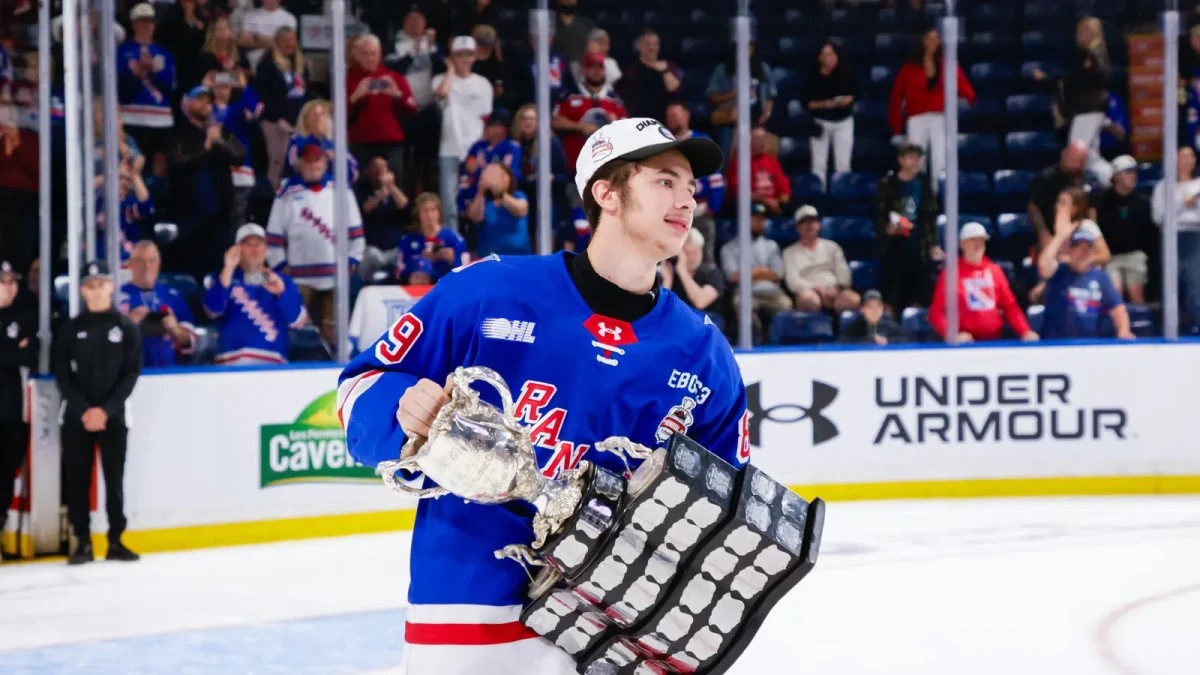
Late in the second round, the Toronto Maple Leafs selected defenseman Alexander Bilecki of the Memorial Cup champion Kitchener Rangers.
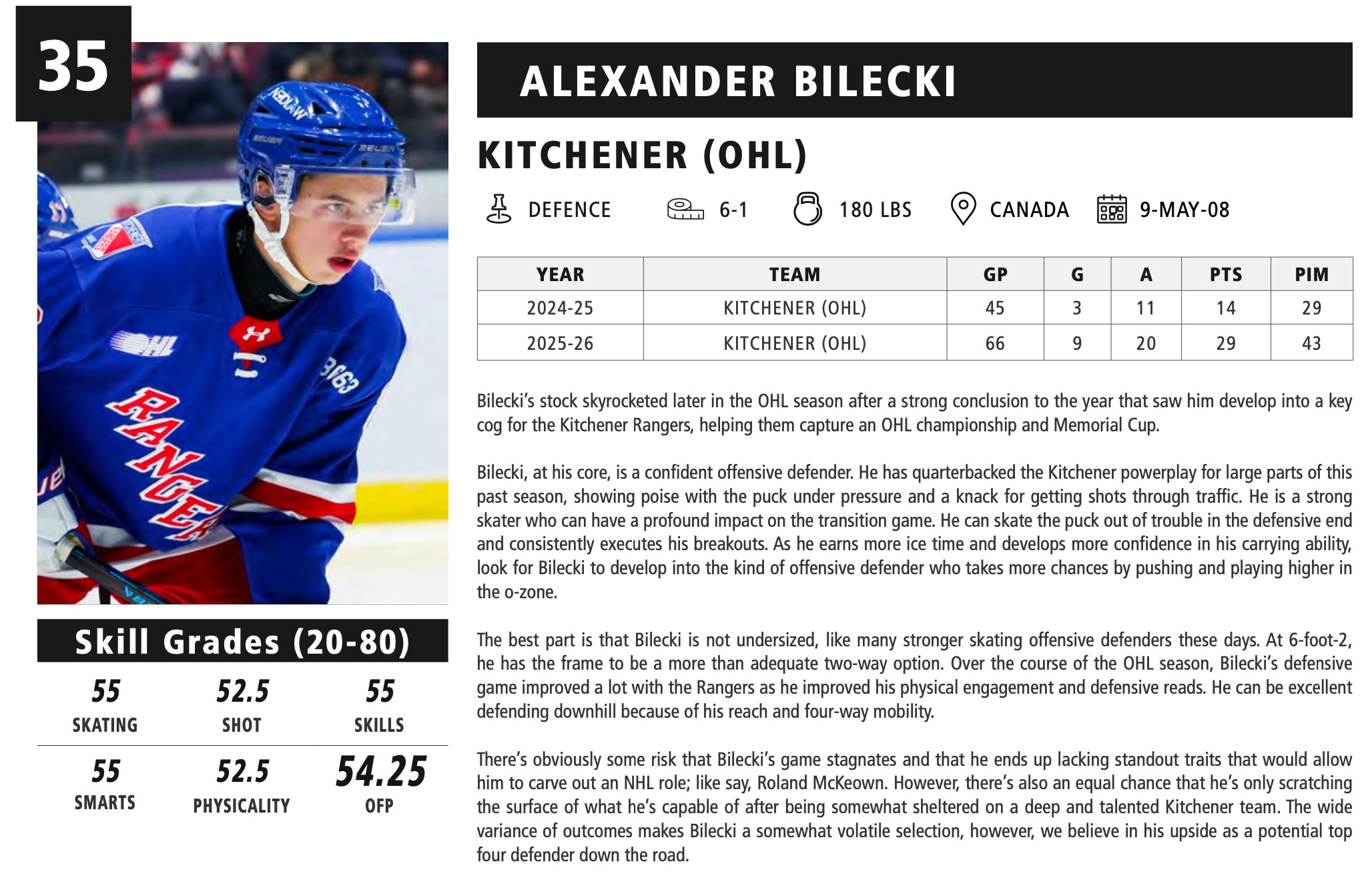
This was an excellent value pick. According to Elite Prospects, Bilecki’s consolidated ranking was 54th. At McKeen’s, where your author is the director of scouting, we had Bilecki ranked 35th. Needless to say, I’m a big fan of the selection and expected him to be taken much earlier than where the Leafs grabbed him.
At McKeen’s, we felt Bilecki had a ton of helium. His game improved considerably over the course of the season, especially in the defensive end, and he was able to be a key contributor for the Rangers late in the season despite them bringing in so many veteran players for a playoff push. He held his spot on the power play and earned key minutes and responsibility in the Memorial Cup. This is a player whose positive growth makes him a solid bet to develop into an NHL contributor.
So what kind of game does Bilecki play? He’s a bit of a jack of all trades type. I know that can be a scary phrase to describe a junior defender; those labeled as such have had difficulty transitioning to the NHL level in the past. The Leafs learned this with Stuart Percy. In reality, it’s likely why Bilecki was able to fall to Toronto at 60th, as some NHL scouting staffs wonder about the kind of role Bilecki will end up playing.
In this situation, it shouldn’t be considered a kiss of death for his projection. Firstly, Bilecki has both a solid frame and good mobility. The foundation there is solid; he’s not undersized. Secondly, Bilecki has the offensive skill set to be a power play contributor, just as he has been in the OHL thus far. Thirdly, Bilecki’s improved defensive play into the OHL playoffs suggests that he could grow further in this regard. Bottom line: There are multiple paths to the NHL for Bilecki, given how well-rounded his skill set is.
Let’s break things down by category to give you a better idea of Bilecki’s strengths and weaknesses. I’m going to use the categories we use at McKeen’s Hockey: Skating, Shot, Skills, Smarts, and Physicality/Compete.
Skating
Bilecki is a very strong skater in straight lines. He builds speed well with long, powerful strides, and he’s tough to knock off stride, which is impressive given his lanky frame. This allows him to have a terrific impact in transition. He can lead the charge out of the offensive end and gain the opposing blueline. He’s also very aggressive jumping up in the play in an effort to beat opposing backcheckers down the ice, making him a backdoor option or a shooting option in transition. Bilecki’s first step quickness is also fairly good for a defender, and he uses this to get space from forecheckers or to step into the slot for shot attempts.
His agility and lateral mobility are also solid, but unspectacular. There’s room for him to be able to build speed better and quicker out of pivots and to be a little more fluid and explosive on his edges so that he can be an even more effective power play quarterback. Defensively, he defends downhill well because he skates well backward and transitions quickly from forward to backward stride. This also allows him to retrieve quickly. Additionally, Bilecki’s linear quickness allows him to be aggressive in the neutral zone as he’ll jump passing lanes and look to force turnovers to start counterattacks.
Bilecki turns on the burners🛞
A great dish by the #NHLDraft prospect sets up Haeden Ellis to put the @OHLRangers ahead in Game 3.#KITvsSOO | #OHLPlayoffs pic.twitter.com/9GT9ybtgfo
— Ontario Hockey League (@OHLHockey) April 14, 2026
How about this play from Bilecki as part of a three point effort the other night? Looked outstanding on the first pairing with Cam Reid.
He’s a top two round pick for me at this point. https://t.co/zVDPU05zlB pic.twitter.com/IGXmijIJmB
— Brock Otten (@BrockOtten) November 28, 2025
Shot
Bilecki didn’t score 11 goals this year (regular and postseason combined) by accident. He’s a solid shooter and a dangerous scoring threat both from the blueline and as a third or fourth man in transition. He has a quick wrister that he places well and will look to utilize when he’s jumping up in the play. He also one-times pucks cleanly and utilizes a half-slapper to get pucks on net quickly. Neither shot is extremely hard, so that could be a focus for him moving forward, but he’s an opportunistic scorer who gets shots on net quickly and hunts down open space well.
Look at the explosive push from Bilecki here as he makes no mistake from the slot. pic.twitter.com/648naEBkVK
— Brock Otten (@BrockOtten) November 23, 2025
Bounce Back Bilecki🚨
The #NHLDraft prospect brings the @OHLRangers back to even.#KITvsWSR | #OHLPlayoffs pic.twitter.com/avGxhL9TYo
— Ontario Hockey League (@OHLHockey) April 24, 2026
Skill
What makes Bilecki an effective puck carrier and playmaker is that he’s really good at using his frame to protect the puck, keeping it in his hip pocket or by playing into defenders’ hands to take away their reach. He’ll drive through opposing defenses and is aggressive at taking the middle lane, looking to catch opposing players flat-footed. He has no issue handling at full speed, rarely fumbling pucks, and is able to play at a breakneck pace as a result.
As a playmaker, Bilecki is comfortable drawing in pressure before passing off. This helps open seams for him to exploit, and he has the skill and touch to thread them.
Inside the offensive blueline, be it at five on five or on the power play, Bilecki walks and holds the line well and is calm under pressure. He’s not an exceptionally creative player in these situations; he’s not a high-end escape artist like Cale Makar, Matthew Schaefer, or Quinn Hughes. He’s more about quick decisions and straight-line attacking. You are more likely to see him make a quick pass off and run a give-and-go than you are to see him try to dangle off the line.
A look at new Leafs draftee Alex "F it, I'm Alex Bilecki" Bilecki (#89) #LeafsForever: pic.twitter.com/zQKlKrj90Z
— Taahaa (@TaahaaLone) June 27, 2026
A couple of strong plays on the powerplay showcase Bilecki's ability to be a transitional leader and offensive catalyst.
It's not always clean. He's confident with the puck and turnovers in the NZ/OZ have been an issue. He'll need to learn to pick his spots. But, there's skill. pic.twitter.com/GcZ86zlTXV
— Brock Otten (@BrockOtten) November 23, 2025
Smarts
One of the things that makes Bilecki so dangerous offensively is that he’s a major threat off the puck. He picks great opportunities to jump up in the play and consistently creates odd-man opportunities. He anticipates plays well in the offensive zone and finds soft spots in coverage, getting open shooting looks from the slot. He sneaks backdoor or runs give-and-gos, showing a high-end ability to shake coverage and “get open.” Top pick (by Seattle) Chase Reid is also really good at this, and I’d argue that this can be a greater indicator of future offensive success at the NHL level than creative on-puck play.
Bilecki’s decision-making with the puck improved a lot over the course of the year. I felt like, in particular, his scanning habits got better, and he became way more comfortable making plays under pressure. As a result, his defensive zone and neutral zone turnovers decreased, and he became much more effective at initiating breakouts. Combine his mobility with his passing ability and improved scanning habits, and you have a defender who could end up becoming a breakout machine.
Defensively, Bilecki’s decision-making and awareness improved, too. He has some length, and he clogs passing lanes and the slot well. As mentioned, he loves to jump up to defend aggressively, looking to force turnovers in the neutral zone; again, his anticipation and ability to read the opposition are strengths. Sometimes his aggressiveness can get him burned, so he’ll need to refine it moving forward.
Great read and stick from Bilecki here and then the heads up outlet to set up the goal. pic.twitter.com/IBWBdB1oCk
— Brock Otten (@BrockOtten) November 23, 2025
Bilecki sneaks backdoor🤝
A great pass from Jack Pridham (#Blackhawks) sets up 2026 #NHLDraft prospect Alexander Bilecki for his 4th of the year!@FloHockey | @OHLRangers pic.twitter.com/yX4qnbnpYQ
— Ontario Hockey League (@OHLHockey) November 24, 2025
Physicality/Compete
As my colleague at McKeen’s Hockey, Liam Staples, has rightfully pointed out, Bilecki was actually a fairly physical defender as an OHL rookie. It was how he left his mark because his offensive contributions were quite inconsistent. He averaged 0.6 hits per game in 2024-25 and dropped to 0.36 this past season. This proves that he’s capable of playing a more physical game as he gains the confidence to be an impactful two-way defender, in addition to improving his strength/conditioning.
Bilecki is a threat to hit in the open ice, and he will catch opposing forwards off guard from time to time. He is assertive in 50/50 battles, looking to pin and use his size/frame/length to win those jousts. His puck-battles-won percentage this past year was 58%, which was actually quite solid, right up there with the likes of defensive stalwarts Jared Woolley (63%) and Matt Andonovski (59%). Obviously, again, his skating ability gives him an advantage here because he’s able to be first to pucks and doesn’t have to win as many of these one-on-one battles.
The biggest area of weakness for Bilecki is his ability to defend the net front. He competes. He’ll block shots. He’ll engage physically. He’s just not yet extremely effective at tying up larger forwards near the crease, and he can struggle in scramble situations or on the penalty kill. The Rangers will be graduating nearly their entire blueline next year, giving Bilecki far more opportunity to play in key defensive situations and on the penalty kill, which will be great for his development.
What does the future hold?
As mentioned, the reigning Memorial Cup champion Rangers will look vastly different next year. Cam Reid is heading to Michigan, which will make Bilecki Kitchener’s primary puck mover and power play quarterback. Matt Andonovski and Jared Woolley are graduating to the pro level, which means Bilecki will also receive more responsibility defensively and in all situations.
Given that the team may be entering a re-tool, Bilecki could ultimately end up a trade candidate in the OHL this coming season. Down the line, you can probably bet that he ends up committing to a high-end NCAA program, which will help develop his defensive and physical games.
At this point, Bilecki’s projection would be that of a solid second-pairing defender who can also quarterback a secondary power-play unit. I’ve seen the name Damon Severson thrown around as a comparison, and that’s probably on point if Bilecki reaches his ultimate upside.
Of course, as alluded to at the beginning of this article, there’s also a chance that Bilecki ends up more of a tweener who struggles to find a consistent role. Former high pick Roland McKeown had a similar profile, and he had a difficult time with the transition, ultimately settling in as organizational depth. Bilecki will need to continue to improve in all areas to be an NHL player, but that’s not out of the realm of possibility.
Quotables
“Despite being the youngest defencemen on a championship-caliber team — one that features four NHL prospects among its six regular blueliners, many of whom are 19- and 20-years-old — Bilecki earns over 17 minutes a night on Kitchener’s top 4, playing every situation at even strength and special teams. Bilecki is an effective puck-mover and has shown to be just as effective rushing the puck. There are translatable traits in his hockey IQ that project well to the professional level, whether through his timely activations in the offensive zone or his ability to track plays and close out in the defensive zone. Bilecki has good size, listed as 6’2,” and despite being listed at 180lbs, he can play physical and use his strength to pin opponents to the boards.”
“What a great run for Bilecki this year in Kitchener. He had a very strong playoffs and Memorial Cup and that has to count for something in the eyes of NHL scouts. He’s a really well-rounded defender who leans offense first. However, he projects as the kind of NHL defender who can play in any situation. He’s been quarterbacking one of the Rangers’ power play units all year and doing a great job. Bilecki’s size and strong mobility give him an advantage at both ends. He can kill the rush, but also kick start the transition game. He’s not the world’s most creative offensive defender, but he’s intelligent. On the puck, he gets pucks to the net quickly and makes quick passes, or he has the elusiveness on his edges to escape the first layer of pressure, working to the inside. Similar to Chase Reid, he’s also good off the puck as an offensive player. He’ll pinch to keep pucks in, activate regularly as a third or fourth man in, or sneak backdoor to earn a look. Defensively, his physical intensity increased over the year and, again, he’s an intelligent zone defender. As he picks up more ice time and responsibility, aka next season, I’m really curious to see how his game evolves further. I think the one concern you’d have is the difficulty that his player type sometimes has with finding a role at the NHL level; the “jack of all trades” type. You think of guys like Roland McKeown or Stuart Percy. It’s why I’d have Bilecki outside of the first round because there is that chance that he fits that similar archetype.”
“This player is still severely under-ranked by a lot of outlets. Puck moving and decision making is excellent, either with breaking out under pressure and while rushing it himself. Has really good speed and has a smart ability to change speeds on the rush. Really like his power play movement when he gets an opportunity, and the puck really gets moving around when he’s leading that assignment. He really could have had better numbers if he wasn’t playing on such a loaded roster. Defensively, he has good instincts and actually does play relatively mean. Throws hits and will be greasy. His issue right now is that he is weak. He has a 6’2 frame that can hold a lot more muscle. There’s immense upside here. Somebody is going to steal this kid. It is noteworthy that this player seemed to get better as the year went on and actually thrived as the opponents got harder.”
“He might be the most underrated player in the Draft. Forced to play lesser minutes behind a stacked Kitchener squad, his statistical output doesn’t tell the full story. He can flat out fly, and he thinks the game offensively at a very high-end level. While slight, he does have a mean streak to him, and I wonder what sort of upside there is defensively when he fills out. I expect him to take a massive leap in offensive production next season. The only thing this kid’s missing is opportunity, and that will come knocking sooner than later.”