























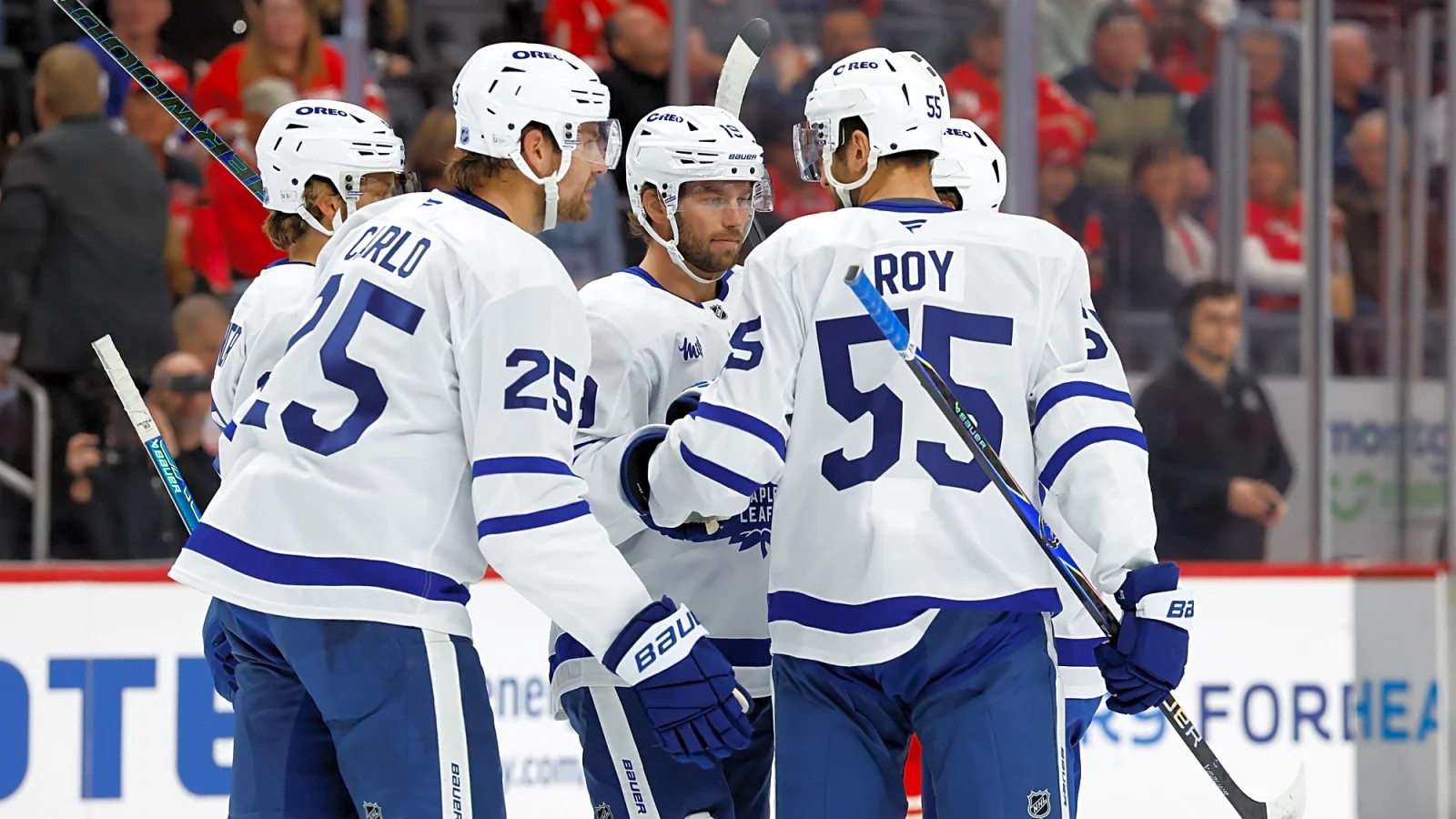
The Maple Leafs’ 2026 trade deadline has officially kicked off, as the team has sent Nic Roy to Colorado for a first-round pick in 2027 (top-10 protected) and a fifth-round pick in 2026.
Roy, who just turned 29 in February, has one year remaining on his contract at a reasonable $3 million. He played 59 games with the Leafs, recording just 20 points.
Roy was used exclusively in a third-line role in Toronto with a revolving door of linemates, including everyone from Dakota Joshua and Matias Maccelli to Nick Robertson and Easton Cowan. Most of his deployment and usage didn’t really make logical sense, but we could write the same about basically every player on the team this season. At one point, Roy formed a really effective line with Joshua and McMann.
Alas, when the team struggles, players will inevitably be moved out. It’s presumably the first step of many as the Leafs seek to restock their draft cupboard, which contained just nine draft picks over the next two drafts, three of which are in rounds six and seven.
In terms of value, Brad Treliving did fairly well. The first-round pick is top-10-protected and would be unprotected if it rolls over into the next season. This return falls reasonably in line with the price the Leafs paid for Scott Laughton just a year prior.
While the Leafs included Nikita Grebenkin in the Laughton deal, it’s often forgotten that the Flyers also retained 50% of Laughton’s contract for a year and a half and also sent the Leafs a fourth-rounder and a sixth-rounder as part of the transaction. While the Leafs won’t net a player back in this Roy trade, they also aren’t retaining any of his salary and didn’t send Colorado back any assets beyond Roy, making it basically a wash — one that arguably favours the Leafs’ return, depending on how one rates Grebenkin.
This is a trade market in which we’ve already seen Michael McCarron moved for a second-rounder and Nic Dowd traded for a second and a third. Roy is younger and generally better than both, so it was to be expected that a trade for Roy would be priced along these lines.
The Question Marks Beyond the Season
If the Leafs’ goal is to trade away players and restock picks/prospects, this trade makes complete sense. If the goal is to sell and also be competitive next season… Well, we will see.
If the Leafs trade Scott Laughton as well — who sat out of their last game — it blows a huge hole in their center group and would leave them with essentially Matthews-Tavares (who should be moving to the wing, if anything) – Quillan – Unknown. It’s not worth it yet to dive into the ramifications of also trading Laughton — and maybe they even circle back to the idea of extending Laughton’s contract, given he clearly wants to stay — but it’s a big hole, and it’s a weak UFA class in which to fill those holes.
Even if the Leafs bring back Laughton now, Roy was their only right-shot center and one of their only right-shot forwards in general. The rest of the list includes William Nylander and Calle Jarnkrok (if we really want to count Jarnkrok, a pending UFA).
If the Leafs shed Laughton and Roy, those were also their top two penalty-killing options on a very good unit. John Tavares isn’t killing penalties anytime soon. Will Auston Matthews be a staple shorthanded now? Will Quillan be thrown to the wolves?
Keeping Roy isn’t critical to the team’s success — that’s obvious, given the Leafs’ current situation with him in the lineup — but he’s a useful piece at a key position, one that is generally difficult to acquire.
Also noteworthy: As part of the deal, the Leafs haven’t shown much creativity. They didn’t retain to increase the return, and they didn’t take back a contract to increase the value coming back; they simply traded a player away and added a good pick. That’s not necessarily a bad thing; it’s simply a “plain” kind of trade, and at some point, management will need to show some actual creativity.
The Leafs still own all three of their retention slots, and we have to believe they will use them to help facilitate future trades between now and the deadline.
In the meantime, this opens up even more cap space for the Leafs. They have almost $6 million in room, and it blows a hole in the lineup for Jacob Quillan to receive a real look, which is a positive. Quillan is in the midst of a strong season in the AHL and has more than earned an extended look with the Leafs. An RFA this summer and 23 years old, if the Leafs aren’t taking a good look at Quillan now, why bother developing him at all?
If nothing else, the swing in footspeed between Roy and Quillan should be significant, and for a Leafs team that has played and looked slow throughout the season, it will at least be semi-interesting to see how this plays out moving forward.
Because Roy was signed through next season, this trade also has future cap ramifications. Not including Philippe Myers, the Leafs now have over $25 million in cap space this offseason with eight forwards, six defensemen, and two goalies (Joseph Woll and Anthony Stolarz) signed. All of Maccelli, Robertson, and now Quillan are RFAs as well. If anything, as the next 24 hours unfold, we would expect even more cap space to open up, positioning the Leafs well to be an aggressive buyer in the UFA and trade markets.
Of course, it will be ironic if the Leafs traded a serviceable bottom-six center only to overpay a different bottom-six center this summer. They received a good return to attempt to justify it, and they desperately need to restock their draft cupboard, too.
There is still a lot of work to do between now and the deadline — and between the deadline and the start of next season, if the team’s goal is to compete again. The path to the latter goal is much murkier—if it’s even still the plan—but the Leafs are at least adding important draft picks in the meantime.