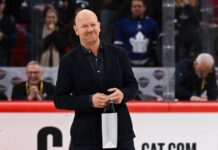

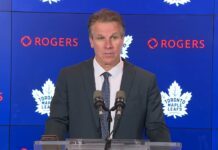




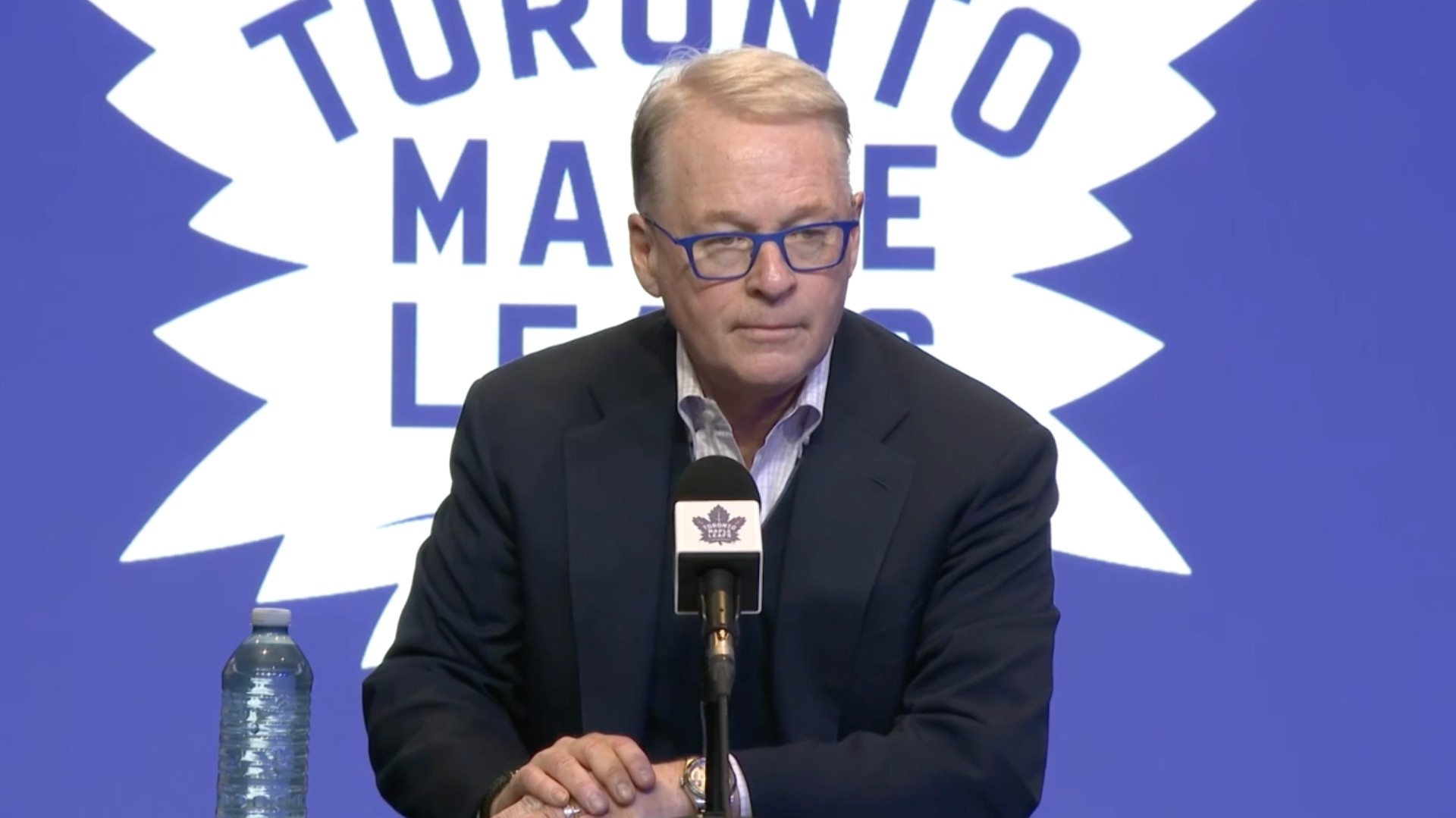
It was a low bar to clear for Keith Pelley in Tuesday’s press conference, but ultimately, he bricked the layup.
I don’t want to speak for all Leafs fans, but I’m pretty sure most simply wanted — on top of the obvious: an acknowledgment that the season fell inexcusably short of expectations and real change was required — Pelley to indicate he plans to hunt down a fabulous candidate to steer this ship back on course while leaving the hockey to the hockey people. There would’ve been a collective sigh of relief if Pelley simply and confidently projected, “My job is to conduct an exhaustive search for a great new leader for this hockey team, armed with the unlimited resources made available to me by our ownership. Don’t ask me about the hockey minutiae, because I’m not that guy.”
Easy.
Instead, Pelley paid lip service to his limited hockey involvement several times but couldn’t fully, confidently remain in his non-hockey lane. And if you think he couldn’t resist the urge to (unsuccessfully) prove his hockey chops in a public press conference but could while in the war room with Brad Treliving on trade deadline day, I’ve got a bridge to sell you.
I don’t know why Pelley felt the need to talk up the Buffalo Sabres in this press conference, let alone the Bruins or Habs (there was no reason this current Leafs team shouldn’t have been just as good as the Bruins, at an absolute minimum). But if you’re going to cower in fear of them, at least highlight the actually scary bits. If I were in the business of worrying about the Sabres instead of the Leafs (which I’m not, and Pelley shouldn’t be, either), I wouldn’t be worried about the Sabres because they drafted Radim Mrtka ninth overall in 2025. I’d be worried that Dahlin, Samuelsson, Power, and Byram are their current top four on the blue line, all in their early-to-mid 20s.
(Who had Radim Mrtka receiving a mention in this press conference, by the way? And Vinny Borgesi getting shouted out more times than leading scorer William Nylander!)
Further, Pelley seemed to have read the division rivals’ Elite Prospects pages before arriving at the press conference and was eager to cite some of the names he saw there, while suggesting these organizations would be tough to compete with going forward, given all their high picks are now coming to fruition, with more on the way. But then that doesn’t exactly jive with the categorical “we don’t tank here” or “we want to be competitive as soon as possible” answers.
But the point here is not to dunk, in fine detail, on Pelley’s lack of hockey knowledge and cringeworthy attempts to prove otherwise on Tuesday. It’s not his job to know this stuff. Which is exactly the point: This is why he shouldn’t talk hockey publicly except in very general terms, and it’s why he shouldn’t be at all involved in the hockey decisions.
This is not to suggest that all of Pelley’s comments were awful or even disagreeable. Ownership’s specific motivations for not wanting a full-scale rebuild/desiring a quick return to the playoffs may be fair to question in some regards (especially when they’re now charging parents $1,000 to let their kid wave the Leaf flag on the ice before the game… Criticize Brendan Shanahan all you want, but these reports show that we’ve taken a clear step back as far as the person at the top of the Leafs’ chain of command having his finger on the pulse of the fan base or how to properly nurture community/fan relations in Toronto.) However, I am not sure the hockey logic isn’t also there in this case.
If you’ve got Nylander and Matthews at age 28 and 29 and two of your next three first-round picks are already out the door, the choice is somewhat made for you to at least try to win for another year or two. I also don’t believe this would be based on a hope and a prayer, either, or that this is a team that couldn’t possibly compete next year with the right off-season moves and coaching hire (the discourse has swung too far the other way here, on a team that won its division and seven playoff games last year). Pelley all but conveying ownership’s desire to get back into the playoffs quickly didn’t surprise me and actually makes some sense in a vacuum.
If there are indeed strong candidates out there only interested in the Leafs’ job if they can tear it down to the studs and rebuild through the draft, they better be able to clearly articulate a creative strategy and reasonable timeline for pulling this off without two of the team’s next three first-round picks.
***
As for the “data” piece of the presser: The Leafs already have a full analytics team, and making evidence-based, data-driven decisions is table stakes in 2026. But what may have occurred here is that Pelley, while awkwardly observing Treliving before firing him, didn’t believe data was actually integrated enough (or at all?) into the final decision-making process among Treliving and his right-hand men. I don’t think Pelley would have the first clue about how that data should be used in a hockey context or what data actually matters, but there may be some real legitimacy to this concern.
The immediate line of questioning in the press conference turned to, “Where are you gonna find your Tulsky, then?”, but I don’t think that’s a fair framing of what Pelley implied. I didn’t take it to mean that the Leafs necessarily need to find a celebrated name in the analytics community to be their GM — though that certainly wasn’t ruled out — but rather someone with the ability and open-mindedness to more effectively integrate the data provided by a staff such as Daryl Metcalf’s current one in Toronto (or the next analytics team of their own choosing) into management’s workflows.
***
At face value, I liked Pelley’s comments about the lack of rigidity/one-size-fits-all approach to the management structure. There are advantages and disadvantages to the various structures, and much of it depends on the reputation, experience, background, personality, and preferences of the individual(s) they hire.
With all of what I wrote above about Pelley in mind, there is an appeal to installing a buffer between the GM and MLSE leadership in the form of a President of Hockey Operations. But we also saw what happened with Shanahan and Kyle Dubas by the end – multiple strong hockey minds/personalities seemingly clashing – and there were probably justified concerns about the clunky, onerous chain of command for major decision-making when a GM seeks approval from a POHO, who then goes to the MLSE President/CEO, who answers to ownership. If they are to get this next major hiring decision right – a big if – it comes down to finding the right person, and if it’s the right person, they certainly wouldn’t be interested in Pelley’s hockey input. The titles can sort themselves out from there. A strong enough leader in the GM’s chair would be able to sell his vision and program and keep any nosy MLSE execs in check, regardless of the particular titles.
***
Another element of the presser/scrum that caught my ear was the references to generational or foundational players, and the team’s current state not falling at the feet of those individuals, who need better support. To me, the tone needs to shift a little bit here after so many seasons.
I’m not suggesting that Pelley specifically call out these players. He’s not the right one to do it, but some version of this does need to be done at some point by someone in charge of the Maple Leafs, in my view: In a measured way, demand better of everyone, including the best players, after a year that went badly awry on and off the ice from a leadership perspective. It does need to be done carefully so as to avoid a major to-do in this market, especially, and I understand the instinct to protect players. I’m at least open to the argument that this is best kept entirely behind closed doors, given the current temperature of the market, but to me, it needs to be made clear at some point by the leader in charge.
There was the Anthony Stolarz incident in October; Nylander apologizing for flipping off a camera as the team’s season was lifelessly slipping away on home ice; Nylander also admitting he should’ve done more than just complain to the ref when Matthews’ MCL got destroyed, which Morgan Rielly and others admitted their own culpability for; Mathews (who could also do more to stand up for teammates) finishing under a point per game as the league’s second-highest paid player… The list goes on, but the core players need to be better than they were this season as leaders, and I think fans are rightfully tired of the perceived public coddling of them.
Again, Pelley shouldn’t be weighing into any of this, but it will be hard to sell for the future President and/or GM if they step up to the podium in a few weeks’ or months’ time and declare, as Pelley basically did, “We’ve got great players here, and just need to support them better.” We’re past last call on that particular song-and-dance. The overall messaging needs refining and updating: “We’re pushing everything to a higher standard here, including demanding more from our leaders in the room.”
It’s okay to say we really believe in the likes of Matthews, Nylander, and Knies as players and people, but we also need more from them as culture-setters, and we believe them to be capable of this, or we wouldn’t be saying it; we’d be trading them instead. From early in the Shanahan era, the Leafs have almost infantilized their core group in their messaging, which made some sense early on, but it’s growing tiresome now that some of them, including the team’s best two players, are among the highest-paid in the league and are nearly 30 years old.