




















“I thought we did a lot of good things. We scored the late goal in the second. I thought we came out really well in the third. We got playing in a four-on-four with these guys, and we missed a check down there. They had a line rush 3-on-2, and they made us pay. They scored quickly again after that.
“Other than that, they didn’t have much. There was a lot to like. We knew this wasn’t going to be easy. It just seems like we’re better when our backs are against the wall. Our backs are against the wall now, because it is a must-win in Game 4.”
– John Gruden
At times, the Toronto Marlies attempted to fight fire with fire but fell short in a high-octane Game 3 that suited the Penguins’ biggest assets: speed, skill, and transition play. After grinding out two victories on the road, it was a little odd to see the Marlies open up the ice and trade chances off the rush against an opponent who thrives in that style of hockey, but the officials also took center stage in this game, and that’s almost never a good thing.
First Period
In a wild first 20 minutes, the teams combined for 15 high-danger scoring chances. Two chances around the four-minute mark encapsulated the opening frame: Logan Shaw was turned aside on a breakaway before Wilkes-Barre/Scranton, attacking in transition, had a dangerous situation snuffed out by a great shot block from Ben Danford. That it took 12 minutes for the opening goal to arrive was primarily the result of outstanding netminding at both ends of the rink.
At the 12-minute mark, some good movement on the cycle from the Marlies‘ top line, plus the Mermis-Villeneuve pair, resulted in Vinni Lettieri scoring on a shot that deflected through traffic in front (screen provided by Cedric Pare), the type of greasy goal any team needs to score in a tight playoff series.
Within 40 seconds of taking the lead, the Marlies were on the penalty kill after a tripping penalty by Michael Pezzetta. After the puck was lost in Marshall Rifai’s feet, the Marlies‘ PK couldn’t take care of a loose-puck situation in the slot, and Aidan McDonough ended up wide open at the back post for an easy tap-in.
The Penguins’ whining after their Game 2 loss seemingly had its effect on the officials in this game. Instead of calling seemingly obvious WBS penalties, sending off one per side for 4v4 situations seemed to be the order of the day.
Artur Akhtyamov was again a rock for the Marlies in the first period, turning away seven high-danger chances and giving up no second opportunities on four other decent looks for the Penguins.
Second Period
The Marlies’ bench again wasn’t thrilled with the officiating in the first two minutes of the middle frame, as WBS got away with an apparent high stick shortly before the 2-1 WBS goal.
Defending the rush, William Villeneuve was behind a step but managed to poke the puck off Bill Zonnon; however, it seemed to handcuff Akhtyamov, who was preparing for a poke check in anticipation of Zonnon cutting across the crease. In the end, an awkward play and bounce was finished off by the Penguins’ 2025 first-rounder in tight.
The Marlies’ mood didn’t improve when Marc Johnstone was singled out for a roughing penalty. Toronto killed it off but almost fell further behind when Dakota Mermis was caught by another high-stick no-call, leading to a 2v1 for the Penguins. Akhtyamov produced another quality save to deny Rafaël Harvey-Pinard.
When the officials finally sent the Penguins to the box for a more marginal holding penalty at the midway mark, the Marlies produced little with the extra skater, but with eight seconds remaining, Ryan Tverberg took a hard hit into the boards on the numbers. Phil Kemp was fortunate to skate away with a minor penalty, and the Marlies were fortunate that Tverberg skated away from it uninjured. The Marlies’ power play struggled to break down WBS despite their success in Game 1 and Game 2.
A flurry of action with three minutes remaining appeared to be a turning point in the game. After Marshall Rifai was stonewalled from point-blank range after a great backdoor feed off the rush from Landon Sim (following a nice between-the-legs breakout play from Danford), Tanner Hower was rejected on a breakaway. The Marlies then broke the other way for a partial breakaway, where Luke Haymes was initially dispossessed but scored on the second effort via a centering feed that took a friendly deflection.
Sergei Murashov robbed Jacob Quillan from the slot inside the final minute, in what was a great period for the Penguins netminder; he turned aside nine high-danger chances, ensuring the game remained tied at 2-2 through 40 minutes.
Third Period
The final frame is best described as frustrating for the Marlies, who threw away a good opportunity to take a 3-0 series lead. Three great scoring chances in the opening four minutes weren’t capitalized on by Haymes, Danford, or Lettieri.
After another reckless boarding penalty by the Penguins — Rutger McGroarty on Landon Sim — the Marlies only went to a two-minute man advantage on what arguably should’ve been a major.
When play returned to five-on-five after another unsuccessful Marlies power play, Logan Shaw and Joona Koppanen were entangled just in front of Murashov, and the Penguins defenseman dropped Shaw with a two-handed punch to the back of the head. Somehow, offsetting minor penalties was the officials’ call, as the refs continued to stick their heads in the sand to the benefit of the Penguins.
Maddeningly, WBS then struck during the subsequent four-on-four due to a poor sort-out by the Marlies, who had the numbers in place checking back into their zone. After the give-and-go goal between Ville Koivunen and Tristan Broz, Koivunen gave it to the Toronto crowd during the goal celebration when he really should’ve shaken the ref’s hand instead.
Pouncing on another defensive breakdown, WBS surged to a 4-2 lead just two minutes later, all but putting the game out of reach. The Marlies mustered just three shots in the next nine minutes, and while Johnstone’s rebound goal with 50 seconds left gave the home crowd some hope briefly, an immediate neutral-zone turnover on the subsequent breakout led to a quick empty-netter for Tanner Howe.
The game finished with some shenanigans, as Sim took a healthy run at a Penguins player, indicative of the overall frustration level after a poorly officiated game from the Marlies’ perspective. The Marlies have plenty to get up for in Game 4 on Wednesday night.
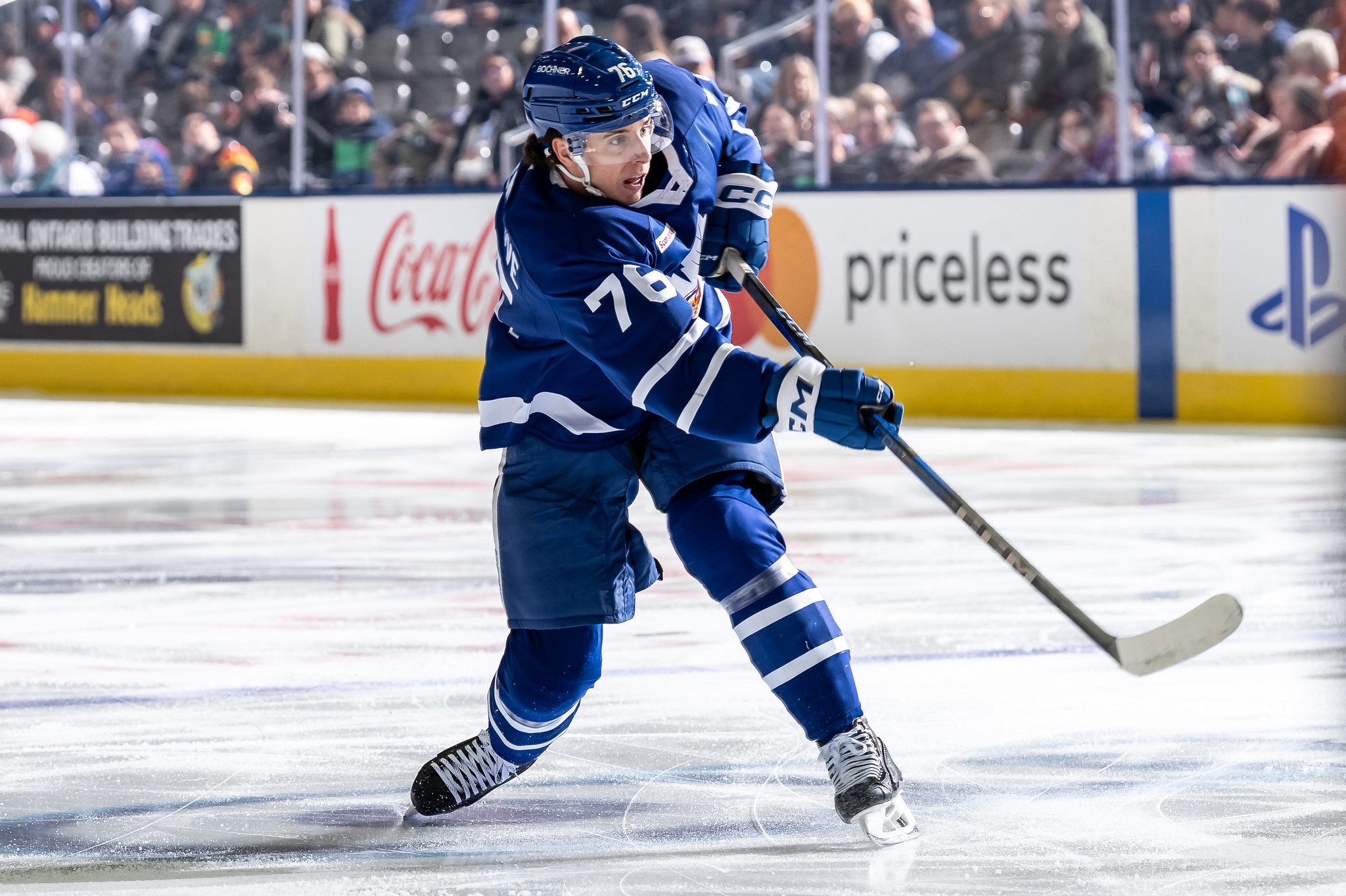
Last but not least, a nod ahead of Game 4 puck drop: With the secondary assist on the first-period goal in Game 3, William Villeneuve recorded his 12th assist of the postseason, the most ever by a Marlies defenseman. Villeneuve has points (1-4-5) in five consecutive games and 14 points (2 goals, 12 assists) in 16 postseason games.
– Game 3 lineup:
Forwards
Paré – Shaw – Lettieri
Groulx – Quillan – Nylander
Sim – Haymes – Tverberg
Pezzetta – Johnstone – Johnson
Defensemen
Thrun – Chadwick
Mermis – Villeneuve
Rifai – Danford
Goalies
Akhtyamov
Hildeby