




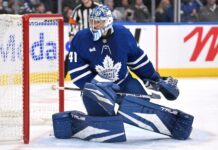


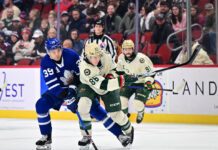













Scott Laughton’s folk hero status continues to rise in Toronto.
I had to blink a few times to make sure I wasn’t superimposing the memory of Laughton’s goal against the Dallas Stars onto this game in my head, wanting the moment for Laughton so badly. It was the exact same goal with the same finish — again, right at the end of a penalty kill — except this time, it meant a hell of a lot more to both the team and the player.
“WELCOME HOME, SCOTTY!”
Laughton 5th of the Season vs Flyers
🔊 @Bonsie1951 @Jim_Ralph pic.twitter.com/de27ESN4Tp
— Maple Leafs Hotstove (@LeafsNews) January 9, 2026
Laughton went 19 for 20 in the faceoff circle tonight. He drew a penalty halfway through the game. He was a huge part of the late-third-period 5-on-3 kill, as well as the late-first-period kill. He had a 2:08 shift on that third-period PK; the goal review — after Trevor Zegras pretended he scored — was a blessing in disguise, allowing Laughton to catch his breath. Still, he was breathing heavy as he won draw after draw, and at one point, he took a hard hit to get the puck out. He was back out again less than a minute later to score a beautiful shorty to tie it up with six minutes to go, paving the way for an OT winner by Easton Cowan. Storybook stuff in his return to Philly.
While we’re on the topic, there is a real case to be made for Laughton as the best penalty-killing forward in the league. He wins draws at an exceptionally high rate, he anticipates extremely well to close off lanes and break up entries, he is fast, he is hard on pucks, and he now has three shorthanded goals — two officially, but it’s really three if we include the one just after the penalty’s expiration in Dallas. All three goals were beautifully taken — two were carbon copies of each other, wherein he pulled the puck in, used the defender as a screen, and picked the top left corner. The other was a breakaway goal where he ripped a bar-down clapper to tie the game in the third period against Montreal on HNIC.
As for the Leafs’ game outside of Laughton’s contributions, this was a fairly low-event battle (before OT), and a mostly 50-50 contest for the majority of the night. It looked like it might’ve gotten away from the Leafs when they took two overlapping penalties in the final 10 minutes of the third while down 1-0. But they stayed composed, got a massive couple of kills, and found a way to win when they weren’t firing on all cylinders, as teams on a roll often do.
The Leafs have scored first on the road just seven times this season (29th), and that statistic didn’t improve tonight. But I didn’t mind the Leafs’ initial start to the game, for the most part, as they generated a fair bit of offensive-zone time, without turning it into many chances of note.
The best scoring chance of the opening stages (eight minutes in) went to Philly, on a breakaway after a suspect pinching decision by Morgan Rielly; he took a low-percentage swoop at a puck in deep that was fully in the Flyers’ control, but Dennis Hildeby came up big against Denver Barkey.
The Leafs answered with a nice chance for Nic Roy on a slick redirect in front off a nice feed from Easton Cowan, who was creating early. Auston Matthews went on a partial breakaway with five minutes left in the opening frame, but he couldn’t solve Dan Vladar on the blocker side.
The late stages of the first really tilted Philly’s way, and Hildeby needed to be sharp, which he was. The other thing that got the Leafs through Philly’s late-first-period push, which included a bogus slashing call on Troy Stecher, was incredible work by Laughton on the kill, winning draws, busting up entries, and clearing the zone.
In the first minute of the second period, the Leafs fell behind with their top line on the ice. Philippe Myers and Auston Matthews were assigned some blame on the TSN broadcast, but this goal was on the wingers, Bobby McMann and Max Domi, who didn’t keep their heads on a swivel and pick up Travis Konecny in the middle. The center and D were in a 2v2 down low, and the wingers were meant to collapse on the slot and cover that off, but they weren’t aware enough. Nearly the same scenario played out a few minutes later, from the opposite side of the zone, but Calle Jarnkrok shoulder checked properly and picked up the stick to prevent a likely Flyer goal.
The Leafs drew two penalties in the middle part of the second period, but their power play took a bit of a step back in this one. They were deliberating with the puck on the perimeter a little too much, and they struggled to pull the Philly PKers apart with their on- and off-puck movement in order to complete any real plays into the middle. They seemed hesitant to shoot their way in, as well. They registered just one shot in the four minutes of power-play time, although Bobby McMann and OEL both had decent looks just as the second opportunity expired.
The Leafs probably should’ve tied it during a late flurry in the middle frame, but Rielly didn’t capitalize on a slick no-look feed from Matias Maccelli in the slot.
After the aforementioned third-period kills and Laughton’s game-tying goal, Auston Matthews had a possible regulation winner on his stick off a feed from Max Domi, but he couldn’t make high-blocker side work against Vladar in this game.
In a chaotic, end-to-end overtime period, the Leafs did everything in their power to turn pucks over and lose the extra point. Dennis Hildeby (with an assist to a hilarious diving leg tackle by Rielly at the backdoor) did everything in his power to keep his team alive before John Tavares made a nice behind-the-back pass to Easton Cowan for the winner on a 2v1 rush.
“HOLY MACKINAW!”
COWAN OT WINNER vs Flyers
🔊 @Bonsie1951 @Jim_Ralph pic.twitter.com/YtS8BeYa5v
— Maple Leafs Hotstove (@LeafsNews) January 9, 2026
Post-Game Notes
– What more can be said about Dennis Hildeby at this point? This shows as just a 22-save win, but it was harder-earned than that. Neither team was throwing much empty-calorie junk at the net, and Natural Stat Trick credited the Flyers with 22 high-danger chances over all situations (that seems a little high to me, but he had to make some real saves). On top of the overtime work, he faced a breakaway on his second shot of the game, and he battled to keep the puck out during the late penalty-kill scramble. He’s been really sharp in PK situations, where he currently owns a .931 save percentage, third-best in the NHL among goalies with at least 20 minutes played on the kill. He’s fully earned something close to a split load with Joseph Woll right now.
– John Tavares was struggling with turnovers in this game, pretty much start to finish, both on the power play and at five-on-five. He’s doing everything a little too slowly right now, and defenders are stripping him too easily as a result. He’s got to do a better job of keeping his feet moving, holding off checks/hanging onto pucks, and taking care of the puck in general. The turnover prior to the Knies penalty in the third period was a good example; he didn’t keep his body between the defender and the puck and was easily dispossessed along the wall. Obviously, puck protection is usually a major strength of Tavares’ game. Let’s hope the nice OT setup for Cowan’s winner can be a bit of a springboard back to his earlier-season form.
Last season, Tavares came out of the Four Nations break rejuvenated, potting 17 goals and 29 points in the final 27 games of the season after a slump in form around this time of year. Maybe the Olympic break can provide a similar reset, but the thing is, the Leafs have a lot of important games they need to win before then, and they’ll need better from Tavares in the meantime.
– I liked Team Canada GM Doug Armstrong’s description of the benefits of long defensemen who make it like “going through a car wash” or “skating in seaweed” for attacking players. At his best, Brandon Carlo is that kind of defender, with his range and mobility for his size (a nice 1v1 sequence vs. Konecny is seen below). Shots are 14-10, xGF are 60%, and goals are 1-0 for Carlo so far at five-on-five. He struggled with some of his puck play earlier in the year, but his touches have been clean and simple so far. Good start, post-injury.
– The Flyers were credited with 12 high-danger chances at five-on-five in this game, and six came in the 10 minutes when Simon Benoit and Philippe Myers were on the ice together. We’ll keep saying it until we’re blue in the face, but they really shouldn’t be a pairing, and the Leafs need to rotate some of their other options through their bottom pair. Look at some of these breakout sequences in a short span in the first period:
This was a defensive-zone draw following a Benoit icing:
Fumbles, icings, hip-to-shoulder-height grenades up the wall, straight up passes to the other team in the defensive zone — it’s all there right now with these two on the ice. There was also a marathon own-zone shift for the pair late in the first period, wherein Cam York almost scored on a backdoor feed.
– I continue to really like what Matias Maccelli is bringing to the ice for the Leafs right now. He’s done a great job in the offensive zone of keeping his feet moving with the puck and pulling out defenders before making an incisive pass into the slot or through a seam. His no-look pass to Rielly at the end of the second period deserved to be finished off; that’s two games in a row he’s put one on a platter for #44, and it hasn’t been converted. He then sent Knies in through the middle early in the third. It honestly isn’t fair that he has only one secondary assist in the last two games, given all the chances he’s created.
Interestingly, after sending Laughton out to win the opening draw at three-on-three (which he did, of course, as well as a d-zone draw shortly after), it was Maccelli who hopped the boards to join Matthews instead of Matthew Knies (which was debatable). OEL also started OT instead of Rielly, and Max Domi never touched the ice, as they turned to Easton Cowan, which paid off. OEL and Matthews each turned the puck over multiple times, and Maccelli blew a tire at one point, but they at least were mixing it up after the loss against the Islanders made it six defeats in their first 10 trips to overtime.
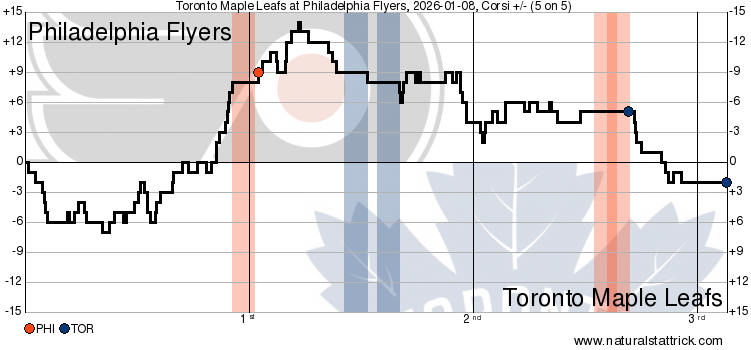
Game Flow: 5v5 Shot Attempts
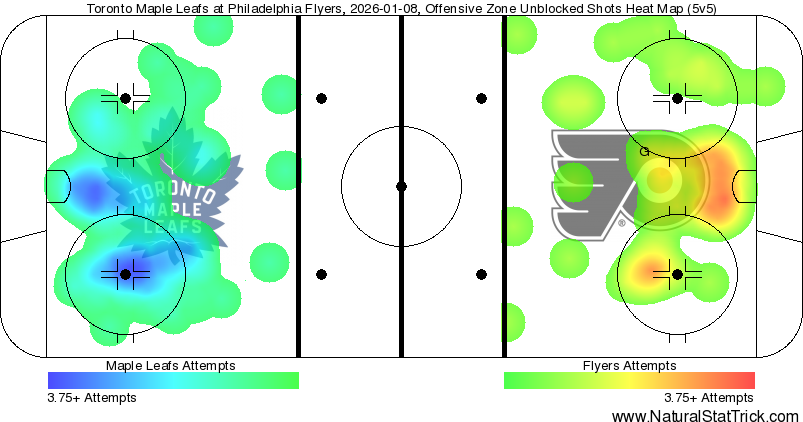
Heat Map: 5v5 Shot Attempts