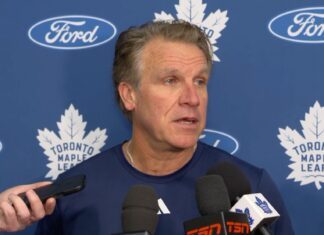
















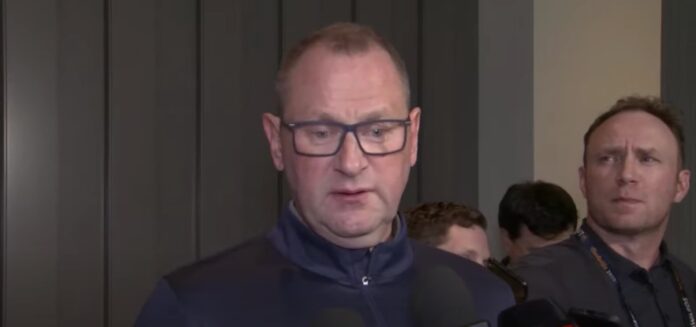
Now serving as the General Manager for Team Canada at the World Championships, Brad Treliving joined TSN Overdrive to discuss John Tavares shifting to the wing in the tournament, Morgan Rielly’s future, and where it went wrong in Toronto in the lead-up to his firing last March.
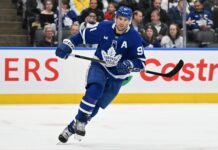
John Tavares has been playing some left-wing in the World Championships tournament. Do you see it as a precursor to what will happen with him in the NHL in the future? Is it about showcasing what he can do for Team Canada, positionally? What do you make of Tavares on the wing?
Treliving: Well, he has been really good. In a lot of these tournaments, as we’ve seen with Team Canada, there are a lot of centers. Of our 14 forwards, I think we have 11 natural centers. Somebody has to go to the wall.
If you remember, in the year before I got to Toronto, in the playoffs when Ryan O’Reilly was obtained, John played a little bit of wing that year in the playoffs. It is something we talked about as a staff over the last year and a half.
He has been really good. Even on the big ice, John is moving well. He is playing with Ryan O’Reilly, and there has been some chemistry there. I think John has scored in every game. He has been a leader and a big influence on a lot of these young guys.
It is something. There is less responsibility, if you will, defensively. It might be something that, when he gets back to Toronto and carries on, they look at, because he has been really good.
Morgan Rielly is a player you know very well from your Leaf days. There has been a lot of conversation about what he has left in the tank for the rest of his career. How do you answer that question, as far as what Rielly can still do for whatever team he plays on?
Treliving: I still think there is a lot of game there. It is something Morgan and I talked a lot about when we were together.
Listen, he has been there a long time. There is a heaviness that goes with it. He is a guy who feels a real responsibility in Toronto. No question, in the last couple of years, he would probably be the first to tell you that it hasn’t been perfect by any stretch, but I still think there is a lot of game left in Morgan.
As you get older, you have to do different things in terms of your conditioning level and how you take care of yourself. You even see it here. When you get him around a different environment, he has been really solid.
We have had a chance to spend some time over here, he and I. I know how much he cares about the Leafs and the market. But I do think there is hockey there.
Who knows what the future holds, but sometimes, a change is good for everybody, right? I don’t know what the future holds for him, but I still think there is a good NHL defenseman there.
What do you think the biggest difference was, from taking Florida to Game 7, to it not being there the next season with the Leafs? How do you view it? What happened from the end of the playoffs to the start of the next season?
Treliving: I have had a little time to reflect, and I need to do more of it. As the manager, you take responsibility for it. The responsibility is mine. But I always say that the managers, the coaches, and the players all share it. We all have 33% of the pie here.
I certainly think that you can look at and say there were injuries, and at the beginning of the year, we had lost the goaltenders. But everybody goes through injuries. To me, those are excuses. There was a fall-off there.
We didn’t have the buy-in. You can debate how we played a little bit. The biggest challenge for me — and I talked a little bit about it in November — is that even the games we won on the scoreboard, we weren’t winning, whether it was shot share, controlling play, or driving play. That is something that is maybe not for today, but in the future, I’ll be able to dissect a little bit further and give you a better, more intelligent answer.
It was a quick turnaround. I left Toronto and jumped into this pretty quickly. Certainly, I’m doing a lot of reflecting on my time there. It is disappointing that it came to an end, for sure. I loved every minute of it. But listen, I understand that it was a tough year. When you go through a year like that, there are consequences.
There are a lot of good people there. I wish them all well. Hopefully, they can regroup for next year.
Craig Berube was let go last week. There was a lot of reporting and discussion about your relationship with Craig and whether you were on the same page. Do you feel like the two of you connected the way you wanted to connect during the season?
Treliving: For sure. There was never a time when we weren’t on the same page.
You can debate between the coach and the manager. I think that is the most important relationship in the organization. You will always have debates on certain things, but I consider Craig a good friend and a close friend. We talk regularly.
It was sad to see things happen there. But we all know the business. Craig has been around and has been in this game a long time. He understands that when you go through a season like that — and specifically when there is change in the regime — those things happen.
Listen, we just didn’t get it done. At the end of the day, you can sit here, and there are all sorts of reasons. It was a little bit of a death by a thousand cuts. I don’t think our record was indicative of the type of team we had there. We saw what the team was able to accomplish the year before.
Craig will do well. He will be fine. He has had a long career in the league. That relationship will always be a strong one between him and me.
We’ve seen a lot of changes to teams that experienced recent success — in Vegas, Edmonton, and so on. Do you feel like there is more pressure throughout the league? Is it just the price of doing business in pro hockey today?
Treliving: It is a little bit of the price of doing business, but it all comes down to expectations.
We talked about it a year ago. I remember talking to our staff when I first got to Toronto. One of the things we talked about was just looking around our division. At that point, when you start the year, it was Toronto, Tampa, and Boston. Shuffle the deck; who is first, second, and third? It is not whether you’ll make the playoffs. It’s whether you will have home ice, and who you are playing. And then Florida came into the mix, so it’s a four-man race.
When I got into Toronto three years ago, my comment was, “Look at Detroit. Look at Montreal. Look at Buffalo. Look at Ottawa.” They had been building for six, seven, or eight years. They were on the come-up. They were coming. They were becoming real teams. We knew that all along.
If you look over the last couple of years, going into last year, I know it sounds funny to say, but everyone was trying to win and get better. There was no one going into the year saying, “We are going to take this thing off the rails.” People weren’t looking to get rid of players.
The cap had risen, and everyone could keep their players. Everyone was either trying to win or take a step. Those rebuilding teams who had been rebuilding for so long weren’t looking to get the number-one pick. They were looking to take a step; that step might be challenging for a playoff spot, making the playoffs, or playing meaningful games in March and April.
Everybody’s expectations rise. When expectations rise and you don’t meet them, things happen. It is not cliché. The league has never been more competitive. It just hasn’t. There are lots of nights before, where as long as you played well, you won the game. Now, it is tight. It is a tight league.
Those teams that had been really good for a long time are still good, but those that have been rebuilding are on the come. They have been for the last couple of years. You look at the year Buffalo had. You look at what Montreal is doing now. The league is just tighter. It is more competitive. There is less margin for error and more expectation. When you have an expectation and don’t reach it, changes happen.
Last offseason, it felt like little happened around the league, outside of Mitch Marner moving to Vegas. Almost everyone re-signed their free agents for the most part. There weren’t massive, ground-breaking trades. Do you have a theory on why that is? Do you expect it to continue this summer?
Treliving: It is a little bit of what I was just saying. There used to be those massive trades where rebuilding teams were looking to unload some good players for prospects, picks, and what have you. Those players weren’t available.
This July 1st, look at the free agency list. Look at what it was in September, and look at what it is now. No offense to the players who are free agents right now, but the star power and difference-makers aren’t there. There just becomes a shortage of good players.
Lots of teams had cap space and picks last year, and it was hard for them to acquire players just because there weren’t a lot of players available. Traditionally, the teams of the last five or seven years that were rebuilding would say, “Okay, I am going to move a good player or two here,” but they wanted to take a step.
It will be interesting. It is hard to find good players. They’re hard to come by. The old adage is that you have to draft them and hold onto them for dear life. Finding those difference-making guys is becoming more and more difficult.