


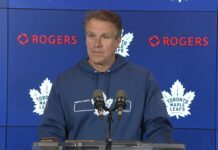










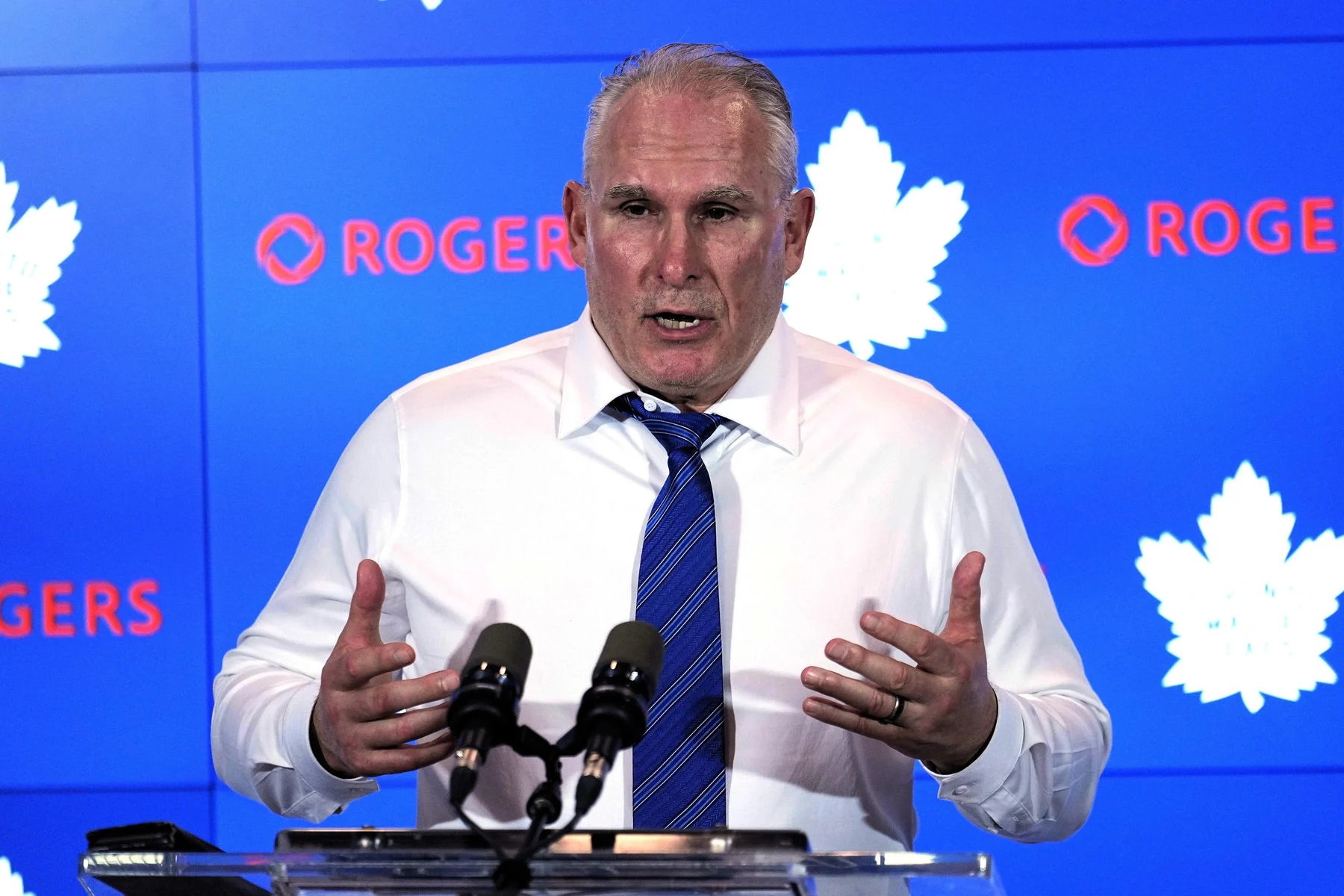
The Toronto Maple Leafs have officially relieved Craig Berube of his duties.
This was the only logical and appropriate step forward.
The Leafs entered the season with the vast majority of the hockey world viewing them as a playoff team, and they didn’t even come close to qualifying. They finished fifth last in the NHL and were the worst team in the league over their final 25 games (30% of the season).
Some of it was out of Berube’s control, as Chris Tanev played only 11 games, their top two goalies were injured or absent at various times, William Nylander played just 65 games, and Auston Matthews played 60. Those are significant injuries to all of their best players.
But the issues extended far deeper, and the product was largely a mess on and off the ice last season. The Leafs finished dead last in puck possession and 29th in expected goals. That can’t just be attributed to injuries. Even the year before, they were 29th in possession and 23rd in expected goals, and that was with a very good roster. They did win their division and a playoff series in 2024-25, but the style of play was unsustainable and showed zero signs of improvement in the last year.
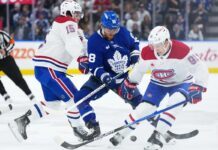
The team simply rarely possessed the puck, in part because they didn’t value it when they did have it. Players were dumping the puck in with obvious space in front of them to skate. They broke out off the glass repeatedly. They tried to go low to high in the offensive zone rather than working pucks to the slot (with passes) for scoring opportunities. The season before Berube arrived, the Leafs finished second in goals per game; in his first season, they dropped to seventh; and last season, they finished 16th.
Auston Matthews, in particular, produced two of his worst seasons under Berube, as he was deployed in some of the toughest minutes any center faced in the league. This past season, the same deployment strategy continued despite some feasible checking options in Scott Laughton and Nic Roy, and despite the loss of Mitch Marner. Berube decided to keep deploying Matthews — who was playing with the likes of Max Domi and Matias Maccelli — in all the difficult minutes. There’s no logic to square that decision.
The players who left the organization immediately improved elsewhere. Nicolas Roy has five points in eight playoff games and is seeing time up the lineup on the wing, which Berube never tried, despite the team completely lacking right shots on the flanks. Bobby McMann was one of the best goal scorers in the league after he was traded to Seattle (he heated up, which we all know he can do, but he played really well and received a ton of opportunity, too). Scott Laughton credibly 3C’d the Kings as they earned a playoff spot. Additionally, depth players Pontus Holmberg, Connor Dewar and even Conor Timmins — all Berube castoffs — found useful roles on playoff teams this season.
And then there were the off-ice matters. Anthony Stolarz called the team out just weeks into the season, Berube and Nylander had repeated blowups on the bench early on in the campaign, and when Nylander eventually broke an 11-game goalless drought, his body language was completely off. That might not be directly the result of a strained relationship with Berube, but this was the vibe around the team more often than not this season. When Stolarz eventually returned, Berube started him against Vegas, and when it went poorly, he was questioned as to why Stolarz didn’t start in the AHL first. Berube’s response: “That’s not my call.”
It was one of many bizarre public comments from the head coach that verged on calling out the team or others around him. The most notable example came when Berube called out the players’ brains and hearts, while also noting that the coaching staff gives them the rest of what they need to succeed (which they obviously didn’t come close to providing). In a roundabout way, it perfectly encapsulated Berube’s tenure: completely unaware of the issues, always barking up the wrong trees.
In the final stretch of the season, the team visibly shut it down and quit. Nobody is going to complain about it now that it resulted in the first-overall pick, but from a coaching standpoint, the idea of Berube walking into the room in September and telling many of those same core players what to do was, frankly, unfathomable to me. How could he look the players in the eye and lead them moving forward after the end of last season?
The team needed to clean the slate after last season. Firing the GM was obvious, and they’ve received a massive boost from first overall, but that’s not enough to hedge a decision to bring back a head coach who oversaw the mess. This had to be a thorough cleanse; the environment was awful last season, and a new voice and direction across the board were needed to turn the page.
This also quiets some of the other worrying storylines that have been percolating around this Berube decision. It is well-known that Keith Pelley liked Berube, and there were lots of rumours about the Leafs’ ownership not wanting to eat the remaining money on Berube’s contract. These concerns are completely dispelled now.
Many Toronto-based “insiders” have been speculating for weeks that Berube is likely staying. They did all of the speculating before John Chayka and Mats Sundin even met with Berube. The sides met over the weekend, and Berube was fired immediately.
Let this also be a note regarding Auston Matthews’ future. Those same insiders have been discussing Matthews’ intentions day in and day out, before he has even met with the team, too. We will see how it ultimately shakes out with Matthews, but they were completely wrong about Berube, and people are seemingly jumping to a lot of conclusions with zero concrete evidence or, frankly, credible reports at this point.
Further, there was a lot of chatter that management would want to speak to Matthews about Berube and that Matthews might have held Berube’s fate in his hands. Yet they’ve fired Berube before they even met with Matthews face-to-face.
Chayka noted, “This decision is more reflective of an organizational shift and an opportunity for a fresh start than it is an evaluation of Craig.” We try to avoid hyperbole in this space, but it would have been impossible to justify hiring a GM that Keith Pelley deems data-centric only to turn around and retain Berube. It’s a clear signal of a shift to a different organizational style.
When he was hired, Chayka also noted the “latent upside” within the current team. It’s a fair assessment — a lot of players underachieved — but in order to change that, a new coach and style-of-play shift were going to be necessary.
This was low-hanging fruit for the new GM, but to his credit, John Chayka didn’t wait around. He didn’t save the proverbial fire-the-head-coach bullet in his chamber. Couple that with winning the lottery, and there are some genuine reasons for optimism, which were sorely needed in this market. Today’s decision is nothing but a positive step forward.