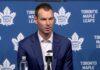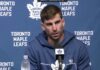










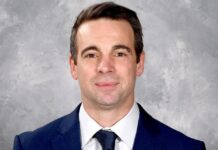











The Maple Leafs’ house cleaning continues. On Sunday, the club announced that AGMs Brandon Pridham and Derek Clancey will depart the organization.
— Toronto Maple Leafs (@MapleLeafs) May 17, 2026
These moves hardly come as a surprise. New GMs almost always clear out the old regime and bring in “their” guys.
A month and a half ago, we wrote about the Leafs’ management group and noted the following about the overall structure, as well as Clancey and Pridham:
In Tuesday’s press conference, Keith Pelley made a reference to the rest of the management group: “We currently have six assistant GMs. Is that the right structure? What is the right structure? It might come down after interviewing candidates and talking to people.”
The above count likely includes Shane Doan, who is technically listed as Special Advisor to the GM and was hired by Treliving. There is also AGM Derek Clancey, another Treliving hire, whom I couldn’t help but think of when Keith Pelley mentioned “data-driven” decisions. Clancey once told The Athletic:
Clancey: “Personally, I’m not a big analytics person. I look at a few things, but I don’t use it in its entirety.
I look at a few key factors when I’m looking at a player. I use that, compare it to how I think of a player and see if it correlates. The biggest fear is that I’m here and the analytics are in a totally different place, and you have to ask yourself: Why is it so different? That’s when you try to get to the middle, maybe I’m not seeing something, or maybe the analytics aren’t analyzing something. So you have to dive into it, and see why there’s a big difference.
I think all the information is good. Everyone uses it differently. Some staff members might use it more than I use it. But at the end of the day, it’s just about using all the information available to you. Maybe that’s a generic answer, but that’s the bottom line.”
It’s hard not to assume Pelley, who was in the Leafs‘ war room at the trade deadline, took note here.
… Brandon Pridham, the team’s salary cap and CBA expert since 2018, has been fine in the role, navigating the Leafs’ often-strained cap situation as they’ve chased Cups. From the outside looking in, he’s held up his end of the bargain.
That group of six has already been cut in half as Shane Doan has also departed the Leafs organization.
It is always difficult to know who you can assign specific decisions — or the lack thereof — to, but the reality is that this group, as a collective, felt like too many cooks in the kitchen. Last season crumbled in front of their eyes, and they largely sat on their hands while it happened. The only time they made moves as a front office came when the season was unequivocally over, and those trades left a lot to be desired. Three moves were essentially the bare minimum in terms of the team’s deadline activity.
The dysfunction ran much deeper recently, though. The Leafs acquired players they seemingly had no idea how to use — which may have been squarely on the coaching staff — from Scott Laughton to Matias Maccelli, to Dakota Joshua, to Nic Roy. Several players left the organization over the past few seasons and instantly improved notably elsewhere, including Pontus Holmberg, Connor Dewar, Conor Timmins, as well as Laughton and Roy. Again, it may have been (or probably was) primarily on the coaching staff, but top to bottom, the organization wasn’t functioning correctly — from pro scouting, to the Marlies’ development, to the NHL team running modern systems that place their players in position to succeed, to identifying talent correctly and acquiring it.
Clancey, in particular, has been with the team for just three seasons, and there isn’t much substance in the body of work in terms of acquisitions during that time. Anthony Stolarz was a hit, and Max Pacioretty was a great pickup on a cheap deal. OEL and Chris Tanev are both good players, but Brad Treliving was already tied to both. Otherwise, it’s mainly been misses or strange fits.
Pridham was one of the Leafs’ longest-tenured employees in their front office. He came from the league, where he helped to write the 2005 and 2013 CBAs. It should be noted that the NHL ratified its latest CBA in 2025 and, in doing so, closed many of the loopholes that Pridham would have helped craft over a decade earlier. They got rid of paper transactions to the AHL and deferred salary, which the Leafs did not leverage nearly enough in Pridham’s 12 years with the team. The Leafs also did not leverage playoff LTIR or front-loaded contracts. High signing-bonus structures have since been restricted, which, again, the Leafs did not use to their advantage as much as they could. All of their stars signed max deals at less than max term while topping up salary bonuses and contract structures.
The Leafs got creative at times, such as Martin Jones’ $100,000 bonus the day after the season started, helping sneak him through waivers. Pridham did bring value, but he’s also been with the team for a very long time. The Leafs failed to maximize some key areas during the window of the CBA he helped write, and now a new CBA is in place.
A few weeks ago, the Leafs were linked to Jake Goldberg, who Chayka hired in Arizona, as well as Chase Glasberg, who is the son of Neil Glaberg, whom the Leafs hired to help search for their new executives. Goldberg is the LA Kings Director of Hockey Operations, while Glasberg is currently Utah’s manager of salary cap and hockey strategy.
This was always going to be an offseason of change; the only question was really how deep it would go. Early indications are that more people at key positions are getting replaced than not, which is typically what happens after a season as disappointing as the Maple Leafs’ in 2025-26.