
















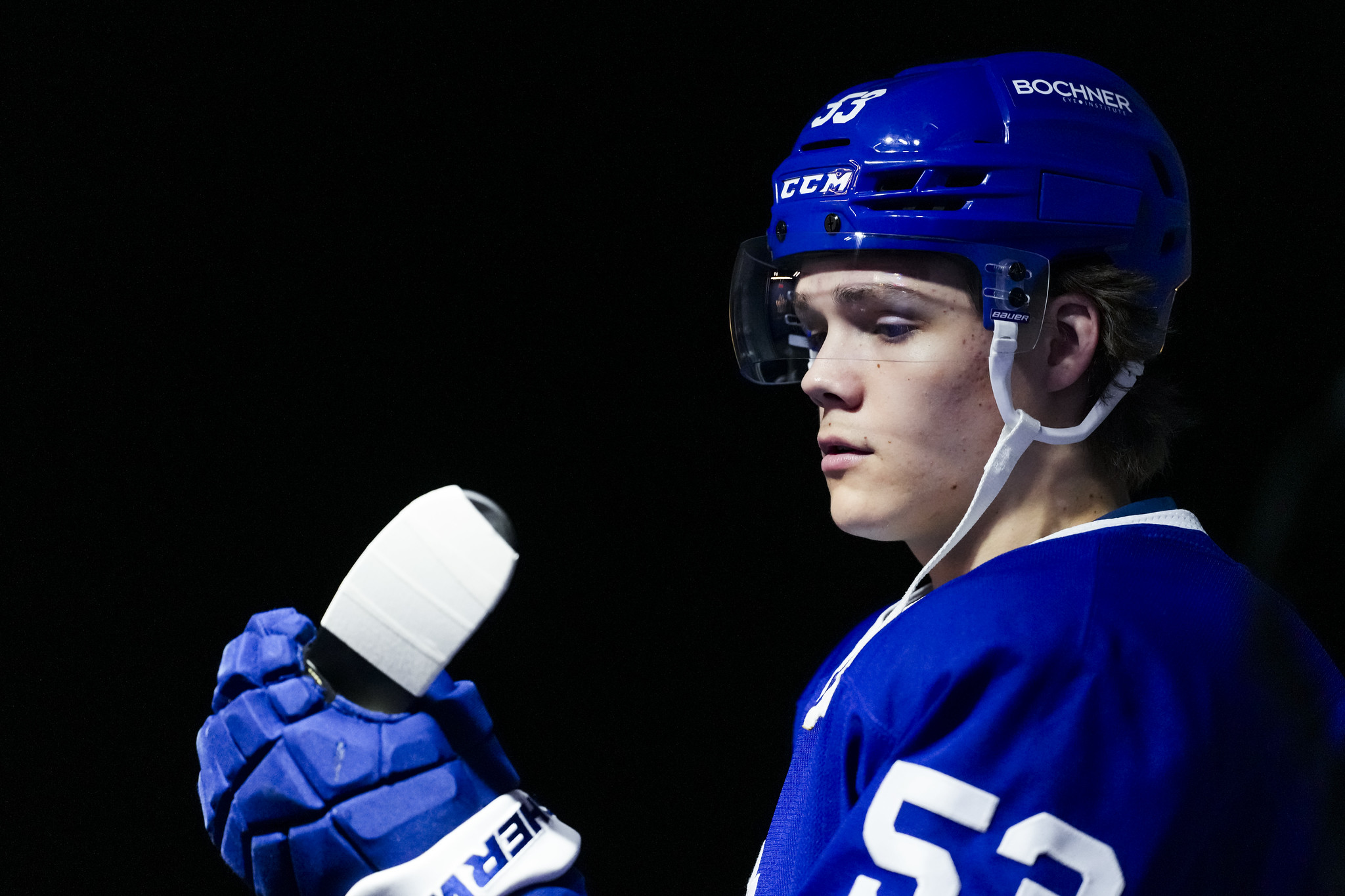
Easton Cowan’s first professional season was rarely straightforward.
He made the Maple Leafs out of training camp — even though he did not dress in the first two games — despite a perfectly reasonable argument that he belonged with the Marlies, where he could play big minutes in all situations. He bounced between the top six, the fourth line, and the press box. He went nearly an entire month without playing a game around the Olympic break despite being healthy. He finished the NHL season playing significant minutes, was sent down to the Marlies, committed a catastrophic mistake in the Eastern Conference Final, immediately redeemed himself, and ultimately lifted the Calder Cup after producing 18 points in 22 playoff games.
Quite the ride for a 20-year-old rookie.
The Leafs did not always put Cowan in the best position to develop, but by the end of the year, he had given them plenty of reason to believe he can become part of the long-term solution in Toronto. The questions entering 2026-27 specifically surround his possible role, his readiness for a potential top-six opportunity, and whether he can build on his late-season NHL traction and Calder Cup success.
A dubious development plan
Before the season, we repeatedly argued that Cowan should begin with the Marlies.
It wasn’t an indictment of the prospect. While he showed enough in preseason to reinforce optimism about his future, he wasn’t so dominant that bypassing the AHL entirely seemed like the obvious next step. The alternative offered obvious benefits: first-line minutes, a role on the top power play, penalty-killing opportunities, and the freedom to play through mistakes away from the nightly scrutiny surrounding the Leafs.
William Nylander scored 45 points in 38 AHL games before establishing himself in the NHL. There was zero shame in Cowan spending some time learning the professional game at that level.
Instead, the Leafs initially kept him in the NHL while frequently assigning him the type of role that made us wonder why he was there at all. A fourth-line assignment on his off-wing was not a better developmental opportunity than playing 20-plus minutes in every situation for the Marlies. Neither was sitting in the press box.
To Cowan’s credit, he earned better opportunities as the season progressed. There was an early glimpse alongside Auston Matthews and Matthew Knies, and his most encouraging stretch arrived after he was recalled in November — following two AHL appearances — and placed on the left wing with John Tavares and William Nylander.
Through his first seven games after the recall, Cowan recorded four points while averaging 18:03 per night. Rather than merely surviving on the line, he legitimately contributed to it with his forechecking, puck pursuit, and ability to make plays in traffic.
There were still rookie mistakes, particularly with turnovers on the defensive half-wall, but there were also examples of his hockey sense translating against NHL competition. On one goal against Columbus, Cowan subtly picked Zach Werenski to create additional time and space for Tavares below the goal line before finishing the play nicely himself. It was a small, intelligent detail from a player beginning to understand how he could complement high-end offensive linemates.
Cowan was helping make the line tick through his forechecking, tenacity, and skill. At that point, the argument for keeping him with the big club was much stronger; he was playing regularly, receiving top-six minutes, and producing.
Unfortunately, progress is rarely perfectly linear for any NHL rookie. Cowan’s ice time fell to 14:10 per game in December and only 11:35 in January. He spent long stretches playing around 10 or 11 minutes, including just 9:44 in Seattle on January 29. He didn’t play again until February 28.
That month-long layoff around the Olympics was one of the stranger developments in a season full of organizational dysfunction. The Leafs could have assigned Cowan to the Marlies before the Olympic roster freeze took effect on February 4, but once they kept him on the NHL roster past the deadline, he became ineligible for assignment during the break. Cowan had played in 17 of Toronto’s previous 20 games and spent more than 80 league days on the NHL roster, meeting both thresholds that protected waiver-exempt players from demotion during the freeze. Rather than planning ahead to preserve an opportunity for meaningful AHL minutes, the Leafs kept a healthy 20-year-old with the NHL team and effectively shut down his development for a month.
There is a difference between giving a young player the occasional reset and removing him from game action for three to four weeks. Cowan was not an established NHLer who needed to recharge for a playoff run. He was a work in progress who needed touches, repetitions, and opportunities to make and correct mistakes.
The situation again exposed an apparent disconnect between the general manager and head coach. Before opening night, Brad Treliving said of Cowan, “If he is going to be playing with us here, great. If he is not, I want him playing.” After the trade deadline, Treliving reiterated that Cowan would be “playing and playing a lot,” adding, “He needs to play at that age to continue to develop.”
Craig Berube did not always appear to share the same urgency throughout the year. Even after Cowan went nearly a month without game action, Berube argued that his development had not been hurt, pointed to the progress he had made over the course of the season, and suggested there was value in the practice time and education that came from remaining around the NHL team.
There is certainly something to be gained from practicing with NHL players and observing their on- and off-ice habits, but it cannot replace actually playing hockey games—particularly for a healthy 20-year-old still learning pro hockey.
Either management failed to give the coaching staff a clear developmental mandate, Berube disagreed with it, or the two simply weren’t communicating effectively. Whichever explanation applies, it was another example of the general incoherence and dysfunction surrounding the organization in 2025-26.
When Cowan finally returned against Ottawa, he looked exactly like a player who hadn’t played in a month. Again, that wasn’t on Cowan. The organization had put him in that position.
Gaining trust and traction down the stretch
The good news was that Cowan didn’t let the initially strange development plan derail his season, and the Leafs eventually turned him loose with the season all but over from a competitive standpoint.
He returned from the Olympic break to play only 13:34 against Ottawa and then a team-low 8:23 against Philadelphia. From there, though, his role began to grow. He averaged 16:03 in March and 19:13 over seven April games, including more than 20 minutes in three of his final four appearances.
The production also picked up. Cowan recorded seven points in 15 March games before adding five points in seven games in April. Over his final 22 games, he produced 12 points while gradually earning power-play time and a larger five-on-five role. He finished his rookie NHL season with a respectable 11 goals and 29 points in 66 games while averaging 14:43 in time on ice.
There was still the typical rookie inconsistency within that stretch. Cowan could follow a dynamic performance with a quieter one, and he remained prone to forcing a play that wasn’t available. His shot volume was also modest—92 shots in 66 games—and he will need to become more comfortable attacking the middle of the ice and creating his own scoring opportunities rather than primarily facilitating for others.
However, the encouraging part was how quickly he absorbed lessons. Cowan became more direct as the year progressed. He grew more comfortable moving pucks into space, getting in behind defenders, and using his motor to recover possession. He was increasingly able to distinguish between a situation where he could make a play and one where he needed to put the puck behind the defense and go to work on the forecheck.
That distinction became a major focus once he joined the Marlies after the Leafs’ season concluded. John Gruden — now on the Leafs’ bench as an assistant coach — noted that Cowan was learning “when to live to fight another day, when to make a play, and when to put it in and go forecheck.” It sounds basic, but it is one of the biggest adjustments for a talented junior player entering the professional game. The openings Cowan could exploit in London aren’t always available against NHL or even AHL defenders, and he had to learn that winning a shift didn’t always mean creating something with the puck.
He also showed some improvement in his work away from it. Reloading above the play, supporting the puck defensively, and becoming a more responsible F3 were all points of emphasis. In the Calder Cup Final, Gruden praised Cowan’s 200-foot detail and noted that he was at his best when he was skating, creating, and “not trying to do it himself.”
That is the balance Cowan will need to continue finding in 2026-27. His skill and creativity are important, but his motor, anticipation, forechecking, and willingness to compete are what can keep him playing reasonable NHL minutes even when the offense isn’t flowing.
Part of the character solution?
For all the concern surrounding the character and culture of the 2025-26 Maple Leafs, Cowan consistently appeared to be wired the right way.
He was on the ice when Radko Gudas ended Auston Matthews’ season with a knee-on-knee hit. Cowan and Nylander were the closest Leafs to the incident, with Morgan Rielly and Brandon Carlo also on the ice. There was no immediate response from anyone.
No reasonable observer would have expected the 20-year-old rookie to be the player responsible for confronting Gudas ahead of Carlo, Rielly, or Nylander. Even so, Cowan took the situation to heart. Later in the game, he dropped the gloves with Jackson LaCombe for his first NHL fight.
Cowan got the message during the intermission and was determined to show he could answer the bell. More importantly, it didn’t prove to be a one-off thing.
Less than two weeks later in Boston, Nikita Zadorov hit Tavares from behind, and Cowan immediately went after the 6’7 defenseman. Dakota Joshua eventually stepped in and handled the fight, but Cowan did not hesitate despite giving up seven inches and roughly 80 pounds.
“That’s a young kid going after a big man,” Berube said afterward. “He just has a lot of character, that kid.” The head coach specifically connected it to the response against Anaheim, noting that Cowan instinctively understood the importance of stepping in for a teammate.
As the season wound down, Cowan was increasingly eager to enter scrums and defend teammates after liberties were taken. He didn’t hang around asking an opponent for permission or waiting for someone else to handle it. He simply went.
Somehow, one of the youngest and smallest players on the team was among the few who seemed to get it.
That quality should not be confused with expecting Cowan to become a fighter. The Leafs do not need him accumulating fighting majors. They need more players who instinctively care when a teammate is wronged and are willing to enter uncomfortable situations for the group.
There were also plenty of indications that Cowan became a beloved member of the room. It wasn’t only what teammates said about him; it was how they said it. Veteran players would noticeably smile when asked about Cowan before talking up his personality, maturity, enthusiasm, and potential.
Tavares called him “such a great kid with such a great head on his shoulders.” Scott Laughton praised how well he handled the difficult transition from junior hockey, the travel, and his shifting roles. Gruden repeatedly referred to him as a gamer and a great teammate.
Cowan plays with a visible love for the game, and that is not an insignificant addition to a team that looked utterly joyless for significant stretches of last season.
Learning—and winning—with the Marlies
For all the questionable decisions surrounding Cowan’s development during the NHL season, the Leafs got one (albeit obvious/basic) call right at the deadline by making him eligible for the AHL playoffs.
Cowan had played 66 NHL games but experienced long stretches of limited ice time and sat out nearly all of February. The Calder Cup run provided a high-volume, high-stakes developmental environment.
It was not a flawless playoff performance by any means. At times, the long season appeared to catch up with him, and he missed two games in the Eastern Conference Final with an undisclosed injury. He also committed the most glaring mistake of the Marlies’ run.
With Game 4 against Wilkes-Barre/Scranton tied late in the third period, Cowan turned the puck over directly into his own slot, leading to the game-losing goal. He did not hide afterward or offer excuses:
I cost my team the game. I’ve got to be better, and I will be Friday.
In the next game, Cowan picked up the puck in the defensive zone, drove up the left wing, pulled a toe drag around Chase Pietila, and snapped home a nice goal that broke the Penguins’ spirit. The Marlies won to move within one victory of the Calder Cup Final.
It was accountability followed by action. In a season when the NHL club too often said the right things without backing them up, Cowan faced the music and responded at the first opportunity.
His play grew stronger as the postseason progressed. After returning from injury, he recorded five points in four games in the Eastern Conference Final and was often the most dangerous player on the ice. In Game 3 of the Calder Cup Final, he scored the only goal and took over the second period as the Marlies grabbed a 3-0 series lead. In the championship-clinching game, he produced three points.
Cowan finished the playoffs with eight goals and 18 points in 22 games. More importantly, he played major minutes on the power play, experienced difficult matchups, worked through costly errors without losing his ice time, delivered in elimination and championship situations, and became a professional hockey champion in his first year out of junior.
He has now won an OHL championship, a Memorial Cup, and a Calder Cup in consecutive seasons. Winning isn’t a transferable skill in a literal sense, but the habits formed in those environments—preparation, handling pressure, responding to adversity, and expecting to find a way through—can become repeatable and contagious.
Cowan arrived from junior with a reputation as a player who elevated his game in big moments. His first AHL playoff run was a good first step toward translating that to the next level.
Cowan’s 2026-27 NHL role
The Leafs made major changes in net and on defense this offseason, but they did not acquire a bona fide, veteran top-six forward. Most of their additions up front—Nick Paul, Jack Roslovic, Colton Sissons, Teddy Blueger, and Brandon Duhaime—either profile as middle-six support or bottom-six role players.
That leaves Cowan and Gavin McKenna as two tantalizing upside possibilities.
It is easy to envision Cowan alongside Tavares and Nylander again. Tavares can provide the steadying influence and middle-lane presence; Nylander can drive play with the puck and command defensive attention; Cowan can retrieve pucks, pressure defenders, and add a second puck-carrying/playmaking element.
It is also easy to envision further growing pains. Cowan produced 29 points as a rookie, and he has not yet proven he can consistently drive offense at the NHL level, while his defensive details remain a work in progress. The Leafs should not enter the season treating top-six production as a given by any stretch.
Ideally, Cowan earns the role rather than inheriting it because the organization didn’t add anyone else. If he pushes his way into the top six from camp onward, wonderful. If he settles onto a third line to start and gives it some puck-carrying and playmaking juice, that could also be a productive next step.
What the Leafs cannot repeat is last season’s muddled approach: keeping Cowan in the NHL while playing him in very limited minutes, scratching him for stretches, or moving him constantly between roles without a clear purpose.
Cowan is still learning, but he has shown himself to be a quick study. He improved as the season progressed, gained the coaching staff’s trust, responded to criticism and mistakes, earned larger minutes, and produced in high-pressure playoff hockey down in the AHL.
Whether he is fully ready to become a full-time top-six NHL forward as of 2026-27 remains an open question. What is much less debatable is that Cowan’s competitiveness, character, accountability, and ability to rise in big moments represent exactly the type of qualities the Maple Leafs need more of moving forward.