

















The Maple Leafs showed their offensive prowess and a refusal to go away in Utah, nearly erasing a three-goal third-period deficit, but another rough second period and some terrible goaltending left them with too much to overcome in a 5-4 loss.
I liked the Leafs’ pace, effort, and forechecking at times in the first period, but their puck play and decision-making were lacking at points, too. Some forced east-west passes in bad spots led to giveaways. They needed a little more directness and simplicity, but they had good legs early. The shots were 8-6 Toronto, and giveaways were 6-3 Toronto.
The lone first-period goal went to Utah and was an obvious error by Morgan Rielly, who only needed to play the most standard rush-defense against a fourth-line attacker but got absolutely skinned on the play. Anthony Stolarz also couldn’t have made himself much smaller on his near post.
It was tough to be 1-0 down after an evenly played opening period, but then the second-period blues continued in a big way for the Maple Leafs.
After a Kirill Marchenko botched a clearance for a turnover outside the defensive blue line, Jake McCabe took a stab at the puck by the line but neither got the puck nor took his man out of the play, creating a quick 3v2 down low and a backdoor tap-in for Vincent Trocheck.
The 3-0 Utah shorthanded goal was a maddening, wild sequence all around. The linesman was a hero on the faceoff drop, tossing out Jack Roslovic (a good faceoff taker who was taking the draw on his strong side); there was then a missed penalty on a slash on Roslovic off the draw, a pretty soft hooking call on Gavin McKenna, and a follow-through high-stick on Morgan Rielly, after which Roslovic stopped playing altogether to take his mouthguard out and yell at the ref. It led to a potential 2v1 rush against, but Easton Cowan’s hustle prevented it. Now in a 1v1 vs. Dylan Guenther, Blankenburg blocked the initial shot, but Roslovic didn’t help out Blankenburg by picking up Mikhail Sergachev jumping in.
The Leafs’ top power-play unit managed to cancel it out with a bouncing-puck play off an entry, which John Tavares and Auston Matthews took advantage of nicely.
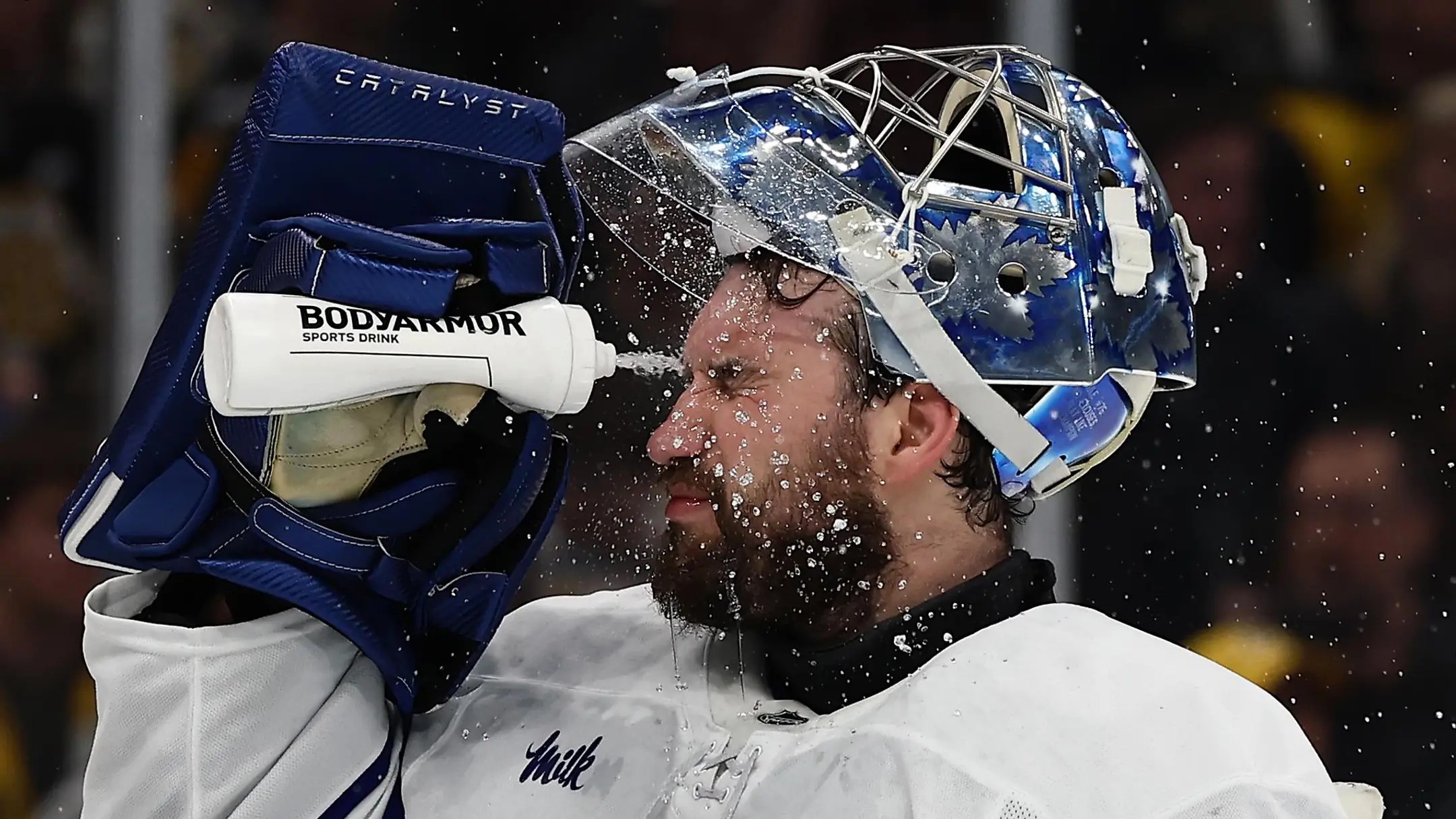
Then came a truly terrible goal past Stolarz to make it 4-1, one that was squarely on the netminder; it was probably going wide before Stolarz intervened with his blocker and helped it into the net. Dylan Guenther felt sheepish about even celebrating.
Two minutes later, the top line got one back at five-on-five. Kirill Marchenko did a good job lugging the puck down the ice and setting the offensive zone. The Leafs worked the cycle, Matthews got the puck to the net front, and Marchenko battled there before Jack Roslovic finished it off to make it 4-2.
In the final minute of the second period, another weak goal past Stolarz made it 5-2 and appeared to kill any hope of a Leaf comeback. As much as Stolarz simply has to stop a puck here, Matthews let up on the backcheck down the ice, giving MacKenzie Weegar time to walk in while the three Leafs down low were tied up with their checks. It was yet another goal against the Leafs just seconds after an offensive-zone faceoff, and it came in the final minute of the period, to boot. That goal proved to be the backbreaker, ultimately, and it felt like it at the time.
Utah opened the third period with a 6-0 advantage in shot attempts, as it looked like the Leafs might’ve been done with the game/road trip in the opening passages. But a Vincent Trocheck offensive-zone penalty gave them an opening. The power play started poorly, but John Tavares ripped one short-side top corner off the rush after Stolarz caught Utah in the middle of a change with a quick-up to the far blue line.
Suddenly, it was somewhat game on at 5-3, though Colton Sissons immediately turned it over in the neutral zone, followed by a dumb penalty from Oliver Ekman-Larsson. Still, the PK came through, and William Nylander nearly made things even more interesting on a shorthanded breakaway. He turned the corner and tried to go back against the grain, but Karel Vejmelka stopped him with a good shoulder save.
The Leafs again weren’t done, though. On a delayed penalty, John Tavares made a composed play on the entry, followed by a nice pass from Darren Raddysh to Nylander in the middle of the offensive zone. Nylander drew in a few defenders and the goalie before finding Gavin McKenna backdoor to make it 5-4 with his second NHL goal and fifth point through seven games.
4 GAME POINT STREAK FOR MCKENNA
HE MAKES IT A ONE GOAL GAME pic.twitter.com/s1oPM3PL9c
— Maple Leafs Hotstove (@LeafsNews) October 14, 2026
Utah had led 3-0, 4-1, and 5-2 leads at various points, but the Leafs’ top six wasn’t going away and could have tied it multiple times down the stretch. At five-on-five, Marchenko produced some really nice work to create a chance that ended with Jack Roslovic hitting the post. Matthews danced around Guenther and drew a penalty to give the Leafs a late 6-on-4 opportunity, where Marchenko produced another dangerous drive.
Tavares, after setting up a power-play goal and scoring one of his own to keep the Leafs in it, dug in and won multiple important late faceoffs against one of the league’s top faceoff men, Vincent Trocheck. A Matthews bobble appeared to end the Leafs’ push, but not before one last reload and grade-A look. At the final whistle, Marchenko mishandled a great Nylander feed with the net at his mercy — a tough ending for Marchenko, given how well he’d played later in the game.
Three of six points is by no means a disaster from the hardest three-game road swing in the league, but it also felt like at least four were on the table, given the lead they had in Vegas, and this was a disappointing overall performance to cap it off.
Post-Game Notes
- No question, the Leafs are faster, more dynamic, and more talented offensively this season. Teams that are generally stingy defensively struggle to contain their top six, shut down a game on them, or put them away. Even in a potential blowout game tonight, they still lost by just one goal, like their other three losses this season. In a game with competent goaltending from Anthony Stolarz, they’d have outscored their problems tonight. But the second period wasn’t serious hockey from them, yet again.
- Colour no one surprised, but the Leafs’ defense was clearly immediately in something of a crisis without Chris Tanev. Hopefully, his absence isn’t long-term (although who won’t be waiting for the next shoe to drop if it isn’t)? Among their top six, only really Troy Stecher played a commendable game through 40 minutes (7D Marshall Rifai barely broke nine minutes and had one tough giveaway, but he otherwise got by fine in tough circumstances). They’re clearly lacking enough quality/talent back there — there were plenty of unforced errors tonight — but that’s also usually a sign the overall five-man structure isn’t where it needs to be to protect the D.
- The second-period problems became a major theme on this road trip. The Leafs have been getting pummeled in the middle frame, unable to break out cleanly and punished regularly for a wide-open neutral zone. The second periods against Vegas, Colorado, and Utah have all featured stretches of truly junky hockey. Five-on-five shot attempts were 61-25 for the opposition in the combined middle frames of the three games. You could definitely argue the Leafs left points on the table on this trip, but on the other hand, if those awful second periods had gone worse from a goals perspective (only 5-3 for the opposition), which they easily could’ve, it could have been a one- or two-point trip, too. Curiously, Jim Hiller hasn’t used his timeouts in any of those situations.
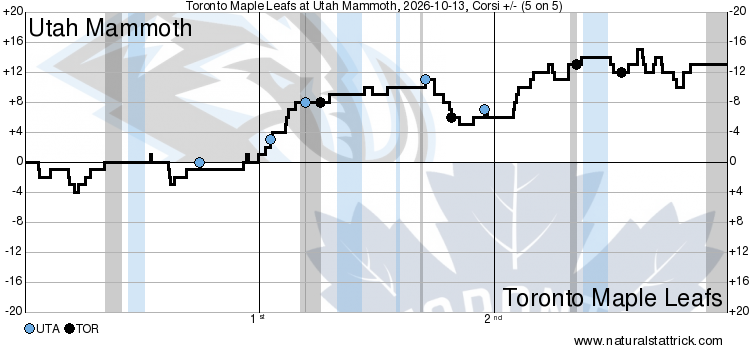
- Serious teams don’t get completely dominated in the long-change period like that, even in tough road buildings, and the Leafs need to get serious quickly back at home. This pattern where they get handily out-possessed (Utah was at 60+% in shot attempts in the second and third, 52% in the first) and also outhit over the game is also a little troublesome; in addition to better structure and puck management, they need more physical pushback in those segments to try to regain the momentum.
- It shows as a tough night on the scoresheet — zero points, minus-three, and he didn’t factor into the 6-on-4 at the end — but Easton Cowan deserves a shoutout for his third period. He clearly wasn’t going away quietly, both at five-on-five and on the PK, and the lack of quit was contagious.
- Painful bobble at the end aside, Kirill Marchenko roaring to life in the second half of this game was encouraging. The magic of Matthews and Marchenko’s first game together hasn’t been as readily apparent for a good string of games now, but Jim Hiller has remained patient with it, despite moving away from it multiple times mid-game. The top line scored the Leafs’ only five-on-five goal in the game, and shot attempts were 13-1 in their favour.
- On the total flip side, the McKenna-Paul-Sissons line was out-attempted 12-0 in six minutes of five-on-five. To me, it made more sense to insert John Tavares next to Gavin McKenna and Colton Sissons and run Easton Cowan, Nick Paul, and William Nylander to start the game, with plenty of flexibility to move things around situationally. It’s actually surprising McKenna-Paul-Sissons managed to play over six minutes together at five-on-five given the run of play, the nine penalties, and Hiller’s 11/7 line blender.
- Within the 11/7 flexibility, I liked a few of the fourth-line shifts with Colton Sissons alongside Brandon Duhaime and Teddy Blueger early in this game. Duhaime benefited from having another winger with good speed and physicality to work off in Sissons. As discussed throughout the offseason, Duhaime-Blueger-Sissons would probably be the ideal fourth-line combination at the end of the day. With Sissons needed higher in the lineup right now, though, the speed and physicality of a Miles Wood is worth a look alongside Duhaime and Blueger when the Leafs return to a 12-forward, six-defenseman setup. Eventually, Dakoa Joshua might be an option here, too.
- The Leafs’ PK helped them hang around and make sure this wasn’t a total laugher, keeping a red-hot Utah power play off the board over four opportunities. The numbers for the PK units are interesting so far: They’ve only allowed one goal on 24 kills, but they’re also fourth-worst in shot attempts against per 60 and seventh-worst in expected goals against per 60. They’re getting in lanes well (a particular nod to Troy Stecher there tonight) and staying compact and structured as a unit, which is preventing the killer seam plays, but they also need to win more faceoffs (just 37.8% so far!) and stiffen up on the entries a little more to spend less time in the zone overall, as that is driving a lot of those underlying metrics. It can be a bit of a double-edged sword when you’re leaving games thinking, “The opposing PP spent a lot of time in the zone working it around, but the Leafs’ PK held firm.” A great start from John Gruden’s units, but one not to get complacent about, either.
- It was an all-around particularly frustrating game from an officiating standpoint, both for the referees and linesmen. The penalty calls were often incoherent and very inconsistent, and the linesmen were brutal on icing calls and faceoffs.
Game Flow: 5v5 Shot Attempts
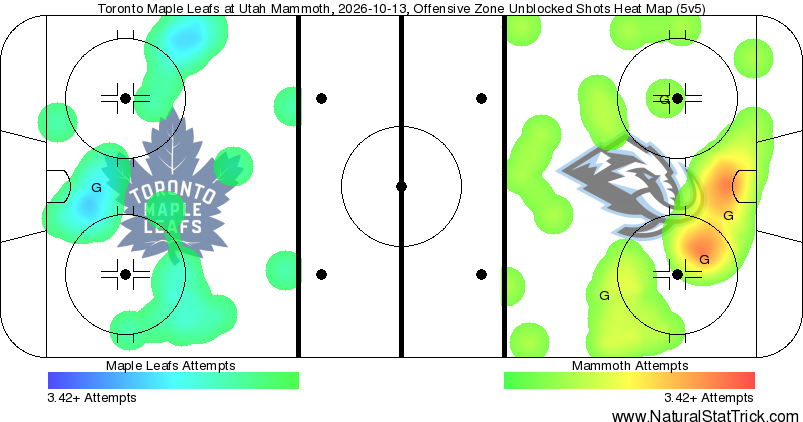
Heat Map: 5v5 Shot Attempts