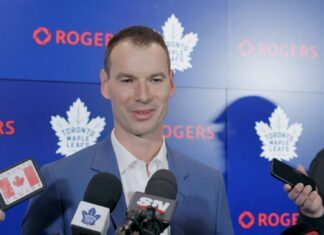













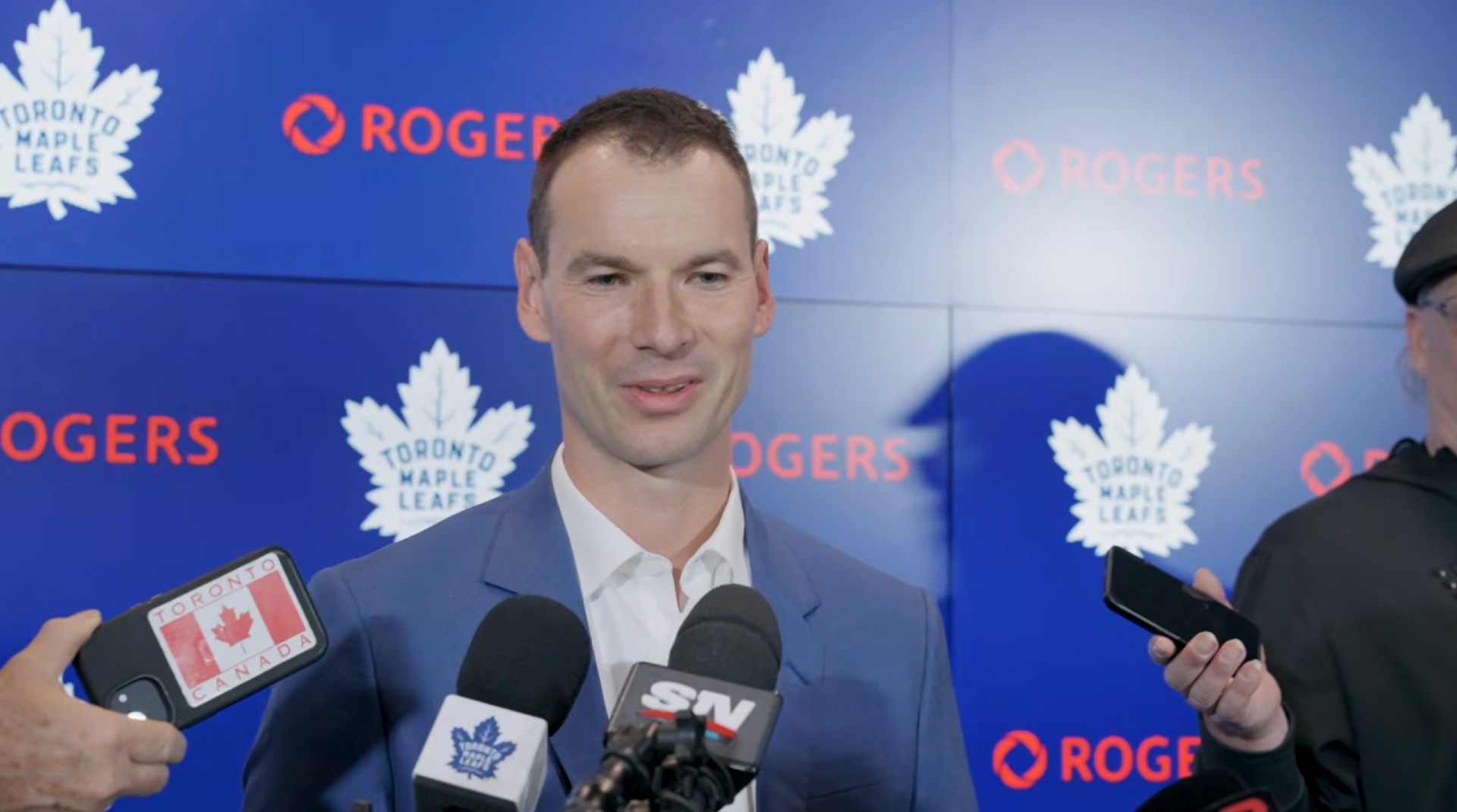
General Manager John Chayka spoke to the media ahead of the season opener about the team’s expectations this season, Gavin McKenna’s first camp, Auston Matthews’ physical condition, the injury outlook for Max Domi and Dakota Joshua, and the workload plan for Sergei Bobrovsky and Anthony Stolarz in net.
You ask the players about their nerves or expectations. What are yours on the dawn of the season?
Chayka: Hopefully no nerves yet for anybody. But no, it’s an exciting time. Anytime you start a season, guys are looking forward. They’ve worked hard through camp. I think we’ve had a good camp so far. A lot of new faces. I think it’s more excitement than nerves.
What are your expectations for what the team can accomplish this year?
Chayka: I think it’s the Toronto Maple Leafs. Expectations are high; they should be. We’re certainly not asking anybody to lower their standards. I think we’ve got a good group. As I said, a bit of the uncertainty is that you’ve got a lot of new faces coming together. We think if we can get some chemistry and get everybody on the same page—it’s a difficult schedule early as well—and if we can get acclimated and get in a good spot through November, we should have a good season.
What did you see from Auston Matthews through camp? Obviously, it was a long summer for him.
Chayka: I thought he looked great. Coming in, he’s lighter, he’s leaner. I think he worked with some of the best people in the world on his rehab and then through his training, and I think that paid dividends for him. All of our internal skating data suggests this is the best he’s skated over the last five years. He looks good, looks healthy, and looks like he’s in good spirits. From our side, he’s been nothing short of a perfect captain, and I expect that when the puck drops.
What are your expectations for Gavin McKenna?
Chayka: He had a good camp and looked good in the preseason. We all know it ramps up in the regular season, but he’s a first overall pick for a reason. I think he showed a lot of those glimpses as to why. At the same time, he’s an 18-year-old kid, and there are going to be ups and downs. We just hope we can support him through that and put him in a spot where, both in the short term and the long term, he’s an important part of the Toronto Maple Leafs. But he’s done and delivered on everything so far that we could have expected.
As for Max Domi and Dakota Joshua, what may be happening with them later today?
Chayka: Same spot. Max is out long term. At the right time, he’ll address that. Dakota has had a lingering issue throughout the offseason. We thought it was in a good spot, ramped up through training camp, but it didn’t respond as well. I think he’s worked his butt off, and the staff’s done everything they can. You can call it week to week, but he’s out longer term still. It’s not anything in the short term that we’re expecting him back, but we do expect that he’ll continue to recover and get ready to play.
It was a bit of a quiet camp for Matthew Knies. What’s your sense of him going into the season, and is there any concern that the trade talk around him might weigh on him mentally?
Chayka: I don’t know that it was a quiet camp. I thought he skated well. I don’t think a player like that is really meant for practices or non-peak games. But certainly, when the lights come on, he’s playing his game hard: north-south, around the net, physical, gritty. He’s a good player. I think, like any player in our lineup, there are a lot of new faces and new linemates, new coaches, a new system. They’re all trying to figure out a little bit of chemistry through all of that, but overall, I think he’s shown well.
Once you get the roster in tonight, how much are you looking forward to having these guys get together, put the trade rumors behind them, and get down to business?
Chayka: I don’t know if the trade rumours will ever stop around here, but yeah, just let them go play. We think a connected team is a dangerous team. Again, a lot of new faces. That’s a bit of the uncertainty: How do we get these guys together and be a team as fast as possible? We try to do everything we can to help facilitate that. But that’s a little bit of the secret sauce of the NHL. There are a lot of great teams out there and a lot of talented teams. Coming together and playing for each other is a big part of what we’re trying to accomplish.
Is there an ideal number of starts for Bobrovsky?
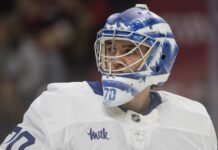
Chayka: I think we’ve actually thought about it less as a number of starts and more about some of the context around those starts. We’ve got a pretty good plan with the coaches, with the goalie coaches, and with Bob himself, trying to put him and Stolie in positions to have success. It tells you the kind of guy he is: When we talk to him about his plan and his schedule, he says, “It’s important to me that we’re putting Anthony Stolarz in a position to have success too, and we’re thoughtful of his game.” I’ve never heard a starting goalie think about that. It just shows you where his mindset is at.
Is there anything else you’ve learned about Bobrovsky that you maybe didn’t know before?
Chayka: He’s just a really unique guy. You do the diligence in the background and have the conversations, but it’s his day-to-day commitment to excellence. You can talk about it and read books about it, but until you see someone who’s been to the top of the mountain, and someone who obviously has a lot of detail and dedication to his game—to see it live every day is pretty special. I’d just say the joy he brings to his work is the most notable. There are a lot of guys who have a regimented lifestyle or are detail-oriented, but to have the amount of joy that he has as he does his work, I think it’s a good thing for all our guys to see, both young and old. I think it tells a lot of his story.
What did you see in Bo Groulx that showed he deserved that extra forward spot?
Chayka: I think it’s his body of work. Bo obviously had a good season last season. He came up; I thought he played well throughout the playoffs. I thought he was a key member of that team. We’re blessed with a lot of good depth. Credit to Ryan Hardy, John Gruden, and really the leadership group down there. I thought that group skated and competed just like the NHL group, and they’ve got a culture and a dedication and mindset just like that group. There are a number of guys in the system we feel completely comfortable with playing NHL games. Bo, at this time, is going to get a sample size, hopefully, to show what he can do. But it’s hard-earned. Happy for him.
You’ve got eight defensemen. Typically, you only play six, sometimes seven. How are you going to get those guys involved?
Chayka: I’ve never had an NHL head coach say we have too many good-quality defensemen. Anytime we got a chance to get a defenseman we thought could skate, move the puck, defend, join the rush, and facilitate offense, we wanted to get as many of those guys as we could. It’s more circumstantial and what was available. Whether it’s through injuries or performance or different variables, these things seem to sort themselves out. We’re happy we’re not in the other position, looking for guys.