


















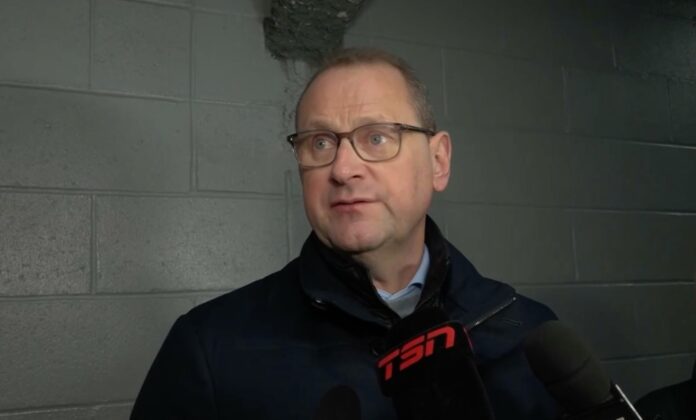
After the trade deadline, Maple Leafs GM Brad Treliving joined TSN Overdrive to discuss his deadline moves, the team’s failures this season, the decision to keep Craig Berube behind the bench, and Auston Matthews’ scoring slump.
You spoke about the market dictating the returns. How would you describe your deadline, based on what you were hoping to accomplish going in?
Treliving: Well, we were hoping to garner more young assets. We put a plan in place, leading up to the Olympic break. As you do every year, there is a lot of communication with the teams, trying to get a sense of what they’re doing, and making sure they’re clear on what your direction and plans are for the things you want to accomplish. Our goal going in was to be as active as we could to regain as many young assets as we possibly could.
Ultimately, you need to have an interest level, to whatever extent, in your players. At the end of the day, the market dictates what teams want, what they need, and ultimately, what they are prepared to pay.
Could you feel, leading up to the deadline, that it was a “changing” market, as far as assets on the market and the teams were in sell mode?
Treliving: At this time of year, it is always about expecting the unexpected. But we had a pretty good idea coming in. There were certainly some teams that were going to wait and see how they came out of the break in terms of where they would be. They might not necessarily be in a full sell or buy mode, but they may do a little bit less.
We felt pretty comfortable that there would be a lot of players on the market. At the end of the day, it still comes down to what their needs are and what they’re prepared to pay. There wasn’t the need or requirement for a lot of teams to retain money or move money. Obviously, there were some rule changes with the double retention process, but there was more money in the system. For those teams that were acquiring players, there was more cap space available than there normally was.
Those are all the types of things we were looking to accomplish, but in short order, I would probably say there were more players in the market than even going back a year ago or in recent years. It always comes down to fit, right? You have a certain player you’re looking to move or have an interest in moving, and a team needs to have a fit and a value for that player to make a deal.
You were also keeping Oliver Ekman-Larsson out of the lineup the past few games. You did not trade him. What was your message to Oliver in terms of his standing in the organization moving forward?
Treliving: I spoke to all three players prior to them sitting out. With Bobby and Scott being UFAs, and some of the interest level from teams indicating they would have interest and would stay in communication over the next 48 hours, we felt it was prudent to keep them out and not risk injury.
It was similar with Oliver. There had been some interest in Oliver. I spoke to him and told him I would keep him apprised if something became available. I just felt that, with some of the conversations that happened prior to, it made sense for him to sit out. All three of them understood.
Does this mean OEL is a Leaf for the next two years? How does it affect your plans with him?
Treliving: Well, it doesn’t affect anything. Oliver is a pro. All of these players are pros. They understand this is part of the business. I spoke to him after the deadline, and I said there wasn’t a deal that took place. I am not going to comment on any player about how long they will be here. He understood fully. The deadline passed, and he remains with us. We move forward.
There are still 19 games to play, and you mentioned you would get to a full synopsis of what happened this season in six weeks or so. Is there a best-case scenario for you in the final 19 games? If you map it out, what is the best-case scenario for your team?
Treliving: It is tough. We’ve underperformed. I said it earlier: I take full responsibility for it. We all own it, whether it is management, coaches, or players. We all share responsibility together. Now, we have 19 games to play. The deadline is behind us. We’re professionals.
Sometimes, you are not where you want to be in whatever walk of life or whatever job you’re in. We are not sitting where we felt we were going to be or wanted to be. But you have to go out there and be professionals.
You watch when things are great. You watch when things are poor. We continue to watch, and we’ll see how people react. I expect we will go out, compete, be professionals, and do the jobs we’re paid to do.
Is it more on the players or the coach to establish that professionalism in the final 19 games?
Treliving: It is on all of us — coaches, players, all of us. We have a job to do. That doesn’t change. The expectation is that it falls on all of us. As I said, we are where we are. You deal with it, and you move forward.
You came out of the break 0-4-2. Did you get the sense that the team was just waiting for a shoe to drop? After the deadline, this is the team, outside of call-ups and so on. Is there a calmness or a different mentality now? Is it on the coach and leadership group to say, “Hey, we need more from this group in the last 19 games.”
Treliving: Well, sure. We haven’t been nearly good enough coming out of the break. You keep a pulse on your team. When we went through that week and a week-and-a-half of practice, I thought we were prepared. I thought we had energy. I thought there was excitement in our group.
Listen, results speak for themselves. There is a realization that you are a professional and are expected to perform like one. I understand, and I don’t say it as an excuse, but the players felt the position we were in. A lot of the guys are going through this for the first time at a deadline. We sat where we sat, and it’s not where this team has sat before. For the last eight or nine years, you’re trying to add.
There is a heaviness to it, no matter how professional you try to be. There is a weight to it. With the deadline coming up, there is a lot of unknown about where they’re going to be. There is a human element. I get all of that. But that is the job we signed up for. It comes with a lot of great things, and it comes with some things we have to deal with.
Those things are behind us now. This is our group. We anticipate that there will be some players we want to take a look at from the Marlies, but we have to go out and do our jobs.
You were asked about Craig Berube’s status today. Why do you think Craig is the right guy to wrap up the season behind the bench?
Treliving: I think Craig is a good coach. It hasn’t gone well. There is a lot of criticism — and rightly so — for the manager. There is a lot of criticism for all of us. We all get evaluated at the end of the season.
There are things that all of us will look back on — players, managers, coaches included — that we could’ve done better and should’ve done better. That autopsy will occur, but at this particular time, Craig is going to be the coach and remain the coach. At the appropriate time, we will all sit down and talk about ways to improve and do a better job.
Auston Matthews hasn’t scored in 10 games. He has one goal in his last 14. Where do you stand on his play? What gives you the faith that the statistical numbers Auston is posting this season are an outlier, and he can return to the player he was a couple of years ago?
Treliving: A lot of attention gets paid to the production, and rightly so. I understand that. I think Auston does a lot more than just score, but he is, in my mind, one of — if not the — most prolific goal-scorers of his era. Sometimes, it hasn’t gone in for him. There is a responsibility on me and the team to get players around him to assist him.
That is my responsibility. That is the team’s responsibility, to help him. He has gone through a tough stretch. He is getting lots of chances. If a few more pucks go in, no one is talking about the production.
I get it. He is the captain of our team. He is the face of our franchise. He is one of the top players in the league. He gets the attention he gets. But I don’t think he gets enough attention for all of the other things he does.
A big part of what Auston does — and has done better than most in the league — is score goals. It hasn’t gone in for him recently. He knows it. He wants it to go in. He wants them to go in. He wants to be productive. But it is also on us to help him and get players and a cast around him to assist him. That is how I look at it.
I have all the faith in the world — and no hesitation in thinking — Auston will be an elite player moving forward. He is just, in my opinion, entering the prime of his career. He is the leader of the team. We saw it on the world stage in the Olympics. Auston is a top player.
Players go through slumps. Players go through times when it is not going in the net. We continue to work with him. More so, we have to continue to find ways to support him and get players around him who can help him.
It feels like 35-40% of the league has some sort of trade protection. It is a constant conversation around the league. What is your stance on players with no-movement and no-trade clauses, and possibly making it uncomfortable — if need be — should you feel you should move on from that player, even though they have the clause in their contract?
Treliving: Any player with a no-trade or any type of trade protection has been negotiated. It has been signed off on by the team and players. It is a negotiated right. I don’t fault any player for any trade protection or anything in that light.
Having said that, I told my players… I’ll use Oliver as an example. I have a really good relationship with Oliver. He has trade protection; he knows it, and I know it. If there is something that comes up, it doesn’t prevent us from going to him and talking to him about it. Ultimately, they have a decision to make on that.
We didn’t have any discussions with players among those with protection, but that is their right. When those are handed out and signed off on, that is the negotiated right for the player. I fully understand that. It is hard to give a player a no-trade and then bitch about it.
It also doesn’t prevent teams from going to players if something comes up that they feel is beneficial to the team, to at least have a discussion with the player about it.