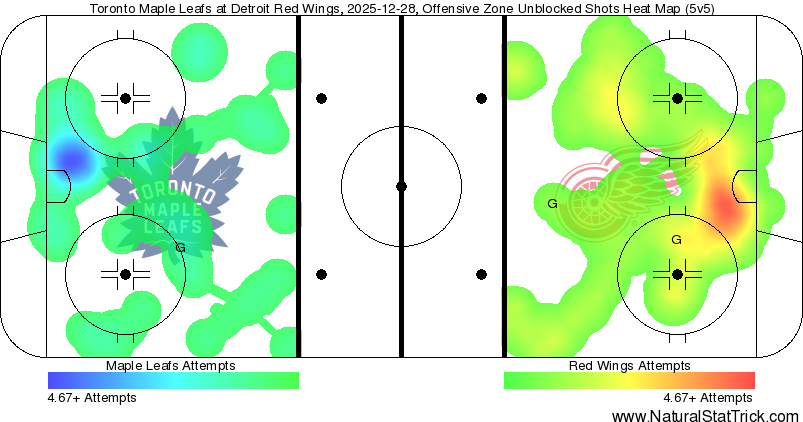






















While the Red Wings were hanging around only down 1-0, you had to feel good about the Maple Leafs’ play through 35 minutes of this game.
After a bit of a jittery first minute or two, the Leafs were mostly breaking out well at five-on-five, using the middle of the ice more and going off the wall less, as they’ve done a better job of in the last handful of games. They generated extended offensive-zone shifts, particularly via their Dakota Joshua-Nic Roy-Nick Robertson line, and held a notable advantage in offensive-zone time and a lead in high-danger scoring chances. Their power play looked more fluid and dynamic, with Auston Matthews taking charge of his unit on both power-play opportunities in the second period. They scored one power play goal via Matthew Knies on their first opportunity — set up by Matthews — and could’ve scored another on their second chance, with Matthews firing four shot attempts during the second Red Wing penalty.
Coming off the second power play, the Roy line generated a good offensive-zone shift, and Matthews nearly scored on a sort of Ovechkin-goal-vs-Phoenix-like attempt that would’ve qualified for the Mount Rushmore of memorable Matthews goals if Cam Talbot hadn’t come up with the save. They needed some insurance, but the game felt in a good spot from the Toronto perspective.
Yet to lose two in a row in December, Detroit seemed to find another level in the urgency and pace of their game late in the second period, and the Leafs didn’t really match it for the rest of the night. The game flow chart tells the story accurately:
 The Leafs spent most of the final five minutes of the middle frame in their own end, leading to the tying goal. A couple of limp-wristed plays on the puck in his own end by Max Domi — one directly preceding the 1-1 Moritz Seider tally — weren’t the lone offenders, as all four lines got in on the act of turning pucks over and struggling to break the Red Wing cycle. A goal with a minute left in the period erased all the good work the Leafs pieced together in the opening 35 minutes.
The Red Wings then generated nine high-danger chances in the third period at five-on-five, seven more than their first two periods combined. The Leafs held the lead (very) briefly, courtesy of a Nick Robertson one-time bomb on a sequence where a tired John Tavares did a great job of refusing to quit on the shift, setting up a quick-strike goal five minutes into the final frame.
Robertson 8th of the Season vs Red Wings
🔊 @Bonsie1951 @Jim_Ralph pic.twitter.com/QYkJ5D4ojP
— Maple Leafs Hotstove (@LeafsNews) December 29, 2025
The Roy line initially built on the Leafs’ 2-1 goal with some offensive-zone pressure, but when the puck transitioned the other way, OEL got caught in a weird play where an attempted chip-in behind OEL by Michael Rasmussen got caught up in OEL’s midsection. OEL lost the battle/was less alert than Rasmussen when the puck landed on the ice, sending Mason Appleton in on a partial break where he beat Dennis Hildeby shortside, just 23 seconds after the Leafs took the lead.
It was a tough game to evaluate from Hildeby — good overall, but he probably should have come up with this one, and then he shared the blame to some extent in OT. Hildeby had the right idea to play the puck to Matthews, but he had more time than he thought and needed to stay on his feet/take a stride out to play it instead of diving and half-whiffing on the puck.
HILDEBY LOBS UP A PIZZA AND EDVINSSON FINISHES THE GAME! pic.twitter.com/yni6zdLL7g
— Spittin' Chiclets (@spittinchiclets) December 29, 2025
This was a tough point to drop from the Leafs’ perspective, but they couldn’t feel too hard done by after their play in the final 25 minutes.
Post-Game Notes
– Thought the Leafs were fairly generous in their post-game descriptions of this performance. Matthew Knies called it a “great game,” and Berube called it a good performance outside of the final five minutes of the second period, which was kind to their final 25. They were the better team in the first half of the game and deserved a 1-0 lead, but they lost steam, finishing the second period terribly and reverting to some sloppy puck play, and they’ve now played subpar third periods two games in a row. In general, they’ve recently struggled to manage the key swing shifts —those big moments within games where their details need to be sharper—immediately after goals and when opening and closing periods. Between the Pittsburgh, Ottawa, and Detroit games, there have been a lot of goals against at the end of periods, at the very start of periods, and the shifts immediately after the Leafs scored a goal.
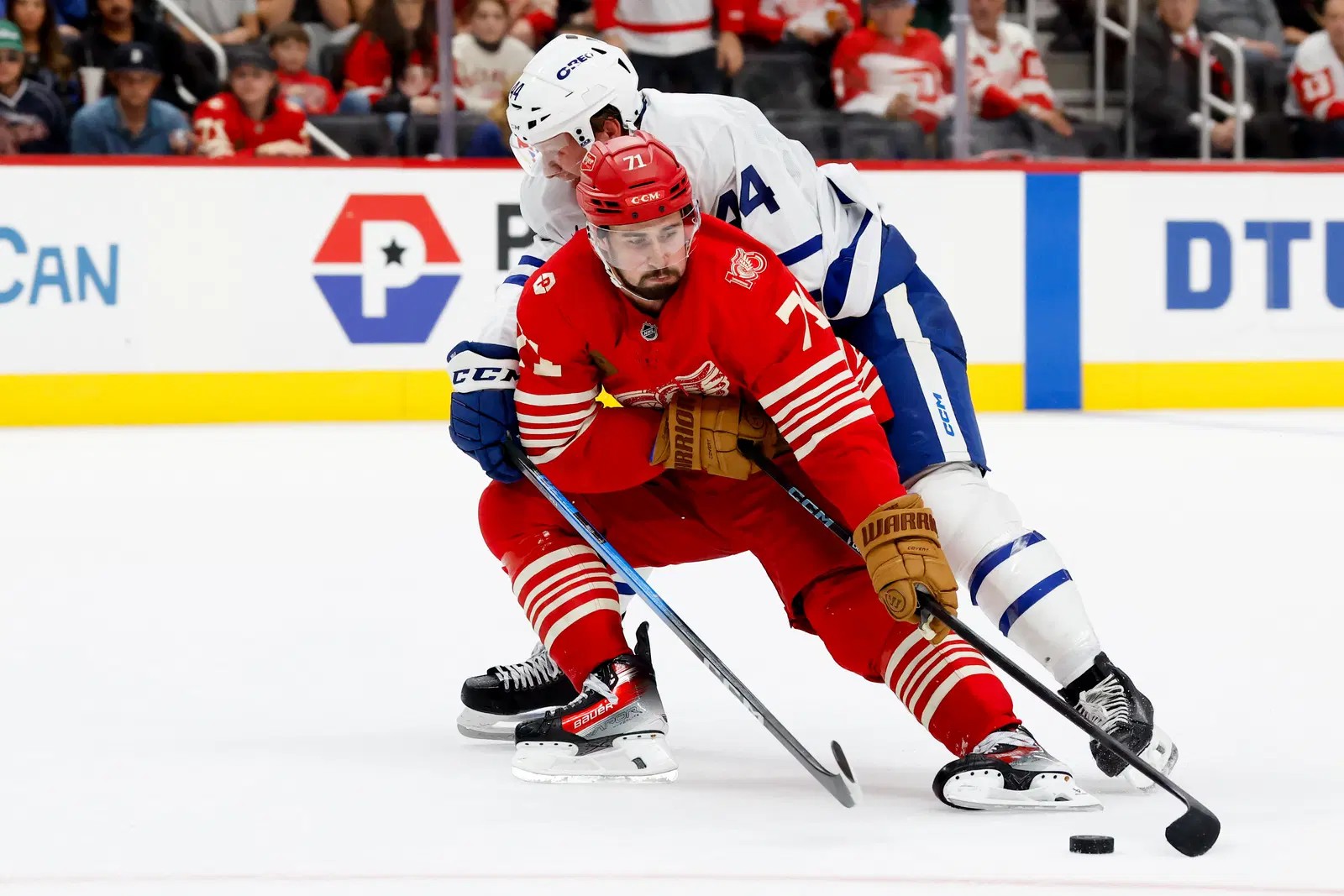
– Absolutely ridiculous that Bobby McMann took the extra call after the third-period net-front melee. The refs, per the official boxscore, picked out a mysterious holding-the-stick penalty for McMann on Moritz Seider just before the scrum broke out. Despite Seider, Simon Edvinsson, and Cam Talbot (who threw a blocker punch) all looking potentially eligible for roughing penalties, only Seider went off for two, and McMann took the two for roughing + two for holding the stick. Just making sh*t up at that point.
– Easton Cowan really struggled to make solid plays on the puck in his return to the lineup, and in his (partial breakaway) opportunity to play hero after Berube sent him to the box to serve McMann’s extra penalty in the third period, he mishandled it. The fourth line of Laughton, Cowan, and Lorentz really struggled in this game, out-attempted 20-5 and outshot 8-2 at five-on-five. Cowan still took a couple of shifts in the final five minutes of the game, much to my surprise, as most of his puck touches weren’t confident/solid.
– On the flip side, Nick Robertson played just 2:56 in the third period spanning five shifts, a shift less/1:20 less than Cowan in the final frame. That was despite scoring a really nice go-ahead goal in the third and threatening multiple other times throughout the night (three shots on goal, one of which was a partial breakaway). He also played under 10 minutes against the Senators on Saturday. The team was fading in the second half of this game in a back-to-back; that’s not a valid excuse overall, as the Red Wings also played (on the road) last night, but Robertson clearly was one Leaf who had his legs throughout. He’s earned more trust than Berube is showing in him of late, and the Joshua-Roy-Robertson line was the Leafs’ most consistent.
Speaking of Leafs with their legs in this game, Bobby McMann and Roberson both deserved overtime shifts, but they were passed over for Max Domi and Matias Maccelli. Further, should the gap between Domi and Robertson be over six minutes in this game, based on their respective performances? It should’ve been identified that Robertson was going in this one, and the coach should’ve found more shifts for him than he did.
– We’ve remarked on the power play looking less static and using the middle/bumper more, as well as Auston Matthews taking charge more (and Knies burying). On the negative side, Morgan Rielly struggled at the PPQB position in this game. On the first power play, despite a Red Wings’ PKer falling — opening a canyon down the middle — he didn’t get a shot through Seider’s block. He put a pass for a Matthews one-timer into his feet at one point, and he also looked Matthews off on a good one-timer possibility on the second power play, choosing to skate a loop with it instead. When Matthews is feeling it and commanding one-timers like he was, Rielly has to find him and find him in his wheelhouse.
– Up until he took a puck to the foot before the 1-1 Red Wings goal and seemed to lose a bit of steam from there, I thought Auston Matthews was stringing as good a two consecutive games as we’ve seen from him this season. He definitely looks refreshed coming out of the break, at both five-on-five and on the power play. He finished the weekend with a goal, three assists, 14 shots on goal (12 at five-on-five), 22 shot attempts, and 11 high-danger chances in two games. Just before the losing goal, he also ripped one off the bar in OT with a vintage, powerful release. Matthews’ play, the recent power-play goals, and Chris Tanev returning to solid 20+-minute form are genuinely promising developments coming out of the break.
– I loved his physical edge all weekend, but Oliver Ekman-Larsson struggled with the rest of his game on both nights. Assuming Brandon Carlo isn’t ready to return on Tuesday, I wouldn’t hesitate to switch up those Rielly-Myers / OEL-Stecher pairs to Rielly-Stecher / Benoit-OEL. Breakouts have looked better since the Leafs started running three lefties/three righties, and the calculation the Leafs’ coaching staff seems to be making is that keeping Myers in the group of six on the right next to Rielly so that OEL can play his strong side makes for a more cohesive overall unit. Honestly, though, the improvement may have more to do with better systems play (less off the boards, more bumps to the middle) and Tanev’s return than it does with playing Myers so they can run OEL on the left. I’d be interested to see the other look, at least, as Myers has been (understandably) under 14 minutes regularly of late.
Game Flow: 5v5 Shot Attempts
Heat Map: 5v5 Shot Attempts