









As is always the case, the defense market was extremely difficult this NHL offseason.
Teams rarely let quality defensemen go, and when they do, the acquisition costs are exorbitant.
There were a number of defensemen traded who, to varying degrees, would have helped the Maple Leafs. But in most cases, the prices were difficult to envision the Leafs matching or beating. To wit:
| Defenseman Traded | Cost |
|---|---|
| Simon Nemec Maksim Tysplakov | 2027 1st 2028 1st 2026 2nd |
| Marcus Pettersson | 2030 Conditional 1st |
| Sean Durzi Cole Beaudoin 2027 3rd | Vincent Trochek |
| Bowen Byram Jordan Greenway | 4th overall 45th overall Louis Crevier |
| Michael Kesselring 27th overall | 20th overall |
| Olen Zellweger | 45th overall Anton Wahlberg (2023 39th overall) |
Again, I think all of those defensemen could have helped the Leafs, but there isn’t much there I’d have been willing to do. You can take the Bowen Byram deal right off the table, as it would have required first overall just to come close to matching the offer — an obvious non-starter. I also don’t know how the Leafs could justify trading a 2030 first-round pick (or some kind of equivalent asset such as Ben Danford) for Marcus Pettersson, either. The same goes for the package of high picks that landed Simon Nemec, something the Leafs simply don’t possess unless, again, they’re putting first overall on the table. Half of those moves are essentially non-starters.
The other half are more intriguing, but there still wasn’t a realistic way to match the offers.
Sean Durzi’s value has clearly cratered to some degree, as he was one of three pieces sent to the Rangers in the Vincent Trocheck deal. He was obviously available, but because he was part of a package for Trocheck, the Leafs would have had to send Utah something significant enough to convince them to forgo simply acquiring Trocheck instead. That’s difficult to envision.
I would have loved to see the Leafs take a swing on Michael Kesselring, but they had no way of matching that type of high-end pick-swap offer. They would have needed to build a completely different — and likely better — package to convince Buffalo to move him within the division. It’s not about making excuses for the Leafs here; it’s just difficult to see a logical offer that beats what Buffalo ultimately accepted.
Which leaves Zellweger as one option that may have been attainable. The Leafs didn’t own their own second-round pick this year, which would have been higher than 45th overall. Instead, they held picks 60, 69, 73, and 76. Considering Anton Wahlberg himself was the 39th overall pick and is coming off a decent AHL season, if you still valued him roughly as an early second-round asset, the PuckPedia Perri Pick Value Calculator suggests that all four Leafs picks combined still fall short of the value of the 39th plus the 45th pick. Matching that value would have looked something like this:
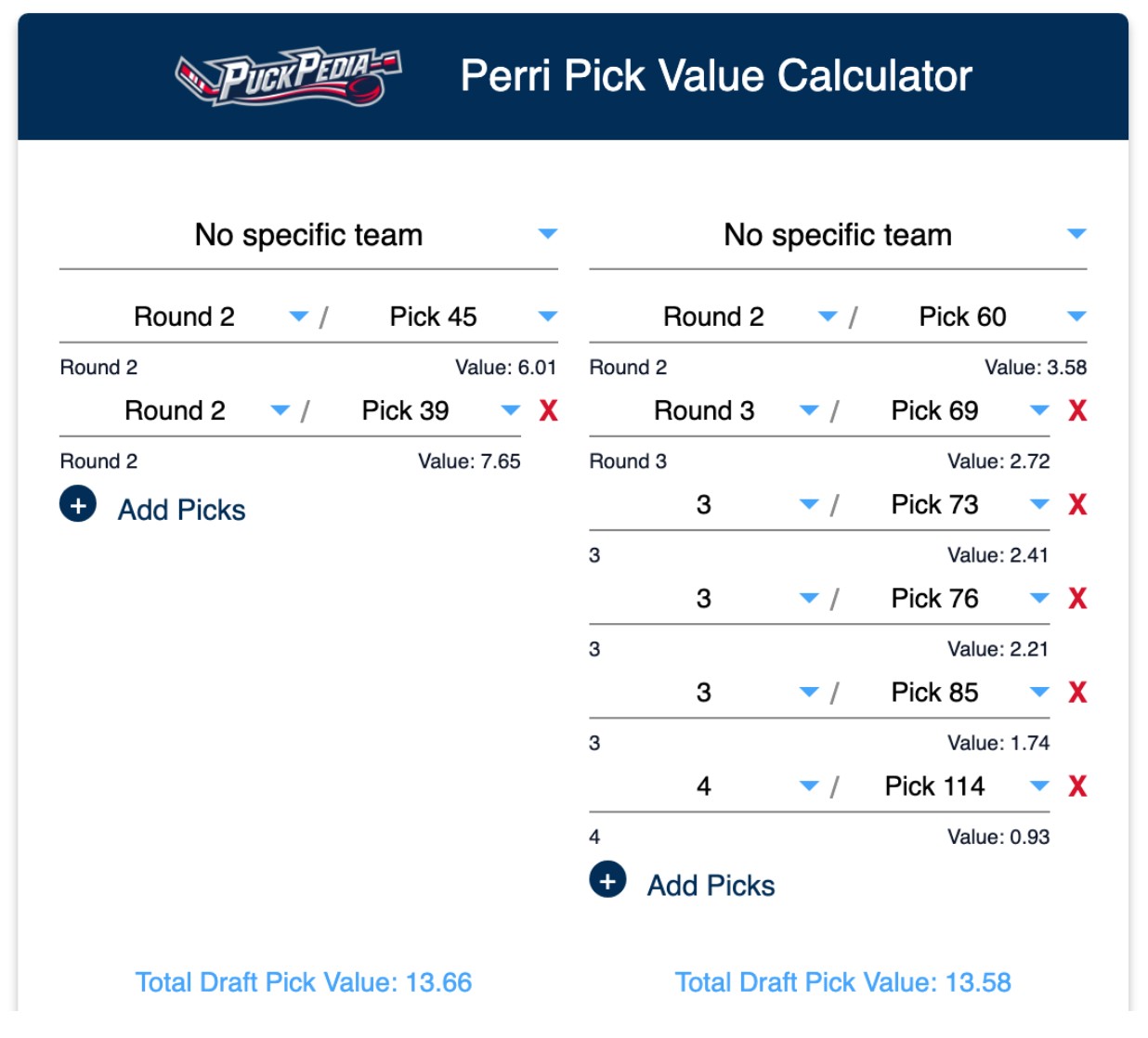
The Leafs simply aren’t in a position to make a trade like that. The only other feasible draft-pick option would have been moving Colorado’s 2027 first-round pick straight up for Zellweger. Some people will probably blanch at that initially, but Zellweger is only 22 years old. If you genuinely believe he’s a long-term top-four defenseman, that’s a perfectly reasonable price to pay. It’s certainly a gamble, made riskier by Toronto’s already-limited draft capital, but it’s one I would have thought long and hard about. I’ll be very interested to track how he develops, especially now that he’s in the division.
Overall, the trade market was difficult, as usual. There are some players worth lamenting, but every acquisition came with meaningful reservations. That leaves the UFA market, where there wasn’t much in the way of legitimate top-four options to begin with. Among the notable signings:
- Andersson: $8.5M AAV x 7
- Trouba: $8.25M AAV x 4
- Ryan Shea: $4M AAV x 5
- John Carlson: $8.5M AAV x 2
- Mario Ferraro: $4M AAV x 3
Darren Raddysh tied for the highest AAV with Andersson and Carlson at $8.5 million, but he also received the most term at eight years. Raddysh is six years younger than Carlson and, while he’s one year older than Andersson and not as tenured, I’d actually rate Raddysh ahead of Andersson. His range of outcomes is more volatile because he has less of a track record as an established top-four defenseman, but Andersson’s best simply doesn’t approach the level Raddysh reached last season.
Paying that type of money for Jacob Trouba never would have made sense for the Leafs. Ferraro and Shea will both be interesting players to monitor, and neither deal is particularly restrictive. The real complication is that Toronto would have needed to move out a defenseman to make either signing work. They’ve clearly wanted to move Morgan Rielly but haven’t been able to.
And that’s before considering that Andersson was almost certainly never leaving Vegas, while Carlson was never coming to Canada.
This is why drafting and developing defensemen is so important — something the Leafs have struggled to do for decades. You hope Ben Danford is NHL-ready sooner rather than later. Perhaps Andrew Bilecki or Ethan MacKenzie eventually pans out as well. In the meantime, the Leafs did well to add Raddysh relative to the market. The trade market was pricey, and several defensemen signed contracts in free agency that simply wouldn’t have made sense for Toronto (e.g. Trouba).
Again, exactly how good Raddysh is remains open for debate. He just produced a career season that he almost certainly won’t replicate. Even so, I feel comfortable saying he’s at least a legitimate top-four defenseman. He’s also a right-shot defenseman with a bomb of a shot, filling one of Toronto’s biggest needs. They had to do something, and he was one of the best possible fits available. It’s an easy move to understand, and he’s essentially replacing Brandon Carlo, whom he’s significantly better than.
It would have been nice to add a player like Zellweger alongside Raddysh. At that point, I would have been fairly bullish on the overall group, especially with Chris Tanev returning. Instead, they added Emil Andrae, and we’ll see whether he can carve out an everyday role.
Andrae is exactly the type of bet I like: a young-ish defenseman who has performed well in third-pairing minutes. If he can move up the lineup and continue succeeding, that’s a big win. If he can’t, having a defenseman who consistently wins his third-pairing minutes is still valuable. That’s certainly preferable to Simon Benoit getting outscored 55-30 at five-on-five. Improving your third pairing may seem like small potatoes, but it is a major opportunity to improve the team.
Truthfully, the blue line still feels like a work in progress — probably one defenseman short. If Tanev can stay reasonably healthy, there’s enough here to cobble together a respectable unit. If he can’t, as we saw last season, they’ll need someone like Andrae (or Danford) to emerge. Jake McCabe was completely overwhelmed without Tanev, but together they form a strong top-four pairing. Oliver Ekman-Larsson is ideally a versatile No. 5 who can move up the lineup when needed and play either side. Andrae should begin the season in a similar role. Troy Stecher is a solid depth or third-pairing option.
That leaves Morgan Rielly, who had won his minutes for eight consecutive seasons before last year. He’s difficult to place in the lineup; he makes too much to play on the third pairing, but there are legitimate defensive concerns about relying on him in the top four. He can still contribute offensively — he scored 11 goals last season — and the system they played did him absolutely no favours. But can he form an effective top-four pairing with either Raddysh or Tanev? If he can’t, then what?
Last season, the Leafs opened with this defense corps, and Tanev ultimately played just 11 games:
Jake McCabe – Chris Tanev
Morgan Rielly – Brandon Carlo
Simon Benoit – Oliver Ekman-Larsson
It’s certainly a more mobile group now, and I’d argue it’s simply better overall given the gap between Raddysh and Carlo, to say nothing of Andrae versus Benoit. How Tanev returns — both in terms of performance and durability — looms large. Changing essentially half the defense corps is fairly significant, and this was one of the worst defensive groups in the league last season. Their two bets to date both make sense. The real question is whether they went far enough.