



















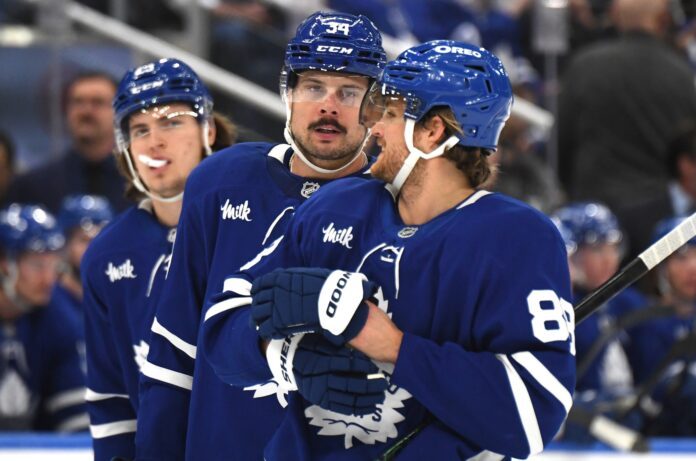
We wrap up the 2026 Offseason Review series with an assortment of thoughts on the Sergei Bobrovsky signing, the Leafs’ work in the trade market, Gavin McKenna’s development, possible line combinations, the average age of the Leafs’ roster, and more.
In case you missed the first three installments of the series:
- Part 1: After the Maple Leafs’ offseason of change, the same truth remains: The buck stops with Auston Matthews
- Part 2: Will the Maple Leafs’ deployment strategy finally align up front?
- Part 3: How much better is the Maple Leafs’ defense?
The bet on Bobrovsky
When the Florida Panthers’ 2025-26 season ended, Matthew Tkachuk said the following:
“The only guy I will be recruiting — and I hope I don’t have to recruit him — is Bob. We cannot lose him. He’s our guy. He is going to get us back to where we want to be. He’s the most important piece of our team, with what he has done over the past couple of years. It’s the character, the work ethic, the drive. He sets the tone on and off the ice. I don’t care what age he is; he is the backbone of this team. If we’re going to get back there, we’re going to need him.”
– Matthew Tkachuk
I’m always hesitant to take players’ words as gospel, but it’s an interesting comment nonetheless given how highly they clearly valued Bobrovsky in that room. His tenure in Florida had its ups and downs, but when push came to shove, he stood tall for them.
During the two seasons in which the Panthers won back-to-back Stanley Cups, no team in the league surrendered more breakaways than Florida. They really trusted Bobrovsky to erase those mistakes, which in turn allowed them to play an ultra-aggressive style through the neutral zone that helped them control games so effectively.
Truthfully, I’m not entirely sure what to make of Bobrovsky at this stage. You could convince me he’ll be great, and you could just as easily convince me he’ll struggle. Goaltending is the hardest position in hockey to evaluate under the best of circumstances. Add in the fact that we’re talking about a future Hall of Famer entering his age-38 season, and there are plenty of variables at play.
One thing I would focus on if I were the Leafs is the sheer workload Bobrovsky carried last season. In the shortened Olympic season, behind an injury-ravaged Panthers team, he ranked fourth in the league in starts from opening night to the Olympic break. Of the three goaltenders ahead of him, two — Juuse Saros and Dustin Wolf — also posted save percentages below .900 by the break, while the other, Karel Vejmelka, sat at just .903. Bobrovsky’s .871 save percentage was notably worse than all of them, but more broadly, it’s a group of heavily used goaltenders who all underperformed relative to their established standards.
Last season’s compressed schedule led to more injuries than usual and plenty of strange performances from star players across the league. The Panthers, already missing Aleksander Barkov for stretches along with a litany of other injured players, almost certainly overtaxed Bobrovsky unnecessarily. Anthony Stolarz, when healthy, is highly capable. With no Olympic interruption this season, the schedule will be much more manageable. Bobrovsky is 38 now, but there is a clear path to giving him significantly more rest than he received in Florida last season, and you’d like to think that will help him return to his previous standard of play.
McKenna’s development
I am very curious to monitor how the Leafs handle Gavin McKenna’s development. A few weeks ago, AGM Ryan Hardy spoke about his potential lineup spot:
“Jim controls the lineup card, but for me, with Mitch departing for Vegas, that’s a type of player who has done well with Auston in the past. Gavin’s line-rush game and ability to make plays in possession through the middle of the ice are unique gifts, and I think he would thrive with Auston.
Auston, as the captain and leader of the team, I know for a fact is really excited about some of these young players coming in. He would take it as a badge of honour to bring a young guy under his wing and help the team.
At the same time, I think it’s very important with Gavin — and any of our young players — to remember that the noise is really loud in Toronto. Sometimes we sell these kids as if they are the second coming. We have to be mindful that he’s a teenager who will have his ups and downs in pro hockey. He’ll have stretches where, for the first time in his life, he goes several games without scoring a goal and experiences different kinds of adversity.”
– Ryan Hardy
To me, you can’t have it both ways. If you pair him with Matthews on the top line, you’re inherently raising expectations, so it’s difficult to then lament the “noise in Toronto.” At that point, you’ve created it yourself.
This isn’t a developmental season for the organization. The Leafs are trying to contend right now. If they weren’t, you could simply give an 18-year-old significant minutes, live with the inevitable growing pains, and see where it leads. That’s not the situation they’re in, which is why team brass’ handling of McKenna will be one of the most fascinating storylines to watch in 2026-27.
Is it time for Matthews-Nylander?
Jim Hiller was with the Leafs for three seasons. During that span, Matthews and Nylander played 1,342 minutes together at five-on-five. Only Zach Hyman spent more ice time alongside Matthews. By comparison, Marner — infamously — played just under 144 minutes with Matthews.
The Matthews-Nylander duo didn’t just play together a lot; they dominated. They outscored opponents 76-47, owning nearly 62 percent of the goals scored during their five-on-five minutes.
Last season, the Leafs experimented with Matthews and Nylander together at times, but it largely neutered the rest of the forward group. The pair themselves were merely average, breaking even at 13 goals for and 13 against. It would be much easier to start McKenna on a more sheltered scoring line with John Tavares while reuniting Matthews and Nylander, who have been elite together before.
Last season, that wasn’t really an option with the likes of Matias Maccelli, Nick Robertson, and Max Domi in the mix. It still might not be if McKenna and/or Easton Cowan aren’t ready, but in theory, the Leafs have more flexibility to make it work. Matthews and Nylander will combine to earn nearly $25 million next season. It’s not asking too much for them to play a lot together and tilt the ice.
You won’t find many teams around the league that don’t play their best center alongside their best winger. Some will question whether Nylander is good enough defensively to handle tough head-to-head matchups next to Matthews, but let’s not pretend players like Cole Caufield or Martin Necas are defensive stalwarts. Both play on their respective teams’ top lines alongside their best centers inside the prime matchups. Over an 84-game season, you need your stars to drive the team and score the lights out, and most teams accomplish that by keeping their best players together.
That’s why, once again, it would’ve been nice to add a more established top-six forward this summer. It would’ve given the Leafs greater flexibility instead of relying on young players who remain relative unknowns.
We highlighted Viktor Arvidsson ahead of free agency, and he signed for the same term as Jack Roslovic at just $1 million more per season. Roslovic is younger, faster, and bigger, but he has never been the type of line-driving top-six winger that Arvidsson has been throughout his career, nor has he ever come close to matching the production Arvidsson delivered last season.
Maybe there’s something to reuniting Roslovic with Matthews. The Leafs certainly wouldn’t be the first team to reunite former junior linemates — the Avalanche did exactly that by signing Jonathan Drouin to play alongside Nathan MacKinnon again.
The Mats Zuccarello contract — one year worth up to $6.5 million with bonuses — also felt like a no-brainer.
The Nick Paul add, and the Leafs’ work in the trade market
On the trade front, a few moves stood out.
The Leafs gave up Dennis Hildeby, a third-round pick, and a fourth-round pick for Nick Paul. Meanwhile, the Columbus Blue Jackets acquired Valeri Nichushkin for a second-, third-, and fifth-round pick. It’s not a dramatically different price for a better player.
Nichushkin is a legitimate top-six forward and line driver who has continued to produce offensively, recording 49 points last season. By comparison, Paul was limited to 15 points in 51 games during an injury-plagued campaign. Nichushkin can’t play center the way Paul can, but Paul also can’t play on a first line the way Nichushkin can.
Of course, Nichushkin’s off-ice history is well known, and there may be factors we aren’t privy to. Even so, it feels like a relatively small gap in acquisition cost for a substantial difference in hockey ability.
The Leafs clearly value players who can play center, which is fair. It’s a premium position, and organizations can never have too much depth there. If Paul rebounds and proves to be a viable center, as he was before his injury-plagued 2025-26 season, the price will look entirely reasonable. If he ultimately settles in as a winger, though, there were plenty of options available in free agency that wouldn’t have cost any assets to acquire.
Elsewhere, Mavrik Bourque was packaged with Ilya Lyubushkin for just a second- and third-round pick. Taking on Lyubushkin’s $3.25 million cap hit for one season was part of the cost, but that’s hardly prohibitive if you believe Bourque has legitimate top-six upside while also offering the ability to play center.
The Leafs already own two second-round picks in next year’s draft, so it’s not the type of price I would’ve been reluctant to pay. It also would’ve made the roster noticeably younger alongside Matthew Knies, Easton Cowan, and Gavin McKenna. One season of Lyubushkin feels like a small price to pay for that type of addition.
Between a move like that and a potential Olen Zellweger-type acquisition, this was the one avenue I was really hoping the Leafs would pursue in addition to the rest of their offseason priorities (adding a top-four defenseman, bringing in legitimate checking forwards, sorting out the goaltending, and so on).
The other thing I wonder about is whether we’ll see a second wave of offseason activity.
The Ducks, for example, are reportedly cash-strapped and could look to attach sweeteners in order to move out money. There are also a few complicated contract situations still to be resolved (such as Dylan Larkin). The Vancouver Canucks, meanwhile, continue to look like a team trying to shed salary.
The Leafs have effectively used all of their available cap space, so perhaps there won’t be a second wave of activity for them. But if opportunities do arise later in the summer, they don’t have much flexibility to capitalize.
This is not to criticize the organization putting a plan together and aggressively executing it. There is always a fine line between acting decisively and leaving yourself enough room to play the market as new opportunities emerge. I’m curious to see how the rest of the offseason unfolds and whether the Leafs find a way to stay involved if another wave of movement materializes.
The Leafs’ veteran roster
As things stand, the Leafs’ projected 12-man forward group — including Gavin McKenna but excluding Steven Lorentz — has an average age of 28.3. Knies, McKenna, and John Tavares all celebrate birthdays during the calendar year as well, nudging that figure closer to 28.6. That would put the forward group slightly younger than league average, roughly in the middle of the pack based on last season’s numbers.
Once you factor in the defense, however, the picture changes.
The Leafs’ projected top six on the blue line has an average age of 31.5, with Emil Andrae the only defenseman under 30. Add the goaltenders, and the roster’s average age sits around 29.85 entering the season. Account for birthdays that occur during the season before the calendar flips to 2027, along with the extra players on the roster, and the Leafs comfortably clear the 30-year-old threshold. That would’ve made them one of the oldest teams in the league last season.
In fact, they were already the second-oldest team in the NHL. They won the draft lottery and also added a 24-year-old defenseman, but otherwise got older in goal and on the blue line. It would’ve been nice to inject a little more youth into the roster.
That youth also could have come from within. For the most part, the Leafs have effectively blocked their Marlies hopefuls from making the opening-night roster. With John Gruden now on the NHL staff, it’ll be interesting to see whether the organization leans more heavily on the Marlies during the season and, if so, which players get those opportunities.
The Leafs didn’t tap into the Marlies enough last season as the NHL club struggled. At the same time, while the Marlies went on to win the Calder Cup, we consistently noted throughout the season that there weren’t many players who looked like true NHL options — something the Leafs’ own roster decisions ultimately reflected.
That said, it still would’ve been nice to leave a little more room for someone like Jacob Quillan or William Villeneuve to make the team. Instead, they’ll likely begin the season as first-call-up options (alongside Ben Danford and perhaps Bo Groulx if he doesn’t crack the opening-night roster outright).
The two players who appear to have curried favour from the Marlies’ Calder Cup run are Easton Cowan, who looks poised to open the season in the Leafs’ top six, and Artur Akhtyamov, who has clearly established himself as the organization’s No. 3 goaltender.
In that respect, it’s also noteworthy that the Leafs don’t have a single unrestricted free agent coming off the books next summer. If young players force their way into the NHL picture, management will have to create room by moving players off the roster.
Will this management group potentially move out players they acquired to create the space? It’s difficult to imagine this management team icing the exact same roster in back-to-back seasons. At some point, something will have to give.
Jim Hiller’s task of configuring the forward group
The offseason is long, so I wanted to share this video discussing the Joshua–Blueger–Garland line that unexpectedly developed into one of the better third lines in the league a few seasons ago.
Reuniting Dakota Joshua and Teddy Blueger makes sense, but there’s an important caveat: Conor Garland was the true engine of that line. He was the primary puck carrier and playmaker.
Jack Roslovic has never really driven a line, but he is a right-shot who can carry the puck and make plays. Maybe that combination works. Maybe it’s Easton Cowan in that role eventually, although that would require someone else to occupy a top-six spot. Players like Colton Sissons or Brandon Duhaime aren’t natural puck carriers or playmakers, which would fundamentally change both the identity and likely the effectiveness of that line.
I’m very curious to see how Jim Hiller puts this forward group together. Every time I sketch out the lineup, it feels like there’s one player who doesn’t quite fit right.
It’ll probably take some time to sort through.
The Leafs have six forwards in their projected top 12 who can credibly play center. Matthews and Tavares will obviously occupy two of those spots. Beyond that, there are several different directions they can go. That flexibility is valuable over an 84-game season, particularly once injuries inevitably arise, but finding the right combinations and deployments is likely to be an ongoing process.
Then you layer in the possibility that Easton Cowan and Gavin McKenna begin the season lower in the lineup before earning larger roles as the year progresses. That’s where Roslovic could provide value as a stopgap, at least early in the season. It’s a roster that should remain in flux for a while.
A legitimate refresh ahead of 2026-27
Half of the Maple Leafs’ forward group is new. The coaching staff is new. There has been significant turnover throughout the organization, and hopefully it provides the fresh start the team desperately needed.
Last season felt like a stale veteran group trying to play the exact same style despite losing a 100-point player and doing little to replace that production. They then lost their best defenseman almost immediately to a season-ending injury. Craig Berube repeatedly lamented that the team wasn’t playing the way it had the year before. They needed to evolve, never did, and the end result was a miserable season to watch.
This roster is better than the one that finished fifth from the bottom last season, but that’s not really the objective.
As John Chayka said the day he was introduced as general manager:
“It is going to take a high hit rate, it is going to have to take some creativity, and we are going to have to have some things go our way, but we certainly feel like we are well-positioned with a core group. We have some players who are some of the best in the world who wear this sweater. It is upon us — Mats and I — to put in place the structure, the principles, and give them the resources to go out and accomplish their goals.”
– John Chayka