





















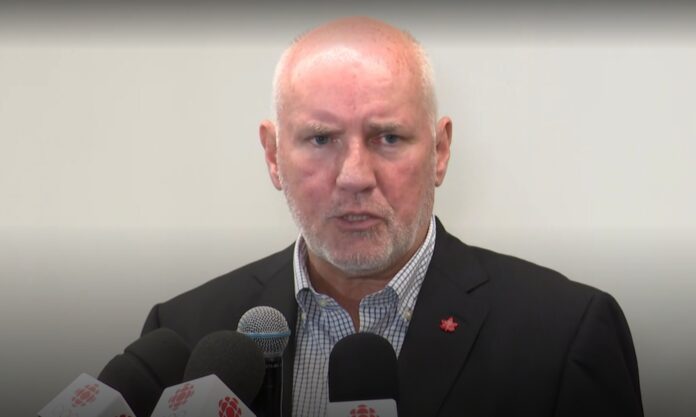
Ahead of the start of the Olympic hockey tournament, Team Canada GM Doug Armstrong discussed the team’s opening line combinations, the officiating standards, the goaltending situation, and the plan for the penalty kill in Anthony Cirelli’s absence.
In the build-up to the tournament, did you have much input into the opening lineup combinations we’ve seen in practice, including Tom Wilson on Connor McDavid’s wing to start?
Armstrong: No, not really. I didn’t really get into line combinations with Jon (Cooper). We had some indication. What happens is that you name the players, and then the coach will call each player. They don’t pick their linemates, but you talk to them and find out who is comfortable doing what. I don’t want to say it’s 100%, but I would be shocked if the lines you see in game one are going to stay together for the tournament.
I think Tom Wilson brings a brand that can be very effective in international hockey: north-south, plays in straight lines, and gets in on the forecheck to turn pucks over. There will be a number of centermen who would enjoy playing with Tom.
Team 🇨🇦 is back on ice in Milan
Celebrini – McDavid – Wilson
Hagel – MacKinnon – Reinhart
Marner – Crosby – Stone
Marchand – Horvat – Suzuki
Jarvis, BennettToews – Makar
Morrissey – Parayko
Theodore – Sanheim
Harley – DoughtyBinnington
Kuemper
Thompson@TSN_Sports pic.twitter.com/sD8fdFxQHO— Mark Masters (@markhmasters) February 11, 2026
What is the identity you’re looking to establish for the Canadian team in this tournament?
Armstrong: We want to be a strong 200-foot team. We believe we’ve built a group where the coach doesn’t have to worry about matching up. We hope to have teams react to us. It is going to be built a little bit like that.
The level of hockey around the world has risen since 2014. I was fortunate to start with Hockey Canada in 2002 at the Worlds. I did feel, at that point, selfishly, that Canada was able to start on third base. Everyone else was on second or first. Now, there are a lot of other countries on third base, and that is great for hockey. It is unreal to see the level of players from all around the world. It’s great.
I think this team will create its own identity. We are not trying to be a team of the past. That is the beauty of this. They can write their own script.
With Anthony Cirelli not participating, he is a key penalty killer. How much has penalty killing entered the conversation? Is it something you can overthink, knowing players of this level can handle it?
Armstrong: Anthony is a great penalty killer. He and Hagel had such awesome synergy, but they’re 200-foot players. We did talk about what we would do. Pete Deboer will handle that aspect for us, and we have a lot of great penalty killers there. He is comfortable with the group we have and that we’ll find a partner for Hagel.
There remains a lot of talk about the team’s goaltending. What makes you comfortable with the three goalies at your disposal?
Armstrong: I just go back to January last year, hearing the same things, and we saw how that turned out. It made me quite comfortable.
When it comes to Jordan Binnington, what are the signs you see when watching a player that suggest they’re suited for the big moments?
Armstrong: You don’t really scout that. The players bring it to you. When they rise up on big occasions, everyone in the world sees it. You don’t have to be a scout to see what he did in the Stanley Cup or at the 4 Nations. There is a massive belief. When players see it time and time again, it is just a foundation where they know, when push comes to shove, we have faith in this guy. That is where they are with Binner right now. We have two excellent partners for him.
I know our goaltending is talked about a lot. I have the utmost confidence we will find the right path with those three.
What is your sense of what the officiating standard will be? Did it factor into some of your decision-making with the lineup?
Armstrong: The officiating will be 13 NHL and 13 international. I think it is seven and six, with the linesmen. I think it is going to be very similar. You are not going to have fighting — we understand that — but you are going to have physical play. You are going to have in-your-face hockey. I think that is what the world wants to see, and I think the referees understand that.
These are the best referees in the world for these events. They understand that the less they’re talked about, the better the event is. I am 100% comfortable that the players will dictate the conclusion of this tournament.
The roster is similar to the 4 Nations, but is there another gear that can be reached? Where can it come from?
Armstrong: The more you play and become familiar with people, you find another level. I think it will come from that — the familiarity of more practices, understanding the nuances of where their linemates like to go. I think the 4 Nations teammates have something of an advantage because of that, but I think time has changed everybody a little bit, too.
I think and hope there is a different gear. We are expecting our competition to find a new level. We have to respond.
You’ve spent a lot of time around Sidney Crosby at these events. What have you seen from the way he conducts himself in moments like these?
Armstrong: My first interaction with Sid was in 2010 in Vancouver. 16 years later, we see the growth off the ice. His maturity at that time was way beyond his years. Celebrini has a little bit of that. You’re thrust into it at such a young age.
Sid was the one who organized the event the other day with the players. He moves between management, coaches, and players with great ease, and the families with great ease. He is as good a leader as I’ve been around and seen. We are so fortunate to have someone like him leading us.
As the manager who picked the team, how cool has it been to see the players gelling and coming together through the Olympic experience?
Armstrong: It was great to see yesterday. They had a great time at the event, watching a silver medal won by Canada. There was the process of getting on the subway and getting off, sitting with the fans, and I’ve seen them on the streets a lot, enjoying everything. The time they’re having at the village is fantastic. They’re interacting with not just Canadian athletes but all athletes from every country. They’re enjoying the overall experience.
We know we’re here for a reason. The competition starts soon, and we’re excited for that.
Is the plan to stay in the village or migrate to the hotel?
Armstrong: The team is doing both. This is actually growing larger than it is. The players have always had a hotel room in all of the Olympics prior to this, in Vancouver and in Sochi. They’ve stayed with their families. They have a room in the village. They have a room provided by the NHL and NHLPA outside of there. This has sort of grown a life of its own. This is no different than the tournaments before. We just want to give the players the option to stay where they’re most comfortable to prepare for the games.
As a GM, how does this experience and pressure compare to the Stanley Cup playoffs?
Armstrong: It is just a different feeling, the Stanley Cup. It is a two-month grind after a six-month grind. This work will be done in a couple of weeks. It is over before you know it.
I do remember, in 1999, being the Assistant GM for Dallas when they won. I do remember being an assistant to Steve Yzerman. The best job in this sport is “assistant” anything, haha.
There is so much interest in this team back home in Canada. Where do you stand on the closed practices?
Armstrong: That was a one-time thing. We were just getting up and running. We had the team picture that day. Practice will be open for the rest of the tournament, though.
What are your thoughts on starting the tournament with games against the Czechs and the Swiss?
Armstrong: I think it is a positive. Starting out of the gates against two teams that have had success internationally at the World Championships recently will make us hone our skills quickly. Again, the tournament starts when it’s a lose-and-go-home. We are not there quite yet, but I am excited about getting up and running, finding rhythms, finding synergy, and finding areas we can improve. Our goal is to get better every day.