


















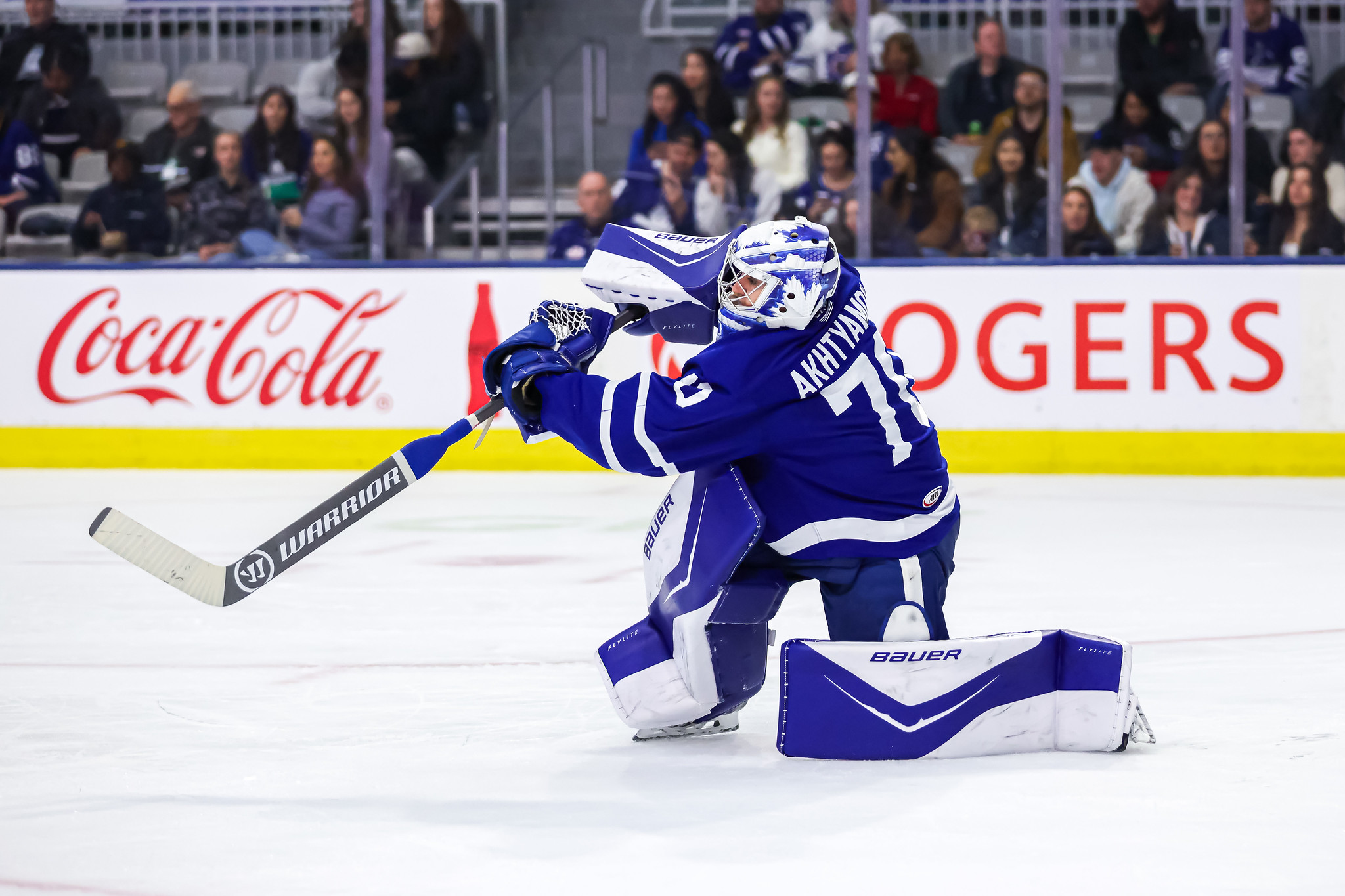
Against all expectations, the Toronto Marlies have bested the rest in the North Division. They did it the hard way, becoming the third team in AHL history to win three winner-take-all games in a single Calder Cup postseason.
Now playing with house money, the Marlies’ reward is a matchup with the vaunted Wilkes-Barre/Scranton Penguins.
Regular Season Series
The difference between the teams during the regular season could not be more stark.
Pittsburgh’s affiliate was one of only three teams to accrue 100+ points and would have won the Atlantic Division if not for the juggernaut Providence Bruins. The Penguins were the top offensive team in the Eastern Conference (243), scoring four-plus goals in 33 games.
The two regular-season games between the teams were notable for two reasons: The teams combined for 14 goals and featured two comebacks. Back in November, Wilkes-Barre/Scranton led 3-0 through 40 minutes on home ice, only for Toronto to produce an unlikely comeback and prevail 4-3 in OT. In the corresponding game hosted by the Marlies in March, Toronto spotted Wilkes-Barre/Scranton a 4-0 lead, and another comeback effort fell short as Toronto lost 4-3 in regulation.
Playoff Series
Toronto and Wilkes-Barre/Scranton have yet to meet in postseason play. This isn’t entirely unsurprising, given the AHL’s playoff structure and the fact that the teams are never divisional rivals.
It’s been a long time between drinks for both clubs to reach this stage of the playoffs. It’s Toronto’s first Eastern Conference appearance since 2019. Staggeringly, you have to go back to 2014 to find the last time Wilkes-Barre/Scranton made it through to this stage of postseason action.
From here on in, the playoffs return to a best-of-seven. This series will start in Wilkes-Barre/Scranton with a 2-3-2 format. As much as home-ice advantage is a thing, neither of these teams fears the road. In the last five years, the regular-season meeting between the teams has seen the road team fare better, picking up twice as many victories away from home. In the 2025-26 campaign, Wilkes-Barre/Scranton owned the third-best record overall at home and on the road. Toronto was equally consistent (the 15th-best record home and away).
Through the playoffs, the Penguins have won three of four road games. The Marlies have won four of seven on the road, including two winner-takes-all victories away from Coca-Cola Coliseum.
Starting On Time & Five-on-Five Play
Both teams have proven themselves to be excellent front-runners in the playoffs. Toronto has scored the first goal in only four of 13 games, but has won all of those games. Wilkes-Barre/Scranton has opened the scoring in seven of nine games and won six.
As shown in the regular-season meetings this season, Toronto cannot afford to have a slow start. Wilkes-Barre/Scranton was a monster in terms of five-on-five play through the regular campaign. They led the AHL in five-on-five goals for (170), five-on-five goal differential (64), and were tied for second in fewest goals conceded at five-on-five (106). In post-season play, the Penguins have outscored their opponents 17-10 at five-on-five.
For the Marlies to compete in this series, they must not feed into Wilkes-Barre/Scranton’s strengths. The Penguins are a mobile, skilled, and fast team that loves to attack in transition off the rush. The majority of the defensemen fit into that mould and are encouraged to break out with speed or seek long breakout passes to stretch the opponent. Managing the puck will be a critical facet of the game for Toronto.
Special Teams
This is an area where Toronto can come out on top if they remain disciplined. Wilkes-Barre/Scranton is scoring on the power play at 18% through nine playoff games, just a tick up from the regular season. Their PK has improved; the Penguins have allowed three goals on 25 occasions shorthanded (88% as opposed to 81% through the regular season).
Ville Koivunen is the man to keep a keen eye on regarding the Penguins’ power play. He netted 12 during the regular season and has two more in the playoffs.
The Marlies’ special teams have fluctuated wildly through the postseason. Against some feisty opponents, Toronto has drawn 54 power-play opportunities in 13 games and scored at a 1-in-5 pace. This may be an area to exploit, as Wilkes-Barre/Scranton has at times taken too many penalties this year.
Goaltending
The goaltending on both sides has the potential to be the difference-maker. It will be the battle of the young Russian netminders as Sergei Murashov faces Artur Akhtyamov. The Marlies haven’t seen Murashov yet this year, as Filip Larsson and Joel Blomqvist were between the pipes in those two meetings.
Selected 118th overall in 2022, Murashov played in his first NHL games this season while excelling in the AHL. He posted a .919 save percentage and recorded four shutouts in 38 games. His post-season numbers have been even better. Murashov has been the Penguins’ starter through the playoffs with one shutout and a .943 save percentage. It’s difficult to envision a situation in which Toronto could chase the rookie Russian from the net, but in that circumstance, the Penguins would turn to Blomqvist.
Akhtyamov has unquestionably been Toronto’s playoff MVP to this point. He will have to take another step against an offensive powerhouse from the Atlantic Division. It’s obviously hyperbole to say this series may make or break his career, or anything to that effect. Still, a defining showing against Wilkes-Barre/Scranton may help his immediate future and shape the Maple Leafs’ goaltending picture for next season and beyond.
Offensive Producers
Wilkes-Barre/Scranton hasn’t relied on one or two players to be dominant offensively at five-on-five this year. 11 skaters produced 20+ points during even-strength action. Six players scored 10+ goals, and 34 different skaters found the net.
Well-known names in Rafaël Harvey-Pinard, Joona Koppanen, and Aidan McDonough have led the way, but the Penguins have a raft of younger players who have produced at a notable clip. Most notably, Ville Koivunen recorded 25 five-on-five points in 34 games, including 10 goals. Another player to watch is the vastly talented Atley Calvert. The sophomore forward has taken a step this season and is a skilled playmaker with an eye for the net.
Wilkes-Barre/Scranton hasn’t been shy about throwing rookies into post-season action, and it’s paid dividends. Mikhail Ilyin (1G/6A), Bill Zonnon (3G/1A), Harrison Brunicke (2G/2A), Aidan McDonough (2G/2A), and Gabe Klassen (1G/3A) have all stepped up.
Scoring by committee has remained a trend in the playoffs as 15 different players have scored for Pittsburgh’s affiliate. Toronto’s depth scoring was a strength up until now, but it looks outmatched by Wilkes-Barre/Scranton on paper.
There has been a little too much reliance on Toronto’s veterans to carry the load so far offensively. Vinni Lettieri is the leading playoff scorer (6G/7A) heading into this series, but Logan Shaw (6G/5A) and William Villenueve (1G/10A) are not far behind.
Bo Groulx (3G/3A) and Alex Nylander (3G) have been disappointing in both performances and production, although the former has been excellent on the PK. Jacob Quillan has struggled to find his early-season form, but he leads the team in five-on-five scoring (1G/4A), despite not bringing his A game consistently.
Easton Cowan could benefit from playing a little more directly, but he should be chock-full of confidence following his late-game heroics in Game 5 in Cleveland. He’s certainly been clutch for Toronto so far, and he has a history of it dating back to junior.
Recent Form
Offense was key to Wilkes-Barre/Scranton’s success versus Hershey. They scored four goals in each victory to win the series 3-1. The Penguins showed they were capable of strong defensive play against Springfield, who produced the shock of the playoffs by eliminating the Providence Bruins.
In a series that went the distance, Wilkes-Barre/Scranton gave up eight goals in five games. Half of those goals were conceded in an overtime defeat. An emphatic 8-1 victory in the winner-takes-all decider against the Thunderbirds was reminiscent of the sort of domination exhibited by the Toronto Marlies in 2018.
Series Prediction
The Marlies were largely outplayed for the first three games of the Cleveland series but found a way to prevail. I wonder if they’re beginning to believe it’s their year, given what has transpired to this point.
Toronto has to perform a whole lot better against a powerhouse Wilkes-Barre/Scranton team. It’s a difficult proposition to shut down an offensively gifted team for a seven-game series, but it’s key that Toronto makes Wilkes-Barre/Scranton work for offense rather than feed into their strengths with poor puck management.
I feel this is a series that will go the distance if the Marlies can return home with a split. The Marlies would surely fancy their chances in another winner-takes-all elimination game. The Penguins will have different ideas, and if they’re able to exert their offensive might over the lower-seeds, they could win this series quickly.
Series Schedule
The Marlies won the best-of-seven series 4-2.| - | Date | Location | Time (EST)/Result |
|---|---|---|---|
| Game 1 | May 27 | Wilkes-Barre | 4-2 Win |
| Game 2 | May 29 | Wilkes-Barre | 2-1 Win (OT) |
| Game 3 | June 1 | Toronto | 5-3 Loss |
| Game 4 | June 3 | Toronto | 4-3 Loss |
| Game 5 | June 5 | Toronto | 5-1 Win |
| Game 6 | June 7 | Wilkes-Barre | 2-1 Win (OT) |