
















The Toronto Marlies just keep finding ways to win, and now they’re off to the Calder Cup Finals. Two overtime wins, an entertaining 5-1 victory, and a win in which they were outshot 36-16 helped them take their best-of-seven series against the WBS Penguins and capture the conference title.
This was, for my money, the Marlies’ most impressive series to date. Wilkes-Barre was a juggernaut in the AHL this season, finishing with the third-most points in the entire league, scoring the fourth-most goals, and allowing the third-fewest. In the Marlies’ previous series, they were largely outshot and outplayed for long stretches, often relying on the heroics of Artur Akhtyamov. He was once again excellent throughout this series, but it wouldn’t be fair to lay all the credit at his feet, either.
The Marlies actually outshot WBS in three games during the series, tied them in shots once, and were outshot by just one in the final game. Aside from the series opener — when they were outshot by 20 and still pulled out a win — I thought they were largely the better team.
So, what has changed for a Marlies team that finished 18th in the regular season and had to go through the play-in round just to officially make the playoffs?
It’s a combination of factors, including a hot goalie, getting all of their players back from the Leafs, and adding Easton Cowan and Ben Danford to the lineup, both of whom have been difference-makers. While the Marlies are still largely a veteran-led team, the play of Cowan, Danford, Akhtyamov, and a few others is worth getting excited about.
As we wrote after the last round, the Abbotsford Canucks won last year, and we all saw the season the Canucks just had; it didn’t translate into any team success. This isn’t meant to squash the enthusiasm surrounding this run—it is genuinely exciting—but it’s important to be realistic, too. There were some wins for the Canucks in Linus Karlsson and Max Sasson, while Arturs Silovs played 39 games for the surprising Penguins this season, although you could argue he wasn’t particularly good over that body of work.
Moving forward, most importantly, the Leafs should properly evaluate the players in the system. Obviously, they didn’t do it with Alex Steeves or when they traded away Fraser Minten. The Leafs, as an organization, have whiffed a lot in this area over the years, giving up on players who were standing right in front of them. We don’t need to relitigate it all, but it’s worth being mindful of here.
The Leafs have four goalies, three of whom will require waivers, and another, Akhtyamov, who is not only playing well but also has a three-year contract kicking in next season.
On defense, the Leafs already have all seven defensemen from last year’s group under contract, while both Henry Thrun and William Villeneuve need new deals and are in their mid-20s. They will need to move out multiple players from last season’s group, but before they look for outside help—which they will absolutely need to do—can they plug any holes internally?
At forward, the Leafs have just two true centers signed, and now that Max Domi’s status for next season is uncertain, they have only eight forwards signed overall (including Easton Cowan but not their prospective first-overall pick). Nick Robertson and Matias Maccelli are both RFAs, as are Jacob Quillan and Ryan Tverberg. Players like Bo Groulx and Michael Pezzetta have played their way into the NHL before and are still in their 20s. Again, they will need to add externally, but can they plug some holes internally?
It would make their lives a lot easier and inject some youth into what felt like a stale veteran lineup last season.
Going to the Finals gives the new management team more games to evaluate, and hopefully, there is a championship to celebrate along with it.
Notes
– Through 17 games, Artur Akhtyamov has posted a .927 save percentage and a 2.12 goals-against average. From the start of the playoffs until now, he has easily been the Marlies’ best player overall. Standing out to me lately is his ability to handle the puck. He consistently cuts off rimmed pucks and makes good decisions by identifying the right outlet. He’s really helped the defense on some sequences by aggressively coming out to play pucks and relieve pressure. It’s not something I see discussed about AA very often, but I’ve been pleasantly impressed with his ability to do it in the playoffs.
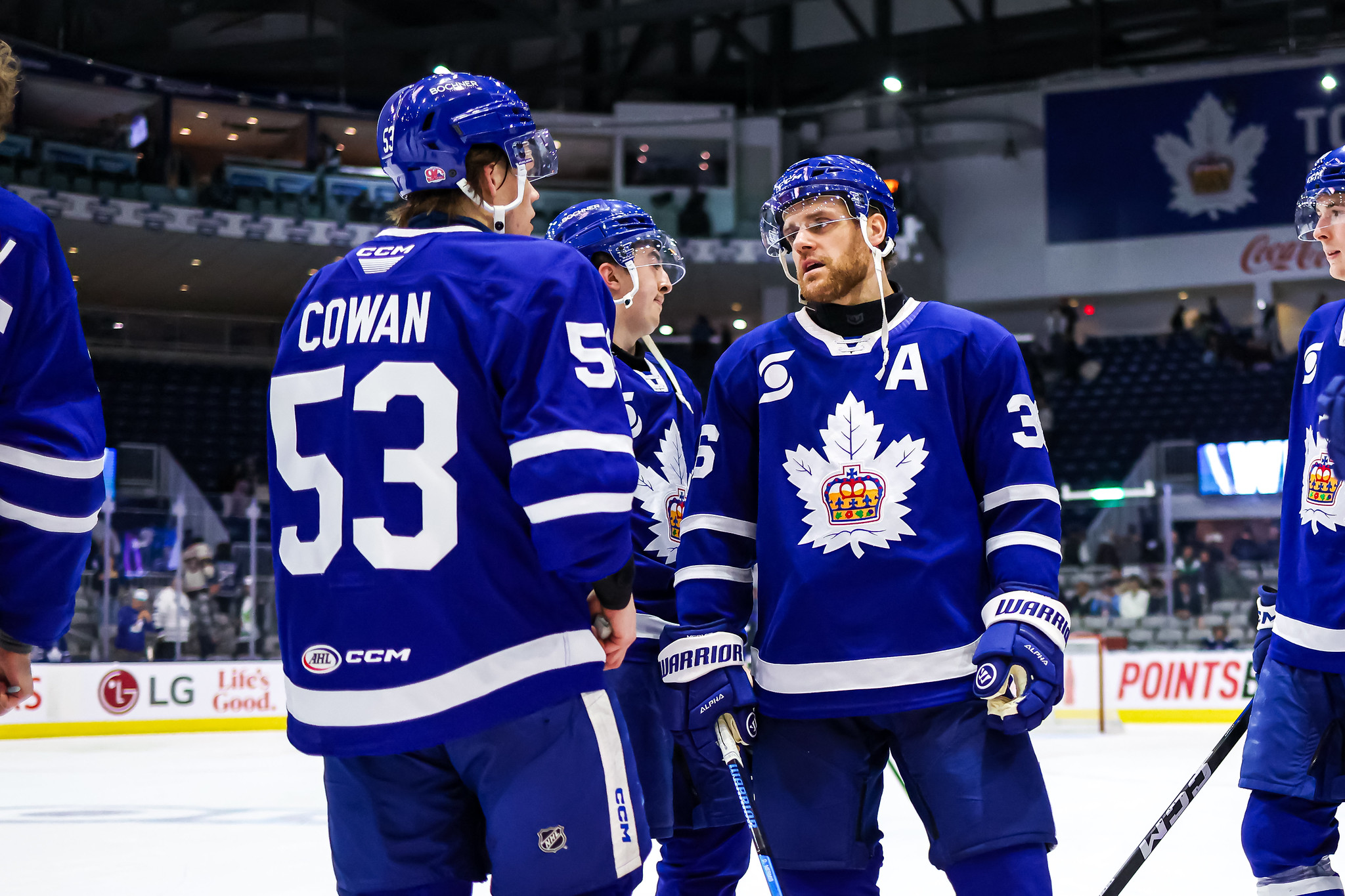
– I thought that was easily Easton Cowan‘s best series of the playoffs so far. After the last round, we mentioned it had been a bit of a mixed bag and referenced the grind of a long season. It appears that may have been the case, as he missed two games in this series with an undisclosed injury. After he returned, his skating looked much better, and he was often the most dangerous player on the ice. Cowan produced five points in four games in the series, recording at least one point in every game he played. He’s tied for the AHL rookie lead in playoff points and goals, with 13 points in 17 games.
– Cowan received a lot of attention for his giveaway in Game 4 that led directly to the game-winning goal. After the game, he took accountability, promised to be better, and then scored a highlight-reel goal in the next game. You have to give him credit for facing the music properly, not mincing words or shying away from a bad play, and then living up to his word. That’s all you can ask of anybody. It hasn’t happened here in a long time.
– I also thought that was Luke Haymes‘ best series to date. He scored five points, and with Jacob Quillan out, he centered Cowan and looked good in the process. Haymes has a good shot—he was tied for 14th among AHL rookies in goals this season—and his strong series has nudged him up to 11 points in 19 playoff games, tied for second among all rookies. At 6’1 and over 200 pounds, he didn’t look physically out of place during his NHL cup of coffee at the end of the season, either. Ideally, he produces at a higher clip in the AHL first, but we can see the tools and ability. We’ll see if he continues to build on this series in the Finals.
– It’s a shame that Quillan is now hurt, as he played only half the series. He helped set up the dramatic series-winning goal against Cleveland, and his skating was really starting to become a factor before the injury. Of note, for a player who would likely project into a bottom-six energy or checking role, he has been getting secondary penalty-killing time throughout the playoffs. Ideally, you’d like to see him drive that type of unit before making the jump to the Leafs.
– You can’t help but root for Landon Sim every time you watch him play. He’s a bit undersized for a player in a physical energy role, but he’s in there like a dirty rag and even chipped in some offense this series with a goal and an assist in five games. I believe he drew a penalty in four of the five games he played, as he absolutely drove the Penguins nuts. Whether finishing hits, forechecking with a high motor, giving little goalie pokes, or clipping opponents when he can, Sim is a real pest who knows his role and is effective at it.
– It’s a shame Sim was hurt this season. Between the missed games and some time in the ECHL, he made only 13 AHL regular-season appearances. There are some offensive flashes where he makes legitimate plays with the puck, either driving the net or finding teammates, and he has a sneakily good shot. Next season will be telling. Can he stay healthy, play regularly all season, and produce at a respectable clip—ideally around 20 goals in the AHL?
– We’ve highlighted some of Ben Danford‘s ability to evade forechecks and move the puck, but he has really started to join the rush and push the play offensively now. He’s a very good skater, and as his confidence has grown, he’s started wheeling pucks out on his own as a one-man breakout. Danford recorded 16 shots on goal in the six-game series, picking up just one point while also hitting the post off the rush on another sequence. He does need to work on his shot, but that kind of volume is still noteworthy. He walks the line well and opens up lanes for himself. While the focus on Danford has always been his defensive abilities, he’s showing regular offensive flashes that suggest it’s worth exploring whether that side of his game can be further developed in the AHL.
– You can add Bo Groulx to the list of players who were scratched due to injury, as he missed a game in this series. Groulx has a modest nine points in 18 playoff games, and a number of those points have come on empty-net goals or gifts resulting from botched plays. He had a really good AHL season and a solid showing with the Leafs, but this playoff run so far hasn’t exactly made a definitive statement that he should be playing in the NHL next season.
– Noah Chadwick sat out the last two games, but he has put together a solid playoff run with five points in 16 games while also getting some secondary power-play duty. He finished tied for seventh among rookie defense scoring, and he turned 21 just a month ago. We’ll see if he gets back into the lineup and how he performs, but this has been a promising season for the 6’4 defenseman. I wanted to mention him here, given we haven’t spoken about him very much.
– Henry Thrun has been solid, if unspectacular. He’s a top-four defenseman for the Marlies who kills penalties and takes on tough minutes, but he’s difficult to project moving forward because he doesn’t own a standout skill. He’s a smart player with some puck-moving ability, he can defend at a reasonable level, and he is 6-foot-2 with decent mobility. In theory, he could be in the mix as a 25-year-old defenseman, but without a defining strength, he’s a difficult player to place in a lineup.