








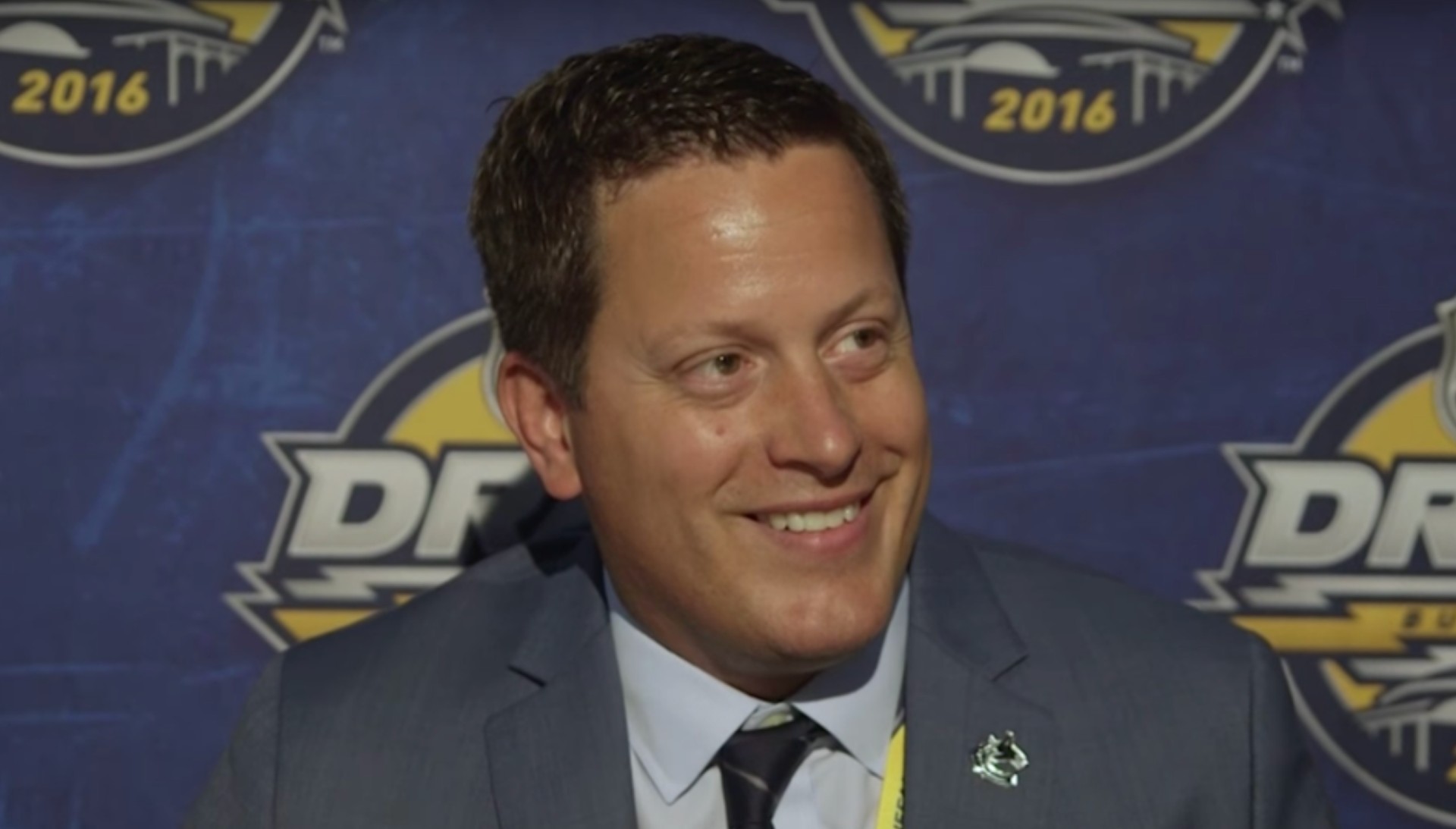
John Chayka continued to reshape the Maple Leafs’ front office on Monday, hiring Judd Brackett as an AGM (Player Evaluation) and Freddie Hamilton as Chief of Staff.
It’s hard to figure out what’s going on with this theme of Leafs managers owning restaurants outside of hockey, but maybe it’s part of why Chayka and Judd Brackett hit it off. Brackett and his brother, Jared, own two restaurants in Cape Cod: one seasonal establishment, The Port, and one year-round establishment, Ember Coal Fire Pizza and Wings. It may not be 60 Wendy’s restaurants or hundreds of Boston Pizzas, but the food sounds far superior.
When he’s not wearing his restaurateur hat, Brackett has been an amateur scout (and later director of amateur scouting) since 2005-06, starting as a scout in the QMJHL before making the jump to the NHL in 2008-09.
Brackett first served as an amateur scout for the Canucks while also working as the Director of Player Personnel for the Indiana Ice in the USHL. It’s not hard to imagine that two notable Canucks picks from the USHL (or with USHL roots), Brock Boeser and Thatcher Demko, were influenced by the Canucks scout who worked in that league at the time.
Promoted to Director of Amateur Scouting in August 2015, Brackett’s time running the Canucks’ amateur scouting operation included a home run (Quinn Hughes at #7); a really good pick with Ellias Pettersson at #5 (especially considering Pettersson was followed by a run of Glass, Andersson, Mittelstadt, Rasmussen); a couple of second-round finds in Nils Hoglander and Jonah Gadjovich; one debatable 10th overall pick in Vasili Podkolzin (especially with a run of Boldy-Knight-York-Caufield falling afterward), and one big, clear whiff: Olli Juolevi at pick #5 in 2016, with Matthew Tkachuk and Clayton Keller drafted at picks six and seven.
Beyond the fact that no scout who has been at it long enough won’t have their fair share of misses, assigning credit or blame in these scenarios to the head scout is always a tricky, probably flawed/pointless exercise, given there are GMs and other brain trust influencing the final decisions. From the outside looking in, you could always blame former GM Jim Benning for the failures and credit Brackett for the successes if you wanted to, or vice versa; at the time, both men called it a collaboration. Some reporting suggests there was a mandate to draft a defenseman at #5 in 2016. There were also strange-sounding circumstances at play in Vancouver, involving Brackett working alongside the person he replaced in the Dir. of Am. Scouting role and the previous incumbent’s staff. It’s noteworthy that when his contract in Vancouver expired, Brackett ostensibly took a lateral step out of the Canucks organization and into the same role with Minnesota, seemingly in pursuit of more autonomy. He left behind a solid track record of success overall.
Even with plenty of trust and autonomy afforded to Brackett by GM Bill Guerin in Minnesota, no head scout operates in a vacuum with carte blanche over every drafting decision, completely unbound by any broader organizational philosophies. When Brackett talked about Minnesota Wild 2023 first-rounder (23rd overall) Charlie Stramel on a Wild podcast, he noted that the player’s attributes align with what Bill Guerin is looking for in terms of the Wild identity. As a hypothetical, if it were a different GM with a different philosophy he was working for, would he consider a different player — let’s say Gabriel Perreault, a smaller winger who just had a productive rookie season with the Rangers — instead? Of course, the debate over drafting Perreault (among others) vs. Stramel won’t be settled for several years yet; it’s a longer-term development project in the form of a big-bodied right-shot center in Stramel (who started slow in college, but progressed significantly at Michigan State) vs. a smaller, more offensively talented winger in Perreault.
A year prior, in the 2022 draft, the Wild added pick #19 via the Kevin Fiala trade, giving them two selections in a five-pick span, at #19 and #24. They landed the two players Brackett had on his whiteboard for their two picks entering the draft, Liam Ohgren — since moved to Vancouver in the Quinn Hughes trade — and Danila Yurov, both of whom are seemingly beginning to emerge as productive young NHLers. They selected Yurov at the later pick, #24, despite rating him slightly higher than Ohgren, as Brackett believed they were more likely to land both players if they drafted them in the reverse order of their internal rankings. After grabbing Ohgren at #19, Yurov was still there for the taking at #24.
“They just put so much work into it that when we get to the table, it’s kind of on autopilot,” said Bill Guerin of Brackett and his team. “There’s no guessing. Everything’s calm. Everything’s in order. We’re ready for any kind of zigzag or anything we have to do.”
Yurov went on to have a productive KHL career over three seasons, including a KHL championship, before breaking into the NHL this past season with a 12-goal, 27-point season as a 21/22-year-old (we’ll see where he goes from here, but solid early returns).
He’s since been traded in the aforementioned Hughes deal, but 2024 12th overall Zeev Bium is showing promising early returns and was ranked much higher than 12 on Brackett’s internal draft board. Brackett mostly picked in the back half of the first round in Minnesota, where he had some success with the likes of Yurov, Ohgren, and goaltender Jesper Wallstedt. Of the two picks he made in the top half of the first round (#9 in 2020 and #12 in 2024), he unearthed a top-six C (Marco Rossi) and what appears to be a legitimate top-four defenseman in the making (Zeev Buium).
The Wild did not often draft high in the order, but they churned out a reasonable influx of prospects who became NHL contributors and/or trade chips as they’ve pushed to (unsuccessfully) get over the playoff hump. Overall, Brackett has a strong track record in the highly difficult, humbling amateur scouting director job and became a voice Guerin trusted on decisions beyond just the draft.
Reportedly, one of those decisions was the David Jiricek trade, which notably didn’t pan out for the Wild. They traded a significant package (a 2025 first-round pick, a 2026 third-round pick, a 2026 fourth-round pick, a 2027 second-round pick, and Daemon Hunt) only to move Jiricek for Bobby Brink a year and a half later.
In the end, while a contract extension was offered, the opportunity for advancement wasn’t provided to Brackett in Minnesota, according to Wild beat writer Michael Russo:
Brackett, 49, was in the final year of his contract. The Wild offered him an extension in December, but Brackett was seeking more responsibility and an elevated role with the franchise. With three assistant GMs — Mat Sells, Chris Kelleher and Mike Murray — promoting Brackett was not something Wild GM and president of hockey operations Bill Guerin was willing to do.
In introducing Brackett as his new AGM, GM John Chayka said:
“He has established one of the strongest amateur scouting and drafting track records in the NHL and has consistently demonstrated an ability to adapt and evolve his approach as the game changes. As we continue to build our hockey operations department, Judd will play a key role in integrating traditional scouting, video analysis, and data-driven insights to strengthen our decision-making process.”
Chayka recently dismissed AGM Derek Clancey, former Director of Player Personnel, who was on the record about the limited use of analytics in his evaluation process. By contrast, here was Brackett while with the Canucks (certainly, more alignment with Chayka’s overall approach):
“Analytics for us is very helpful in identifying players. Maybe someone is driving such good numbers or trends that you overlooked and you need to go back and see. They sort of work in harmony. It’s part of the equation and you use it, but we still have to go to games, see the players, and meet them and make sure the character checks out.”
An individual currently working in the Leafs’ player personnel department told MLHS after the hire that he’s only heard good things about Brackett from around the league.
Notably, Mark Leach — a Brad Treliving hire — remains the Director of Amateur Scouting in Toronto, so how the two co-exist will be interesting to monitor. Leach’s track record from Dallas is strong, and in his first draft as the Leafs’ draft czar in 2025, he selected the promising Tinus-Luc Klobar with his first pick way down at #64. Of note, in the few preview videos the Leafs have released directly showing their management group discussing the first overall pick, Leach has been heavily involved and central to the discussions (as one would expect).
Lastly, in introducing new Chief of Staff Freddie Hamilton, Chayka said the following:
“We are excited to add Freddie to our hockey operations department. Throughout his playing career, Freddie distinguished himself through his character, professionalism, and work ethic. Since retiring, he has built an impressive career in business and finance, gaining valuable experience across investing, strategy and organizational leadership. His diverse background and collaborative approach will make him a valuable addition to our group as we execute key strategic initiatives and strengthen alignment across our hockey operations department.”
Traditionally, a Chief of Staff acts as a high-level strategic partner who helps manage the President/GM’s priorities, oversees cross-departmental operations, filters key information, and drives strategic initiatives from start to finish. While Hamilton obviously has a hockey background (he played in the NHL), how much of an actual hockey role he would be filling, compared to connecting the dots and helping the organization run smoothly across departments, remains to be seen.
And yes, he is the brother of Dougie Hamilton. Let the (probably baseless) speculation begin.