


















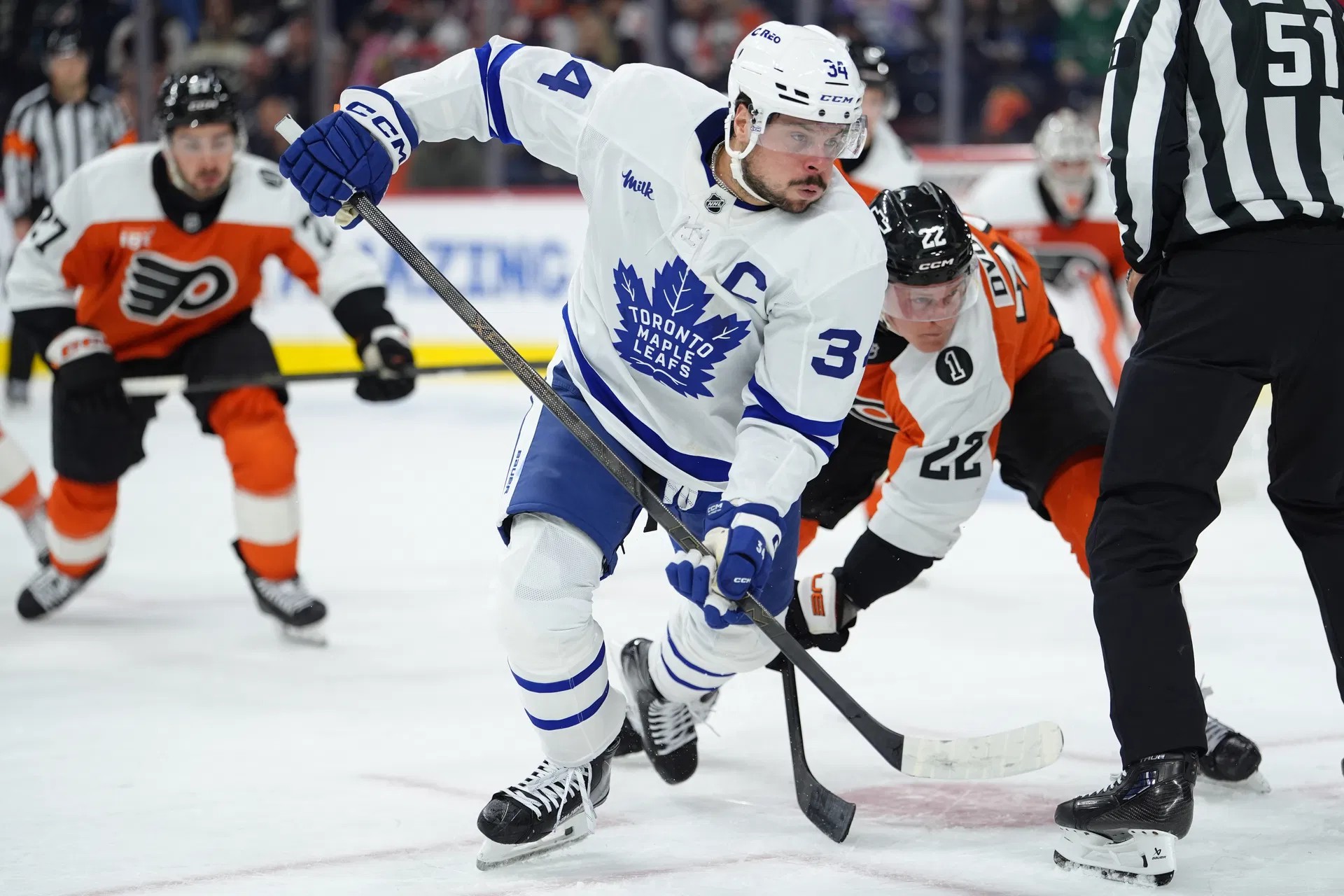
Auston Matthews’ 2025-26 season made one thing abundantly clear: The Maple Leafs need their franchise player back.
The flashes were still there. There were nights and stretches during the 2025-26 season when Auston Matthews looked like the player we all remember — the one capable of taking over games, pouring shots on goal, and beating goalies from just about anywhere. It just didn’t happen frequently enough.
Matthews finished with 27 goals and 53 points in 60 games, producing 0.45 goals per game (lowest of his career) and 0.88 points per game (lowest since his rookie season). Among regular NHL forwards, he finished outside the top 40 in goals per 60 and 80th in points per 60 over all situations — unthinkable territory for a player who entered the season as the league’s active leader in career goals per game.
He also averaged 20:48 per night, blocked a career-high 81 shots, won 55.3 percent of his faceoffs, and regularly handled some of the most difficult assignments in the league. It wasn’t as though Matthews stopped contributing at a pretty high level. Even an underachieving version of him could still defend, win draws, kill penalties, and produce at close to a point-per-game rate.
But for a player of Matthews’ calibre — and at his price point — that is not the standard. The Leafs do not need Matthews to be merely good. They need him to dominate.
The flashes of the old Matthews
Matthews’ 2025-26 season was not one prolonged struggle.
His first truly encouraging stretch arrived around the Christmas break. After missing time in November and spending chunks of the first 31 games looking unusually quiet (23 points in those 31 pre-Christmas games), Matthews started attacking with more confidence.
He produced four points across the home-and-home set against Ottawa and Detroit after Christmas before taking over against Winnipeg on January 1. Matthews scored a hat trick and added an assist in a wild 6-5 win, repeatedly created offense off the rush, and looked dangerous nearly every time he touched the puck.
Two nights later against the Islanders, he broke Mats Sundin’s franchise goals record with a two-goal performance. Matthews appeared to turn a corner and looked dangerous on virtually every shift against Winnipeg and New York. A shot off the crossbar in Detroit engendered a genuine “Where have you been?” reaction, given the velocity with which it came off his blade.
During the Leafs’ 7-0-2 run back into the playoff conversation, Matthews again looked capable of driving the bus. The McMann-Matthews-Domi line brought speed in transition and controlled over 65 percent of the shot attempts and 70 percent of the high-danger chances through its early sample. McMann’s puck pressure on the forecheck helped the line possess the puck, while Domi found Matthews in good spots.
He generated enough chances against Florida that he could have scored three. He scored a vintage goal in a big win over Colorado on January 12, collecting an awkward pass in his skates through the neutral zone, gaining the offensive blue line with speed, changing the shooting angle, and ripping the puck far-side over Mackenzie Blackwood. It was a release only a tiny handful of players in the world can execute.
Those moments kept the question alive: Was the real Matthews finally standing up?
It never lasted.
Matthews’ disappointing season wasn’t limited to raw production. He didn’t take over shifts or games at the rate we became accustomed to during his peak years. The puck did not follow him around the offensive zone. There were fewer undeniable retrievals, fewer strips that immediately turned into scoring chances, and fewer sequences where the opposition simply could not get the puck from him.
Most concerningly, Matthews sometimes looked reluctant to shoot, and when he did, the shot didn’t seem to have the same zip. Before the Olympic break, he walked into a prime shooting position on a five-on-three but attempted an awkward pass to Matthew Knies instead. During the Olympic gold-medal game, Matthews again received the puck alone in front and elected to pass rather than blow it by the goalie.
Those moments fit the larger statistical picture. Matthews was producing his lowest shot-attempt and shot-on-goal rates since his entry-level seasons. His 3.78 shots per game is a high number in general, but it was well below the standards of one of the greatest volume shooters and finishers of his generation.
Matthews has set an absurdly high bar for himself, and that context matters. Even during a disappointing season, he scored at a 37-goal pace over 82 games. Every team would happily take the supposedly broken version of Matthews.
But this was not simply a case of an elite player falling slightly below his usual level. For substantial portions of the season, Matthews looked like a shell of the player who scored 60 goals in 73 games in 2021-22 and 69 in 81 games two years later.
Before his final game of the season, he went 12 consecutive games without scoring (zero goals, seven points, minus-six).
Leafs brass made life difficult for Matthews
Matthews needs to take responsibility for his season, but the Leafs also spent the year making his ice time less conducive to offensive production.
Craig Berube deployed Matthews as a matchup center regardless of the quality of his linemates. Matthews handled the most difficult workload of any Leafs forward and stood well apart from other top NHL centers in the combination of strength of competition and defensive responsibility he faced.
The Leafs under Craig Berube essentially played head-to-head every night, and Matthews was asked to win those minutes while regularly playing with wingers such as Max Domi, Bobby McMann, and at times Matias Maccelli. Domi was Matthews’ most frequent five-on-five linemate; McMann was third. Both had productive stretches, and McMann was arguably the winger who most consistently helped the line tilt the ice. Still, Matthews spent the season without a proper right winger. Domi’s offensive instincts helped at times, but his well-known shortcomings created problems against top competition. On the left, McMann brought speed and an excellent shot but is not a natural distributor.
The team’s playing style compounded the problem. The Leafs struggled to execute clean breakouts, and Matthews regularly had to start shifts by chasing the puck or receiving it without speed instead of attacking in an organized fashion through the neutral zone with possession.
It was hard to watch him play that system/style without wondering whether he was becoming discouraged by it. The Leafs had one of hockey’s most dangerous offensive players and often deployed him like a shutdown center attached to mediocre wingers on a team incapable of breaking out or recovering their dump-ins consistently.
That does not totally absolve Matthews. Truly great players have to find ways to produce through difficult circumstances, particularly when they are the captain and second-highest-paid player in the league at the time.
The post-Olympic boost never arrived
The Leafs entered the Olympic break having at least narrowed the gap in the playoff race. Matthews then won gold with Team USA, creating some hope that the experience might restore a little swagger for the stretch run.
The possibility was admittedly a bit of a reach, but Leafs fans had little else to cling to. Matthews recorded 48 points in 51 games before the break — 54 NHL players had more points at the time — and the team’s fading playoff hopes depended on him changing the trajectory.
Instead, the Leafs lost their first three games after the break and their season was effectively over.
The schedule did them no favours. Matthews returned from an emotional high to immediate travel and a difficult NHL stretch, with little time to reset. At his end-of-season availability, he acknowledged that he found it difficult to regain his rhythm:
“Coming back from the Olympics, it was tough. You’re riding a very big emotional high, and then you’re trying to get back into it, continuing to play and not really getting a break, and there is the travel and all of that stuff. I found it kind of hard to get my game going back after the Olympics for a little bit.”
It was understandable. It was also disappointing. The Leafs needed their captain to lead them in a playoff push, but Matthews simply didn’t have much juice left.
The Gudas incident and Matthews’ role in the Leafs’ culture
As we all know, Matthews’ season ended on March 12 when Radko Gudas delivered a knee-on-knee hit that caused a Grade 3 MCL tear and quadriceps contusion. The injury was significant enough that Matthews was still on crutches shortly before his end-of-season media availability. Gudas received a controversially short five-game suspension, but the lasting conversation in Toronto surrounded the Leafs’ response — or lack thereof.
Cowan, Nylander, Morgan Rielly, and Brandon Carlo were on the ice. Nobody immediately confronted Gudas. Rielly later took responsibility publicly and was reportedly extremely apologetic privately, while Cowan fought Jackson LaCombe in the third period. But the initial image was impossible to shake: The Leafs’ franchise player and captain lying injured on the ice while the player responsible left the game untouched.
When Matthews was asked directly about the lack of response at the end of the season, he did not exactly rush to dismiss the question:
“It was an unfortunate play. I thought they responded in the third period. But it is an unfortunate play.”
The undertone of disappointment was difficult to ignore. At the same time, the captain cannot be separated entirely from the culture we were all criticizing.
Earlier in the season, rookie linemate Easton Cowan was dangerously thrown into the Leafs’ net by 5-foot-10 Ozzy Wiesblatt against Nashville. Matthews was directly beside the play but skated away while appealing to the referee. Cowan was then drilled by Filip Forsberg later in the period, and Matthews’ response amounted to little more than a light embrace.
Nobody should want the Leafs’ franchise player trading punches every time a teammate takes a hit. But it’s reasonable to expect him to properly confront the opponent, initiate a scrum, and make it clear that taking liberties will not be ignored, particularly with a rookie linemate.
If Matthews wanted a stronger response from his teammates against Gudas — and he had every right to — it is also fair to expect him to help establish that standard as captain.
Can the old Matthews re-emerge?
This is now the defining question of the Maple Leafs’ 2026-27 season.
Matthews will turn 29 before opening night. He has played more than 75 games only twice in 10 NHL seasons and is not a good bet to play 80-plus. Even when he is in the lineup, he regularly seems to be managing some kind of physical issue.
The concern is not that Matthews suddenly forgot how to play hockey. The concern is whether the explosive, dominant version of him can remain healthy enough to appear consistently.
There are legitimate reasons for optimism. Matthews liked playing for Jim Hiller during Hiller’s previous stint on the Leafs’ coaching staff. Hiller will look to rejuvenate the team’s offense, power play, and puck possession, and that should include a willingness to deploy Matthews as a goal-scoring superstar rather than as Patrice Bergeron with a worse collection of wingers.
There is also an argument for giving Matthews more time with William Nylander. The Leafs can always separate them when necessary, but after watching Matthews search for chemistry with a revolving cast, there is little reason not to give the pairing a meaningful run.
If Hiller prefers to keep Nylander with John Tavares for lineup balance reasons, Jack Roslovic is an option to try on Matthews’ right wing. Roslovic is a right shot, possesses speed and finishing ability, and has a longstanding friendship with Matthews. He is not a top-line winger with a track record of winning his five-on-five minutes, but he at least offers tools that might complement Matthews, even if it’s just during the less competitively intense stretches of a long regular season.
There is also the wildcard of Gavin McKenna’s potential. The 18-year-old will inevitably experience some ups and downs, and the Leafs should remain flexible/realistic with his deployment, but the appeal of pairing such a gifted playmaker with Matthews is obvious.
Over the offseason, assistant GM Ryan Hardy noted the parallel to Marner’s skill set historically complementing Matthews before adding, “Gavin’s line-rush game and some of the interior plays inside of possession — he’s got some unique gifts, and I think he would thrive with Auston.” Hardy also said Matthews would take it as “a bit of a badge of honour” to bring the first-overall pick under his wing. McKenna should not enter the league immediately burdened with that responsibility if he is not clearly ready for it, but his creativity could, sooner or later, give the captain the dynamic playmaking presence that was clearly missing from his line last season.
Further down the lineup, the additions of Nick Paul, Colton Sissons, Teddy Blueger, and Brandon Duhaime should hopefully give Hiller enough checking personnel to alleviate some of the defensive burden. Matthews will always face top competition to some extent — every elite center does — but there is no reason he should once again lead all centers in matchup duty.
The Leafs need to create more offensive opportunities for Matthews, connect him with better linemates, and allow their depth players to perform the checking roles they were specifically acquired to handle.
From there, the rest is on Matthews.
The buck still stops with #34
The Leafs changed many things around their captain. The management group is new. The coaching staff is new. Roughly half of the roster has turned over. The forward group now contains more legitimate checking personnel, and the defense should hopefully move the puck more effectively.
But none of it works unless Auston Matthews is Auston Matthews.
The organization is not operating on an indefinite timeline. Matthews has two years remaining on his contract, and the Leafs do not own their next two first-round picks. They cannot patiently wait several years for another contention window to materialize.
Matthews will also be eligible for an enormous payday in 2028 with the salary cap projected to reach approximately $120 million for 2028-29. When he chose a four-year contract instead of locking himself in for eight, the tradeoff was clear: less long-term security for an opportunity to sign a whopping deal under a dramatically higher cap ceiling.
Recent precedent-setting contracts around the league will only raise the incentive. If returning the Leafs to the playoffs, pursuing his first legitimate postseason run as he approaches 30, and answering for his own disappointing season are not enough motivation on their own, the financial reward awaiting him should be the cherry on top.
There is no roster construction, coaching adjustment, or clever deployment strategy capable of turning the Leafs into a contender if Matthews is merely a good two-way center who scores at a 37-goal pace while missing notable chunks of time. They need the healthy Matthews who takes over shifts and terrifies goalies from just about anywhere inside the offensive zone. They need the player who can carry mediocre linemates at times, dictate matchups, and make the rest of the lineup fall naturally into place.
Maybe that version was only hiding beneath injuries, questionable deployment, weak linemates, and a system Matthews appeared to lose faith in. The 2026-27 season will tell us all we need to know.