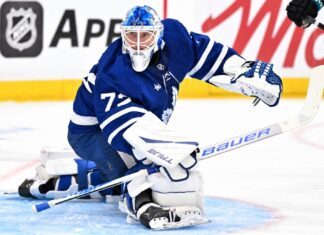


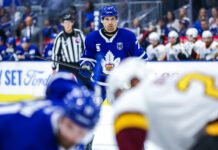

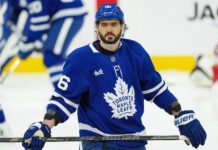






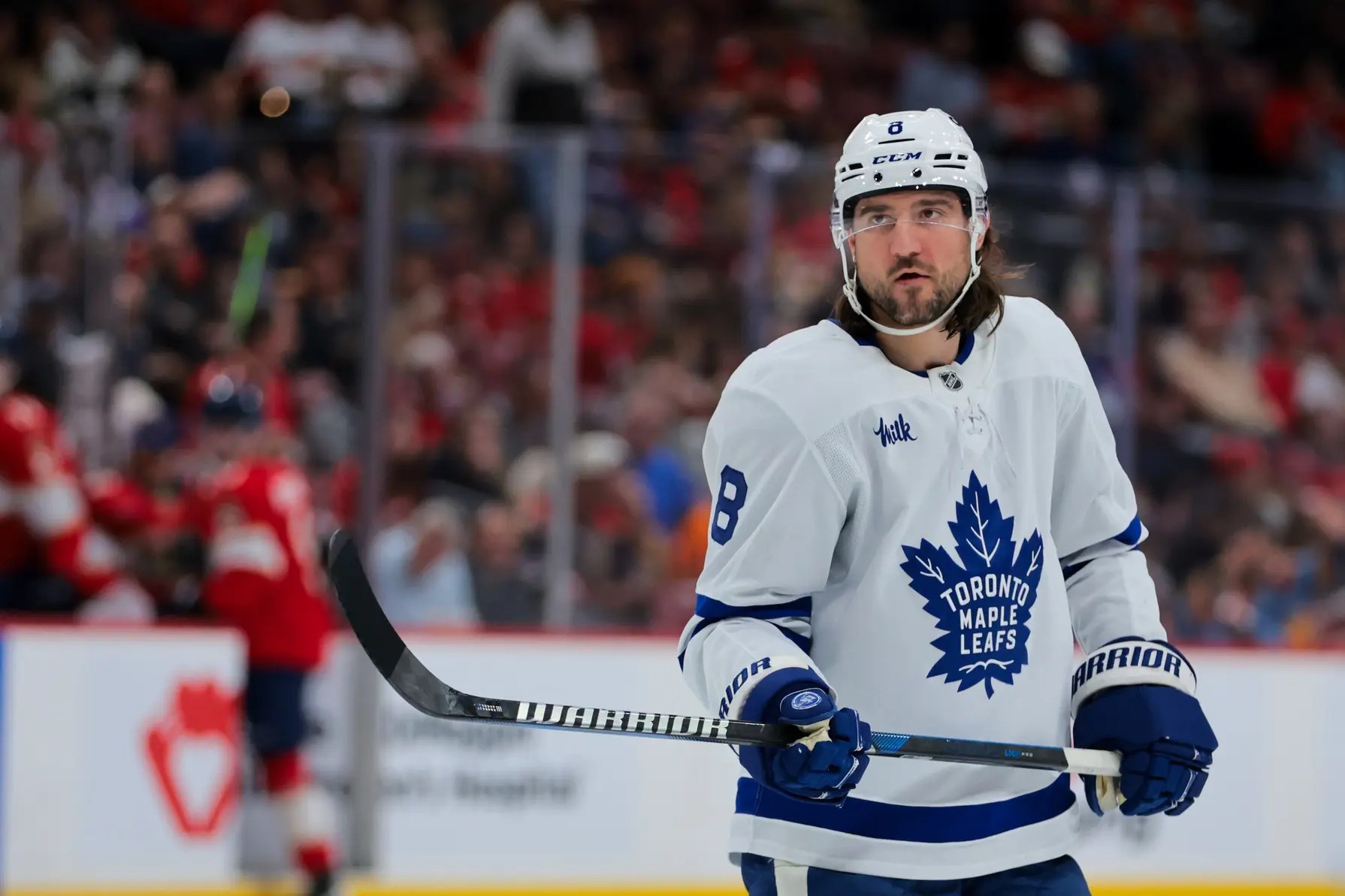
Assessing Chris Tanev’s first season in Toronto was fairly straightforward: He was exactly the player the Maple Leafs hoped they were acquiring.
His second season basically never got off the ground. Tanev appeared in just 11 games in 2025-26, one of which lasted less than six minutes. He recorded two assists, averaged 17:58 per game, and somehow still finished with a team-leading plus-eight rating. I mention that last stat more for fun than to pretend it’s truly meaningful over such a tiny sample, but it does capture how much better things generally looked when he was available.
The Leafs went 6-3-2 in Tanev’s 11 appearances, scoring 44 goals and allowing 38. Their record isn’t entirely attributable to him, of course, but it is notable in the context of a team that finished 32-36-14. The Leafs collected 14 of a possible 22 points with Tanev in the lineup and just 64 of a possible 142 without him.
For the most part, Tanev resumed his familiar role beside Jake McCabe. The pairing was the Leafs’ dedicated shutdown duo in 2024-25, and the Leafs started the new season by going right back to it. On opening night against Montreal, McCabe and Tanev led the defense in ice time, started only two of their combined 15 faceoffs in the offensive zone, and kept a clean sheet together.
Tanev’s individual game was not flawless in his brief run. There were some rusty/sloppy puck touches early in the season, and he played only seven full games before the injuries took over. Still, the broader impact was familiar: He settles things down in the defensive zone, kills plays early, moves pucks, defends the net front, and kills penalties.
The contrast after Tanev disappeared was stark. McCabe was pushed into an oversized workload and eventually became overwhelmed by it. Brandon Carlo never came close to filling the void. The Leafs dressed Philippe Myers too often and asked too much of the scrappy Troy Stecher while their defensive play deteriorated.
There was no replacing Tanev, and the Leafs spent almost their entire 2025-26 season proving it.
Two attempted returns, two crushing setbacks
Tanev’s season first went sideways on October 21 against New Jersey, where he left the game after just 5:57 with what was subsequently identified as a concussion. He missed the following three games before returning on November 1 in Philadelphia.
That return lasted less than a full game. Early in the third period, Flyers forward Matvei Michkov bumped Tanev from behind near the Leafs’ blue line. Tanev’s head snapped back as he fell awkwardly to the ice, and he remained down while medical personnel attended to him. He was eventually removed on a stretcher and taken to a Philadelphia hospital, staying overnight as a precaution before returning to Toronto.
It was a frightening scene. Tanev later described it as a “weird, fluke hit” and thanked the Leafs and Flyers’ medical staffs for making sure nothing catastrophic happened.
He remained active during recovery, skating on his own and working out in the gym, but the injury still cost him 23 games. After seeking additional medical opinions and gradually returning to contact, he finally rejoined the lineup on December 23 against Pittsburgh.
Unsurprisingly, Tanev was a little rusty. He played 17:23 and committed an early giveaway that handed Anthony Mantha a great scoring chance, but his presence was nevertheless an immediate emotional lift. By the end of the first period, the coaching staff reunited him with McCabe, and the Leafs went on to win 6-3.
Tanev played again in a 7-5 win over Ottawa on December 27 and suited up the following night in Detroit. On his final shift against the Red Wings, he took a step, felt a pop, and immediately knew something was wrong.
The diagnosis was a core-muscle injury, and doctors told Tanev that surgery was required. Initially, he chose to wait, hoping the Leafs might work their way back into playoff contention, allowing him to attempt one more return in April before undergoing surgery in the offseason. He skated on his own through the Olympic break and continued trying to reach the level required to rejoin team practices. As late as February, the possibility of playing again had not been entirely ruled out.
This was not a player looking for the earliest exit from a miserable season. Tanev was delaying a necessary surgical procedure because, if the Leafs got themselves within shouting distance of a playoff spot, he wanted to help.
Once the team stumbled out of the break and its playoff hopes effectively ended, the calculation changed. Tanev underwent season-ending core-muscle surgery on March 4, with the expectation that he would be ready for the start of 2026-27 training camp.
A culture setter: Tanev’s admirable accountability
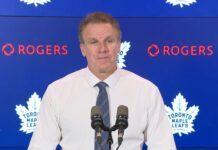
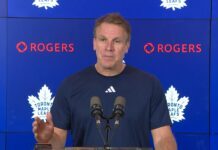
There were plenty of uncomfortable moments in the end-of-season media availabilities following the Leafs’ disastrous campaign. Tanev’s stood out for all the right reasons, and he described his season in one word: “Awful.” He did not use the injuries as an excuse or distance himself from what happened while he was unavailable. He acknowledged how difficult it was to watch the team struggle and repeatedly mentioned his disappointment over appearing in only 11 games.
When discussing former GM Brad Treliving’s dismissal, Tanev said he felt terrible for the GM who brought him home to Toronto:
I’m disappointed in how I was only able to play 11 games and let a lot of people down.
In reality, Tanev did not let anyone down. Bodies break down, especially after 16 NHL seasons of eating shots, absorbing hits on puck retrievals, and generally treating personal well-being as secondary to winning hockey games. Nobody who has watched Tanev compete could reasonably question his commitment.
But his response told us plenty about why he matters so much inside the Leafs’ room. He watched an embarrassing season unfold, hated that he could not help, and felt personally responsible for it.
The decision to delay surgery sent a similar message. Whether it was medically advisable is a separate discussion, but the motivation was admirable: Tanev refused to close the door while there was still a chance his teammates might need him.
He is a competitive savage. Pulling back has never been part of his DNA.
Is this becoming a Jake Muzzin situation?
The big question entering 2026-27 is whether Tanev’s body will still allow him to be the only style of player he knows how to be.
There is an obvious parallel to Jake Muzzin. Muzzin largely remained an excellent defenseman who made the Leafs significantly better. Eventually, though, the accumulation of wear and tear became too much. The issue was no longer whether he could play effectively when healthy; it was whether his body could withstand the rigors of NHL hockey at all.
Similar to Muzzin, whenever you hear about something popping or giving out in a non-contact situation—as Tanev described his final shift in Detroit—it is generally an ominous sign. It suggests less of a freak accident and more of a body struggling under years of accumulated wear and tear. That doesn’t mean Tanev’s career is destined to end the same way, but the comparison is difficult to ignore.
We are not definitively at that point with Tanev. He is expected to be ready for camp, and the injury that ended his season was surgically repaired. He also played 75 regular-season games and all 13 playoff games in 2024-25, so we are only one season removed from Tanev carrying a significant workload and playing excellent hockey.
But he will turn 37 in December. He played 11 games last season, suffered three separate physical setbacks, and required surgery. Even if the specific injuries are behind him, durability can no longer be treated as a secondary concern.
That makes Tanev one of the Leafs’ biggest wildcards in 2026-27. If he is healthy and still close to the 2024-25 version, the entire defense changes. The penalty kill regains its best right-shot defenseman. The Leafs could restore a matchup pair capable of absorbing difficult minutes, which eases the burden on Morgan Rielly, Oliver Ekman-Larsson, Darren Raddysh, and the rest of the group.
The Leafs’ blue line is probably one quality defenseman short on paper, but a healthy Tanev can close a significant portion of that gap by himself. If he cannot stay in the lineup—or if the injuries and aging have significantly eroded his game—the Leafs are again left trying to replace a player whose particular combination of defensive IQ, positioning, puck movement, penalty killing, and physical sacrifice does not exist elsewhere on the roster.
Load management has to be more than a nice idea
If Tanev arrives at camp healthy and looks like himself, the temptation will be strong: reunite him with McCabe, restore him to the top penalty-killing unit, assign him the toughest opposition every night, and let him solve half of the defense’s problems.
The Leafs cannot give in to all of it. Tanev is highly unlikely to ask for fewer minutes, easier assignments, nights off, or a reduced penalty-killing role; he is wired the complete opposite way. If the coaching staff offers him 22 minutes against the opponent’s best players, including every important penalty kill and defensive-zone draw, he will jump the boards every time without blinking.
That is why the organization has to provide the restraint for him. Load management does not necessarily mean placing Tanev in bubble wrap or sitting him every other game. It means recognizing back-to-backs, monitoring his minutes when games are effectively decided, avoiding the urge to double-shift him through every difficult stretch, and distributing some of the matchup and penalty-killing responsibilities across the group. The Leafs should be aiming for the largest sustainable contribution, not squeezing every possible minute out of him until something breaks.
If Tanev can give them a significant percentage of the season healthy while playing anywhere close to his established level, it would be an enormous boon. His presence immediately makes his partner better, gives the defense a leader/culture setter and more of an identity, and stabilizes areas that completely fell apart without him.
Leafs brass know how valuable Tanev is when he plays, and they can only do so much about his injuries. But for their part, the challenge in 2026-27 is ensuring they don’t lean on him so heavily that they lose him again.