


We can all agree with Craig Berube’s lamentation of his team’s lack of urgency to start the third period while down a goal in this game.
The contest obviously ended inside the first two minutes of the final frame when the Leafs came out, played in their own end, punted pucks back to the Oilers repeatedly, and gave up two goals in two minutes to make it 5-2. It started with a miserable tone-setting shift from the top line and unravelled from there.
Berube also lamented a mental slip-up late in the second period by the makeshift Domi, Roy, and Robertson combination; he wanted them to change off quickly, as they ended up on the ice against McDavd, Draisaitl, and Hyman at period’s end in a tie game. Berube suggested it cost the team after “playing pretty well for two periods.” Here were the numbers for the first 40 minutes, via SportsLoqIQ:
| Stat (SportsLogIQ) | Oilers | Maple Leafs |
|---|---|---|
| Goals | 3 | 2 |
| High-Danger Chances | 21 | 9 |
| Cycle Chances | 10 | 4 |
| Puck Battle % | 60 | 40 |
It begs the question: What is the bar for “pretty well” in the eyes of the Leafs‘ coaching staff?
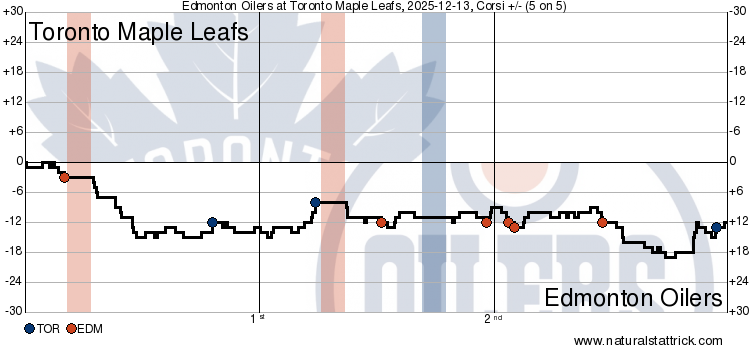
It’s easy to spend all of our time talking about character, leadership, and effort, especially after the headline-grabbing post-game quote from Berube about the team’s leaders needing to take control of things. To be clear, there are some very fair and valid questions to be asked there. But if you’re ignoring the systemic flaws rearing their heads in these game-swinging moments, or the fact that the Leafs were more than doubled up in five-on-five shot attempts from early in this game (23-10 after the first period), you’re missing a critical part of the equation. Structurally, philosophically, and in their public messaging, the coaching staff is off the mark right now.
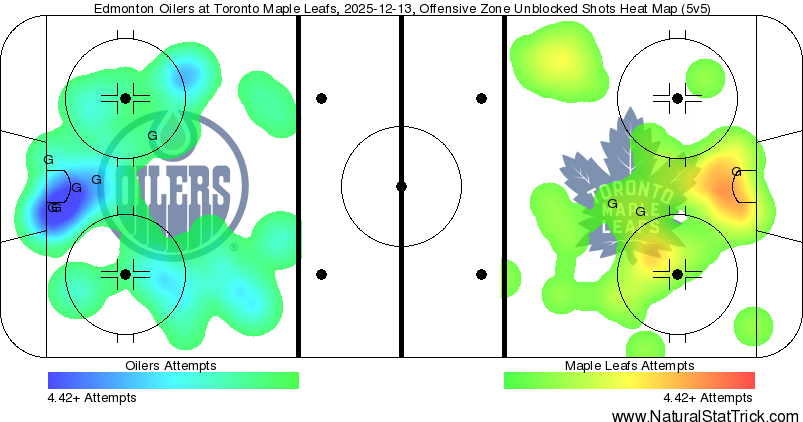
As seen again to start that third period, the Leafs repeatedly throw pucks away to the other team, and their breakouts are, by and large, a mess. It goes without saying that you must possess the puck enough and make a team like the Oilers defend for their fair share of the five-on-five game, or the odds of a positive result become very low, knowing Edmonton’s pace and offensive abilities. You could count the number of extended offensive-zone shifts the Leafs generated in this game on one hand (they scored on one of them, via the top line and OEL, to make it 2-1). And yet the messaging from the coach after the game was that the team played pretty well for two periods and threw it away with mental mistakes.
If you’re not seeing the throughline from Berube’s “patience” and “mentality” talk after Florida completely dominated the puck against the Leafs in Game 7, you’re missing a big part of the story of the team’s underachievement this season. For Berube, it’s almost always about impatience or mental mistakes. It’s never about the clear structural flaws.
The worst part is that it’s all become very predictable. In almost every single game against a strong opponent, we’re all but assured the Leafs will struggle to break out cleanly and will be handily out-possessed and out-shot. They will need a combination of very committed in-zone defending, good-to-great goaltending, and opportunistic offense to win the game (despite a currently league-basement power play). This is not a sustainable formula for beating serious teams, and certainly not for picking up 16 playoff wins over four different best-of-seven series.
Round and round we go.
Post-Game Notes
– I encourage everyone to listen to the short post-game interview by Scott Laughton (who had another good night on the PK, in the faceoff circle, and picked up a nice assist on the Easton Cowan 1-1 goal). He sees it. This isn’t just about cleaning up a few details in the team’s game, e.g., Nic Roy not turning it over at the offensive blue line, the situational awareness late in the second period, Morgan Rielly not picking up a stick in front, etc. The problems run deeper than that.
“We need to be better in every area of the game. It is just not good enough… You have to wear the team down, go the other way, play north, and make them come 200 feet… We have to start pushing, have some urgency, and get going here.”
– There is a fine line between admirably playing through injury/illness to be there for your teammates, and knowing when you’re better off stepping aside for a healthy body that can give the team a proper effort on the ice. William Nylander was clearly sick tonight; he could hardly move his feet, let alone make a decent play or decision with the puck. Remarkably, that line ended up with one five-in-five shot on goal in nearly 11 minutes (vs. seven against), and it was Tavares’ breakaway where he stripped a puck himself at the defensive-zone blue line and was stopped by Jarry. Nylander and Tavares finished minus-three, and the expected goal share of their line for the game was 3% (not a typo). At that point, just let Matias Maccelli dress.
– After the OT loss to San Jose, we wrote:
With the Joshua-Roy-Nylander and Lorentz-Laughton-Jarnkrok lines on the ice, the Leafs were up 21-13 in shot attempts, 11-5 in shots, and owned nearly 80% of the expected goals at five-on-five (1-0 in actual goals, courtesy of the Roy-Nylander line). With the Tavares and Matthews lines on the ice, the Sharks were up 23-19 in shot attempts, 14-9 in shots, and over 80% in expected goals (1-0 in actual goals).
Tonight, the shot attempts were 24-9 for the Oilers with the Leafs’ top six on the ice. The only core player who showed obvious signs of elevating inside a marquee matchup like this was Matthew Knies, who was a beast at various points and drove/created a lot for his line.
– It’s natural to compare Auston Matthews’ impact to McDavid or Draisaitl’s in games like these and talk cap hits and so on (those are obviously fair convos). I am not going to open that can of worms today, but I will measure Matthews against his own previous standard, as we continue to ask ourselves, “Geez, what’s happening here?”
He remains not as explosive in his shot or skating, not as sure on the puck or in his puck battles. Late in the Oilers’ first-period power play, with a tired Oilers unit on the ice, Knies was leading a promising shorthanded rush. Matthews hopped the boards with fresh legs and a potential chance to turn on the jets, past a tired Zach Hyman and into the zone, for a potential cross-ice pass or rebound opportunity. Matthews tried, but he didn’t even come close to closing the gap. Knies shot it, and Jarry pretty easily saved/froze it, but if there was a far-pad rebound play there, Matthews wouldn’t have even been in a position to bury it.
Similarly, there was a dump-in play at one point where you thought Matthews had a good chance to close on Darnell Nurse and potentially strip him — at his best, if a puck was anywhere in Matthews’ orbit, he almost always came up with it — but it ended up as a routine play out of the zone for Nurse. At another point, the Leafs’ top line appeared to be getting a cycle and sustained pressure going in the offensive zone, but Matthews just whiffed on the puck on a routine play behind the Oilers’ net, killing the offensive sequence.
It’s not like he’s playing downright poorly most nights (seven points, 33 shots on goal in his last eight is by no means poor), but it remains hard to put a finger on what’s going on here, other than what Justin Bourne once termed “the absence of greatness” we once knew.
– Don’t want to leave this review without finding some kind of positive out of this one, so: The Leafs’ one power-play opportunity in this game was their best in a while. Lots of urgency, pounding pucks from the top with traffic, winning pucks back, and reloading for more. Oliver Ekman-Larsson was a real threat on the second unit from up top and remains their clear best option at the QB spot, for my money.
Game Flow: 5v5 Shot Attempts
Heat Map: 5v5 Shot Attempts
Game Highlights: Oilers 6 vs. Maple Leafs 3


