























In a quarterfinal rematch against a Czech team that Canada thoroughly outclassed just six days earlier, Canada got through to the semifinal by the skin of their teeth.
The signs were there early, as David Kampf missed a wide-open net to give Czechia the early lead. At the time, it felt like a big momentum swing when Canada went down the ice shortly afterward and scored off a brilliant solo effort from Connor McDavid.
McDavid stole the puck from David Pastrnak in the neutral zone and drove wide off the rush before sifting a nifty backhand pass to Macklin Celebrini in the slot. Celebrini did really well to get a quick release off, and just like that, Canada was up early despite an inauspicious start.
However, the goal didn’t settle the game down for Canada. Five minutes later, Czechia tied it following an awful cross-ice pass by Mark Stone. Radko Gudas picked it off in the neutral zone and immediately transitioned it up ice, catching Canada on a line change. Gudas made a nice cross-ice pass to Roman Cervenka, who found Lukas Sedlak at the backdoor for a gift of a goal.
Canada went to a power play afterward with a chance to get the goal right back, but they didn’t generate a ton. Soon after, Czechia went to a power play of its own and cashed in. It was a goal Leafs fans know all too well: a David Pastrnak one-timer from the faceoff circle following a faceoff win. Just like that, Canada was suddenly down 2-1.
By this point in the game, Czechia registered seven shot slots in the period after recording just six against Canada in their entire previous meeting.
This marked the first time Canada had trailed throughout the tournament, so it was going to be interesting to clock the response. The start of the second period felt tentative, if anything. Czechia locked down the neutral zone and forced dump-ins, and Canada wasn’t making much of a push to generate chances or sustain zone time.
It went from bad to worse for Canada when Sidney Crosby took two Gudas hits on the same shift and came away limping. Crosby stayed on the bench for a bit, never came out to take another shift, and ultimately left the game for good.
The game was officially a slog and was starting to turn ugly, but then Canada received a gift of its own. On a shift where Czechia pinned Canada deep in their own end, Michal Kempny knocked down MacKinnon away from the puck and took a needless — and truthfully soft — interference penalty. Canada made them pay via none other than MacKinnon himself, who walked in from the half-wall and ripped one off the bar and in.
With Crosby out, MacKinnon moved up to play with McDavid and Celebrini, and Nick Suzuki moved in between Mitch Marner and Mark Stone, as Canada seemingly rallied around their captain’s injury.
At this point, Czechia was begging to make it to the intermission tied. Canada outshot them a ridiculous 17-5 and dominated the period, doing everything but scoring more than once. Not among those 17 shots on goal was Suzuki’s wide-open-net miss/post at the backdoor, and there was also a failed power play late in the period.
We’ve seen this movie a million times in hockey: one side should be leading; they don’t score, and it bites them at the other end.
The third period was a lot more tentative, and Canada looked a lot like a one-line team for most of the final period of regulation. If the McDavid line wasn’t out there, essentially no other Canadian line was creating much of anything. And then disaster struck.
With just under eight minutes left in the game, Czechia scored on an odd-man rush after Thomas Harley fired one into the shinpads. Ondrej Palat took a trailing pass and ripped one home. The goal should not have counted; there were six Czech skaters on the ice, including in their goal celebration huddle:
Suzuki and Doughty struggled to sort out the 3-on-2 coverage on the goal that almost ended 🇨🇦’s Olympic tournament. Why? 🇨🇿 got away with having 6 players on the ice.
Credit eagle eye @DimFilipovic for noticing, but this screen shot is from right after Harley’s shot got blocked. pic.twitter.com/f58ydhjbrI
— Thomas Drance (@ThomasDrance) February 18, 2026
That’s an awful missed call in any game, let alone the third period of a tied quarterfinal game in the Olympics. Beyond the pale.
Now, Canada was facing some real adversity: down late, with Czechia fired up, the other goalie locked in, and Crosby out of the game. The concern was real and justified, and outside of a few MacKinnon/McDavid moments, Canada didn’t have much of anything going on.
Almost out of nowhere, Suzuki — who missed an open net to give them the lead in the second period — snapped into hero mode. He won a battle to get the puck out of the Canadian zone, dumped it in, and solo forechecked to create a turnover and some zone time. He then applied a gorgeous tip on a Devon Toews point shot to tie the game with under four minutes remaining.
It was a great goal and a great moment, but the celebration was almost short-lived. Toews shot one in the shinpads of Martin Necas, who turned it up ice for a clean breakaway on Jordan Binnington. The heavily scrutinized Canadian netminder stopped not just the first chance but also the rebound attempt.
Binnington’s night wasn’t done yet. The game headed to 3v3 overtime, where Binnington again faced a Czech player alone and aggressively challenged out of his crease to make yet another big save.
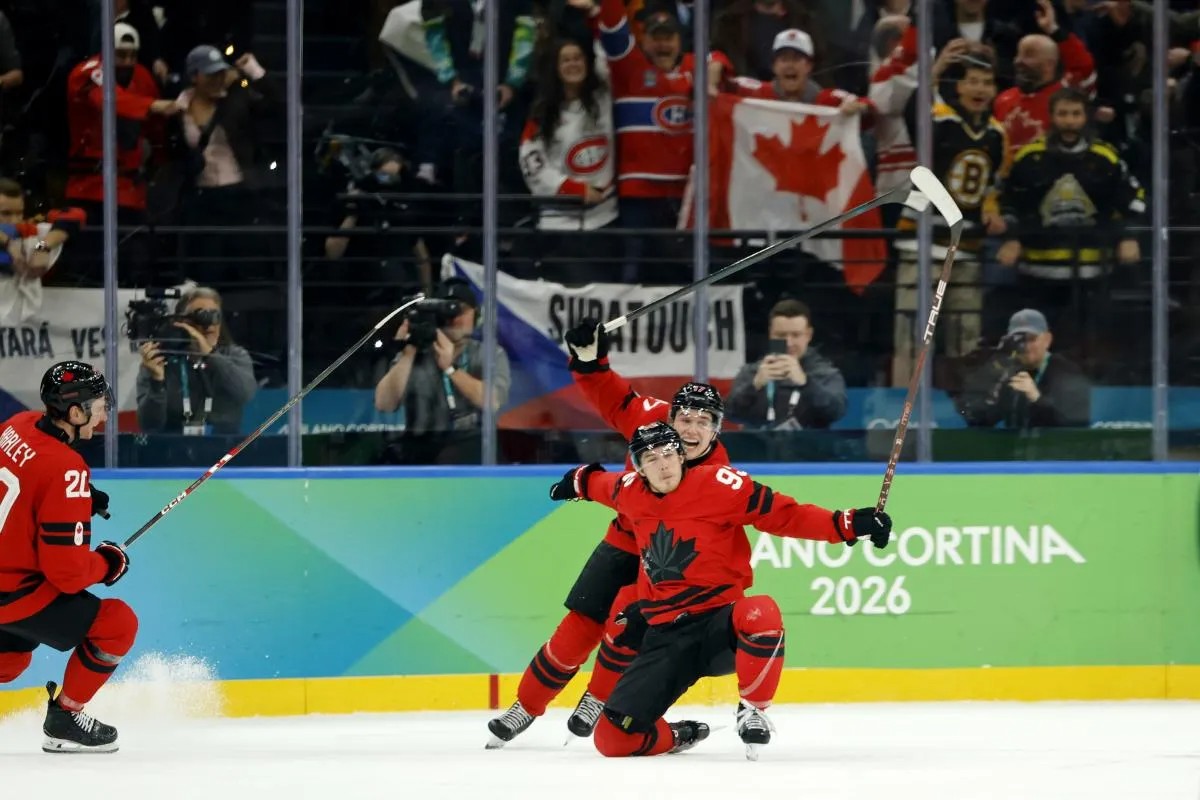
After the McDavid-MacKinnon duo didn’t score, the next tandem up was Celebrini-Marner for Canada. Marner took a drop pass in the neutral zone and sifted through (ironically) ex-Leafs Kampf and Ondrej Kase before firing a cross-body backhand into the top corner on Dostal, sending Canada to the semifinals in highly stressful, dramatic fashion.
Post-Game Notes
– Early on, this very much felt like a game where Canada would be genuinely tested for the first time. Would they dig in and get through it, or collapse under their first real adversity of the tournament? There were many moments when the collapse looked fully underway, but credit to them for their perseverance and grit in pulling this one out.
– Nick Suzuki and Mitch Marner will rightfully receive a lot of attention for their efforts on the game-tying and game-winning goals, but Binnington came up big multiple times with the game on the line. He’s faced a lot of criticism for even being on the roster — and he has been terrible this season in the NHL, to be clear — but he has shown himself to be a gamer time and time again.
– Another proven gamer was not in the lineup today: Sam Bennett, whose absence was felt. There’s some talk of a Bennett injury, but Brad Marchand laboured around the ice for 7:13 in a game where Canada was down a forward for effectively two periods. Bennett should definitely be reinserted for the next game.
– Suzuki looked much better once he was moved back to center compared to his play on MacKinnon’s wing. Firstly, he doesn’t have the wheels for the latter situation. Secondly, he looked a bit like a lost puppy on the wing; fair, considering he’s a natural center through and through. I wonder how much wing, in serious hockey, he’s played in his entire life up until these Olympics? At center, he was far more assertive and involved.
– Sam Reinhart also moved to center due to the Crosby injury and was not particularly effective or useful. He played just 9:37. Only Marchand and Tom Wilson played less at forward.
– 21:48 for McDavid, and 22:43 for MacKinnon. I think the coaching staff will need to do more to at least get two lines rolling for Canada, but these are there-is-no-tomorrow, do-or-die games. You have to load the big dogs with minutes, and Jon Cooper did. To that end, Makar played a monster 26:41; what a treat he is to watch, and he also hit the post in the second period. Makar appears to be Canada’s only truly dynamic defenseman right now. Canada has some good shooters on the back end outside of Makar, but he’s the only one who can really beat defenders straight up with his speed/skill.
– The coaching staff also may want to reconsider Celebrini’s 14:48. It ranked sixth among Canadian forwards, and he tallied points on three of Canada’s four goals in this game.
– Maybe I’m a traditionalist, but I just can’t get behind games of this magnitude being decided in 3v3 overtime. It leans more to a gimmick and a skills competition than real hockey. 4v4 would be a little bit better. 5v5 would be ideal.