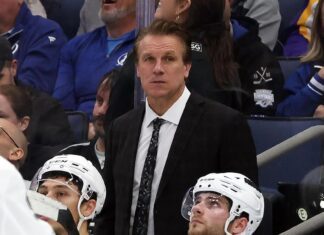


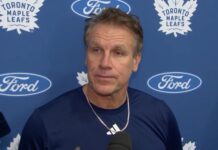











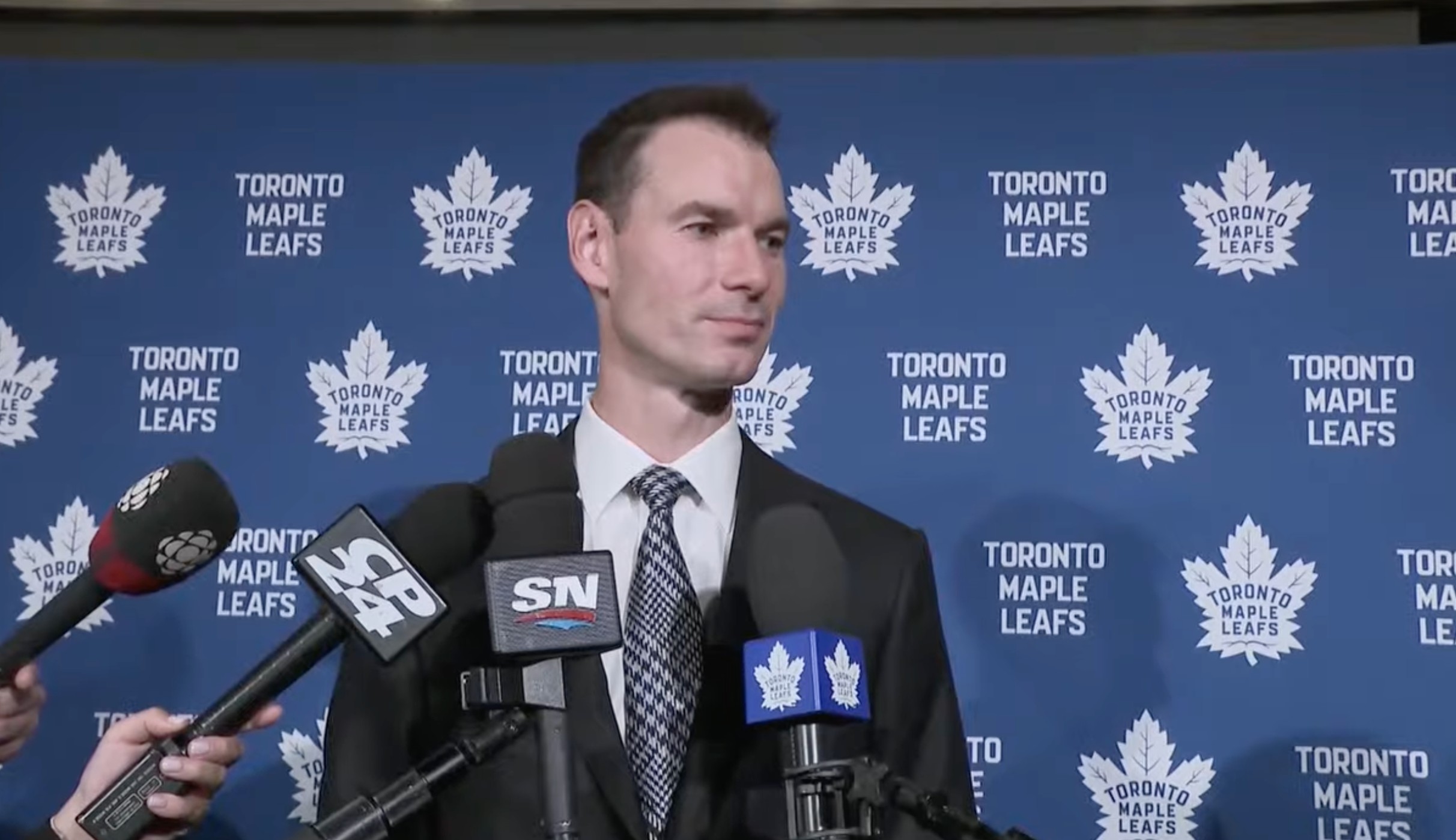
On the eve of the 2026 NHL Draft, GM John Chayka formally introduced Jim Hiller as head coach and discussed the process of preparing for the draft, free agency, and the trade market as the offseason progresses.
John Chayka’s Opening Statement
Chayka: I’d like to start by congratulating Keith Pelley, Ryan Hardy, Mike Dixon, and John Gruden for their Marlies championship. Hopefully, it’s a sign of things to come for us around here.
I also wanted to acknowledge the greatest sports fans in the world, Leafs Nation. Your passion, loyalty, and unwavering support are what make an organization like this so special. Today is an exciting day for all of us.
I want to extend a warm welcome — welcome back — to Jim and his family to Toronto. We are thrilled to have you, and you are a big part of our next chapter here.
I want to thank our owner, Ed Rogers, as well as Tony Staffieri, for their support throughout this process.
We conducted a thorough and comprehensive search, looking for the right leader and the right partner for our hockey operations group. Throughout that process, Jim consistently distinguished himself with his experience, leadership, his ability to communicate and connect with people, and his vision for what it takes to build a winning team.
We are excited to introduce the next head coach of the Toronto Maple Leafs, Jim Hiller.
Q&A: John Chayka on the draft, FA, and trade talks
How much do you lean on Jim Hiller’s expertise in terms of the pick and beyond this offseason?
Chayka: On the pick side, I think the amateur scouts have done the two-year process, but the philosophy and principles are a partnership with Jim. That is one of the reasons why I felt really comfortable with him. Mats and I both talked about having an extension of the front office and a real thought partner who could challenge some things but could also find a lot of alignment in how we saw hockey and building out an organization.
One of the advantages of Jim was our view on collaboration. Whether it is the draft, free agency, the locker room, or dealing with personalities, it’s important that we have some alignment around that, and we do.
Do you have a quick thought ahead of tomorrow’s draft, and what you can share as far as the preparation? Any trade secrets you can share at this point?
Chayka: Haha, no trade secrets, but we do have our pick, though, and a lot of conviction around it. As soon as the ball drops, everyone is working through all of the different scenarios. It was really a two-year process for the guys. They’ve done a nice job of collecting information, the ground intel, watching the trends, talking to the coaches, and collecting as much info as possible.
You hope to get some luck like that, and it is an opportunity you can take advantage of. It is not just a special opportunity to get the first-overall pick. It is what you can do with it, and certainly, it can change franchises for decades to come.
How would you describe the process of arriving at the final selection? Was it really hard?
Chayka: Any time you make a big decision, the more time you can spend on it, the more angles and lenses you can consider — all of the different data points and perspectives. You want to almost make it a bit painful to make sure you are getting it right.
I think that is what we did. We spent a lot of time on it. We heard all of the different perspectives and got a lot of input. Judd Brackett and Mark Leach are ultimately the ones responsible for that selection, and I support them.
What sort of impact do you expect your first overall pick to make immediately in the NHL?
Chayka: Historically, it has been a pretty good impact, but obviously, there is some variance to it as well. We are less focused on the immediate impact and more focused on who will be the best player over their career. Again, the ability for those top picks to be able to shape franchises is real. We certainly hope that is one of them for us.
Having gone through the process now, what are your final takeaways about Gavin McKenna as a player?
Chayka: Again, we spent time with all of the top picks. I got the chance to spend time with Gavin in Whitehorse, and he is a unique player and person. It is an amazing story.
He never had a skills coach until he was 13. He didn’t have a skating coach until he was 13. He was not in the gym until he was 15. It is that Canadian story of being out in the rink, love for the game, and passion for the game. His unique ability to break down the game and create offensive chances is special.
But Mats spent a lot of time with some of the players as well, and we kind of broke it up. But I am really impressed with Gavin, of course.
How do you feel about the decentralized draft? What will that be like?
Chayka: I defer to the commissioner and his process on that. I’ll support whatever they want to do. I am flexible, honestly. There are pros and cons. I don’t know if there is a right answer.
How would you gauge the market in terms of trade activity? Is your phone blowing up? Is it quiet or ridiculously busy? How would you describe it?
Chayka: It is normal, which is ridiculously busy at this time of year. There is liquidity in the market right now. The opportunity to make our team better over the next 10 days is vital. We really have to be prepared. We have all the scenarios mapped out, and then it is about Mats and me making the big decisions and making the right ones.
Where do things stand with Morgan Rielly? How have you approached the situation with him?
Chayka: Morgan is the longest tenured Leaf. I have tons of respect for everything he has done, not only on the ice — he is a prolific player — but off the ice as well.
It is no different than any other player. We have a lot of discussions about what the best fit is for the player, what the best fit is for the team, and how we put the roster together on the ice. We continue to have all of those types of discussions to see if there is an opportunity to make our team better.
It is a great relationship. We’ve had great discussions. He loves being a Toronto Maple Leaf. We certainly think he is a great player.
How do you feel about the free-agent market this summer? Is that somewhere you envision improving the team, or are you more focused on trades?
Chayka: With where we are, we have to look at everything, including free agency. We made a trade to be proactive and secure a player we felt was a difference-maker in free agency, but there are still a lot of opportunities out there. We are trying to balance it all. Obviously, it is not cheap in free agency. You have to make smart bets, and when you do have vision, go after those types of opportunities. But we are equally engaged in the trade market and are having lots of discussions there, too.
How do you feel about the team’s goaltending situation after the Joseph Woll trade? Are you comfortable with it as is? Is it an area you’re still looking to improve?
Chayka: I think we are comfortable with it. Anthony has been a very successful goalie over the last couple of years at stopping pucks. That is a good start. The way AA finished the season gives you a lot of hope for what he can do in the future. Dennis, for a young goalie, has stopped the puck at a really high level at the NHL level. We feel really good about the combination of that.
Just like our defense and forward group, we will continue to pursue everything that gives us a chance to be better. There might be some opportunities. There might not. As we sit here today, it is a good group, and it is good to have good depth and strength in that position, but it is also one of those positions where you’re always focusing on how to be better.
You mentioned finding some internal candidates intriguing at the center ice position. Who jumps out to you from within the organization?
Chayka: There is some flexibility with some players in terms of center or wing. Certainly, as we forecast into the future, Koblar is a guy who is on the right trajectory. We were able to get him signed. He will be coming to camp to compete. There are some guys on the Marlies who have done a good job and are signed for next year. They came up in spurts and played really well for us. It will be an open competition. We will try to have some good depth. That is really what we’re focused on.
How close do you think the team is to being a contender?
Chayka: As we sit here today, we are certainly better than we were at the last press conference, but I would still say there are significant holes we’re trying to address. Now is the time to do that. We still have a long way to go, but we are in a better place.