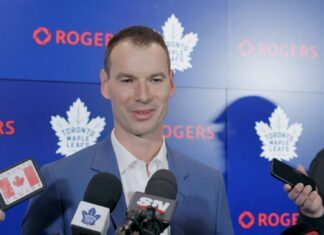

















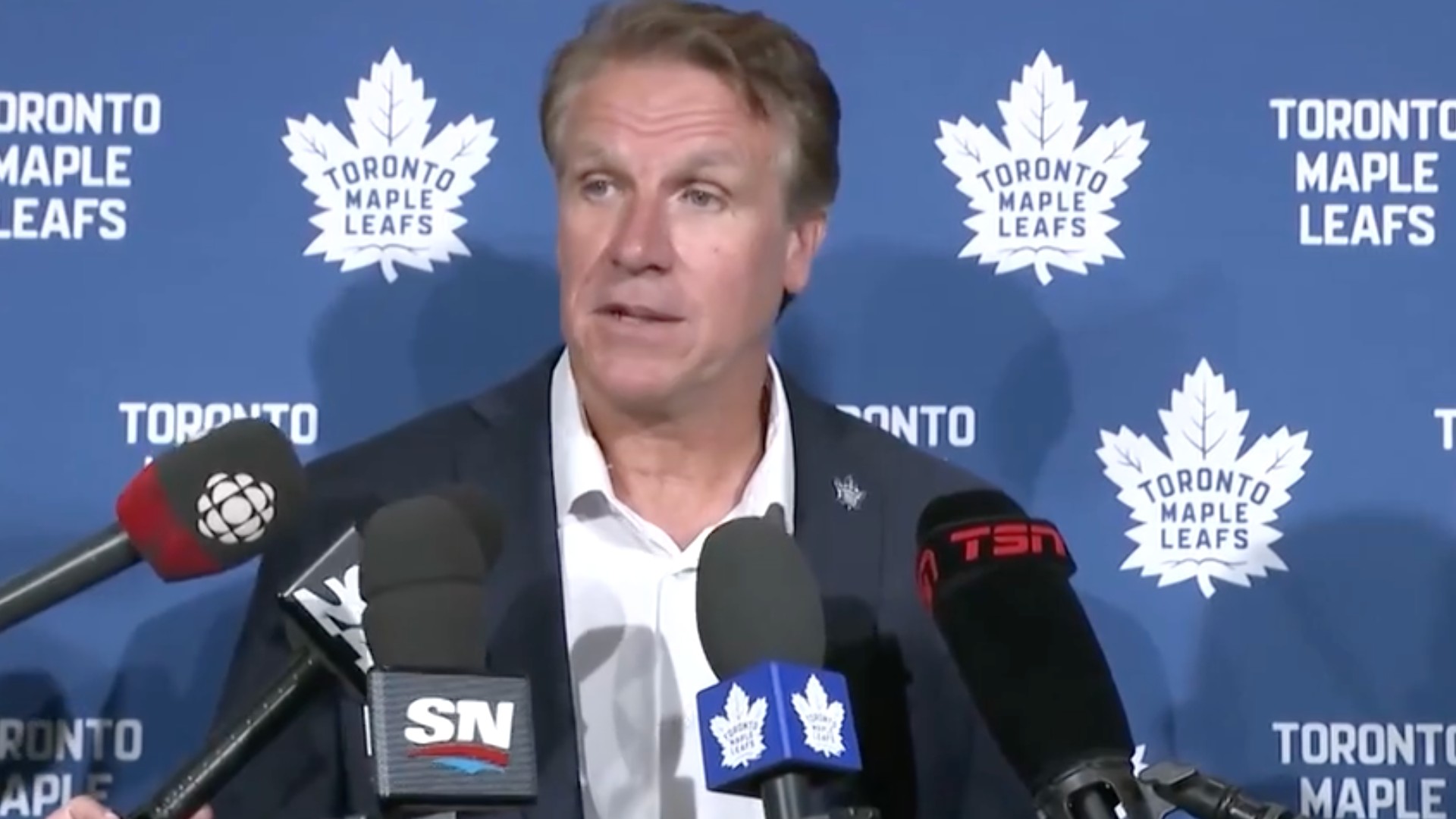
After his formal introduction as the 41st head coach of the Toronto Maple Leafs, Jim Hiller joined Real Kyper & Bourne and TSN Overdrive to discuss the style of play he wants to implement, working with Auston Matthews, filling out his coaching staff, the opportunity to coach the 2026 first-overall pick, and much more.
What have your priorities been like on the agenda over the last few busy days?
Hiller: Well, there are a lot of them. I am trying to get a good sense of the players, getting their thoughts, and reaching out to them. It is more listening than talking, I hope. I am just seeing where they’re at as individuals and team-wise, in terms of what their thoughts are.
I haven’t been here for seven years. I followed the team like everyone else, so I have my thoughts and opinions, but it is really important that I get them from the inside.
What has it been like to be back after seven years? Did you check if your old key card still works?
Hiller: I got a new one today. It is so familiar, and I’ll just tell you this. We flew in and landed at around 11:30 the other night. We drove down the Gardiner. There was no one on it, so that wasn’t familiar. But driving into the city, with the lights of the city, it was just electric for me.
If you drive through the heart of the city on the Gardiner, you just know this place reverberates ice hockey. Chills ran down my spine, even after getting off the five-hour flight. It is a beautiful city. It is a passionate fan base. I can’t wait to get it started.
There were various reports about Morgan Rielly submitting potential trade destinations to lift his no-movement clause. There seems to have been a change of heart regarding Morgan leaving. What changed in the last little while in the decision to bring Morgan back?
Hiller: That is not going to be my decision to bring Morgan back. My point is that I spent four great years with Morgan. I have a ton of respect for him as a person and a player. I am looking forward to coaching him. I am more than happy to have Morgan Rielly on the blue line.
There are different things that may or may not happen. It is out of my control. But if Morgan ends up playing for the Leafs next year, I’ll be extremely excited.
Do you enter the job with an idea of how you want the team to play, or will you evaluate the roster and decide to tailor the game plan to the personnel in place?
Hiller: First and foremost, the most important job I have is to try to massage the spirit of the team and within that dressing room. That is where I’ll start. That is job one.
Now, job two is to get out there and skate. Keep it really simple — skate. That is up and back. That is to the corner quickly. It encapsulates a lot of different things. Does that mean offense? Does that mean defense? To me, it means both. You have to skate and check if you don’t have the puck. If you do have the puck, you have to skate and attack.
I am not trying to define a certain style of play at this point. I just want our guys to have a spirit and grow. I want them to get out there and skate. We’ll adapt the systems and style of play. If you do that, you will give yourself a chance. That is the way I see it.
Would you go back and rewatch all the games, or just specific ones, from last season? In terms of priorities, where would “spending less time in your own zone” fall? The team struggled in so many games in that capacity last season.
Hiller: I’ll tell you that I’ve watched two games. I re-watched our game in here in November. I watched the game — because I didn’t watch it live — after [DJ Smith] took over in April at some point. I rewatched those two games. There were some system changes with the Leafs, so it was good for me to get a handle on what they changed and how they were executing through that change. Those are the two.
I am not going to watch too much more than that. I think that is what I need. We are moving forward from last year. Again, in talking to the players, no one is happy with what happened last year. It was a tough season. It hurts. These guys are proud professionals, and that hurts.
I think we have a good frame of mind. We’ll put a style of play in. We’re just going to start the whole thing fresh.
Captain Auston Matthews’ usage has been fascinating. He has also experienced some injuries, but last year, he saw the highest percentage of defensive-zone starts and shot blocks — all things he can do, but how do you see yourself trying to take advantage of his gifts? You’ve seen he can shoot the puck in the net, too.
Hiller: I’ve been a part of plenty of his goals. I missed a bunch of them, but I was still a part of plenty of them in my first two years with him.
It is like this, really. For me, the game is extremely quick, extremely tight, and you don’t have the puck on your stick that much. Everyone’s responsibility is to check and play without the puck. But the reward is when you get the puck. That is a time to be creative, passionate, and to use your skills and instincts.
I can’t tell exactly why and how at this point, but those are the things we have to get back into Auston’s game: having the puck more, attacking with it more, and feeling creative and passionate when he gets the puck. He is going to do the work without the puck — everybody is, all of the guys in the team, and I’m comfortable with that — but we just have to find a way to celebrate offense again, once we do that work to get it.
Have you had in-depth conversations with Auston Matthews in terms of style of play and what best suits a player like him to get him back to 50-60 goals? Is that the objective?
Hiller: We have had some good conversations, but it is not necessary to get to 50 or 60 goals. If that happens, that is great. It is to get back to celebrating offense, having the puck, skating the puck, moving quickly with the puck, and attacking — all of those things that I remember from my time here and just from watching highlights over the years.
I would agree. Last season, we didn’t see that enough from him. We’ll help him to do that. I know he wants to do that. Great offensive players love to have the puck. We’ll look at ways of getting him more of those types of opportunities.
You’ve talked a lot about re-establishing the spirit of your team. How do you go about accomplishing that?
Hiller: I don’t know that you’ll re-establish it on your own. I think you just understand it and try to help it along; you try to do things in certain ways with the team or individuals, or celebrate different moments, or emphasize different moments.
It is really kind of a nebulous thing, but anybody who has played sports at a team level has had the realization at some point of, “How did we get here? We were a good team, but we didn’t realize we were this good.” There is something that takes over during those years when you get on those types of runs. I would call it the spirit. You become bigger than the sum of your parts, and there is a special thing that kind of carries you through.
That is really what I want to emphasize and work toward building with this team out of the gate.
Have you had a chance to chat with the previous assistant coaching staff? Do you plan on making any changes? Do you have a sense of how your structure will look around you?
Hiller: Yeah, I have talked to them. We haven’t made any commitments as far as what the staff will look like. I am certainly talking to other people. We are going through an interview process.
Very much like John and Mats, as they set their agenda out, they were very thorough. They talked to a lot of people. They did not rush. I think it is a really responsible way to go about it. I am trying to follow a similar path, keep them involved, and just make sure I am feeling like I’ve done the work required.
I have certain people in my mind, but I am going slow and being very, very process-oriented here. We’ll see how it all shakes out. It is still going to take a little time.
What type of requirements do you have for filling out the staff?
Hiller: I will take you back to Lou Lamoriello, who is obviously a mentor of mine. Lou said it best, “It is just like a band. You have to make sure everything is in tune. You can’t have two electric guitar players. You can’t have two guys on the bass. You have to try to make it balance itself out.”
I am going through that process right now. I’ve talked to quite a few people. John and Mats were really thorough in their process, and I think that is kind of an organizational motto right now. They’ve encouraged me to be that way, and I have been.
We’re starting to get there, but there are still some different ways to think about it. It is not just black-and-white: This guy does this, and this guy does this. How do people complement each other and my skill set? How could I get people to balance that out?
It is a long-winded answer to say that we’re working on it.
As far as the team’s personnel moves ahead of next season, what is the most important feedback? Is it tape of last season? Is it from people in hockey, and what they say about the team? Is it feedback from the players? What is the most important factor for you and the GM on what needs to happen moving forward?
Hiller: I would say all of the above. First of all, pro athletes have a lot of pride. This team has done very well over the last seven years since I was there. We were in the playoffs three years, and in two years, we went to Game 7 and didn’t get the results. There has been a long string of at least regular-season success.
What happened last year — nobody feels good about it. There is a starting point, for sure. A lot of the players in the room are well-established NHL players and are very elite in some of their positions. You can spread that through the lineup. You can talk about a Chris Tanev, who would be classified as one of those elite shutdown defensemen. It is not just the players who score all the goals you think about; there are a lot of players in there with a lot of pride.
That is a starting point for them, without me at all. But I’ve watched the league. I’ve been gone for a long time. I’ve seen the ups and downs of the team. I just think that is something we have to start from scratch, with the spirit, and build it back up. That is what is so exciting—to try to do that in this market.
You had some of those star players when they were 20 or 21. Now, Auston Matthews, William Nylander, and John Tavares are 28, 30, and 35 years old. The relationship is there, but it is a different approach now that they’re grizzled vets?
Hiller: Yeah, I think it will be, but I go back to the relationship and that being critical, even though the approach will be different.
I’ve watched them from afar. I stayed in touch with those guys. I’ve seen some of their great moments. I’ve sent them texts and screenshots of some of the plays they’ve made where I’ve been impressed. I think they just know who I am personally, so that gives us a running start. But there is no question their games have evolved and gotten to where they are now, and they have to continue.
I think knowing that we are starting from a place of trust gives me an advantage to push and try to achieve something more.
Matthews was not the team’s captain when you were here the first time. He is now. What do you need from him, in particular, to get our message across and establish the spirit of the team you’ve talked about? How much of the onus begins with Auston and his approach?
Hiller: I mentioned this before. First of all, in the NHL today, if you want to have success as a team, everybody has to check and work without the puck. It is just a prerequisite. It is too competitive otherwise. If you don’t do that, you don’t have a chance. That doesn’t get a lot of people excited, but it is the baseline for any good team.
What I would say to Auston and the other players on the team: When we do have the puck, we have to get really excited, embrace, and celebrate playing offense. We have to let the skill and these amazing players — with the talent they’ve shown us, creating a lot of goals and not just highlight-reel goals — we have to really embrace and celebrate that again.
We will demand the part one — the baseline — but we will really try to emphasize, work on, and maybe a better word is celebrate — in different ways, as a team — getting back to scoring goals and being dangerous. I think Auston is the epitome of that.
In terms of celebrating offense, what do you mean by it? Is it the way you utilize them? Is it the way you emphasize the power play, or who they play with? Can you expand on “celebrating” the offense?
Hiller: It is all of those things, but it is also in practice, through our video sessions, and in any way we can highlight, emphasize, and show the passion, skill, and creativity required to score goals and create those types of chances.
I want to make sure that, yes, we are banging on our structure, defensive game, and our play without the puck, but I want to give equal time and equal respect to the great talents that we have and try to make it fun, exciting, and a priority — not just to be good defensively, which you have to be, but to score goals and to see guys get that touch again.
I do agree that it starts with the power play. I really believe that. I believe the power play can really help those players get their touches and drive the five-on-five offense by getting them feeling good about that.
How important is it for the coach to work closely with the manager, not only for roster construction but also for the type of players you want to coach within your system and structure?
Hiller: I think it is more important than ever, and not just for that reason. I think it’s more important than ever because, for me, the manager and the management have to understand exactly the style of play and — I don’t think this happened necessarily before — exactly what the systems are. There has to be a review, of course, with the players, but also with the management and coaches about how, why, and what certain players are performing, with a good discussion on that.
I don’t think that was really that critical in the past. I don’t know when it changed. But I do believe now today, more than ever, that group of people — the coaches, the management, and particularly the head coach and GM — have to understand.
I am sure there will be times when John is not questioning but wondering why we are doing this. I’ll be very clear on, “This is the logic behind it. This is why.” So at least there is an understanding between both parties of what is trying to be accomplished.
I don’t think that was as necessary before. Today, I think it is critical.
Do you mean in regard to the Leafs of last season, or the way the league has operated in the past?
Hiller: I think the way the league is operating. I mean, there has always been a level of that, for sure, but I just mean that you’re so in lockstep that it is just very clear. I think that gives the management a better idea of the type of player to acquire, and why some players may be having less success in a certain style or situation. These are the details that are demanded.
I just think it is really important that everybody is aligned with the style of play and player evaluation. There are different ways to evaluate players nowadays. We are really clear on that. Analytics is one way to evaluate players. Maybe coaches use a different (approach) — and I won’t say they don’t use analytics, but maybe it is done in a different way, or the emphasis is on different types of numbers.
Everybody has to understand each other’s point of view. It is not necessarily that you’re agreeing all the time, but you understand where both sides are coming from. I think there is a lot of information, and the communication between the coach and GM is critical.
The team has the first-overall pick on Friday night. How does it affect your plan for next season? There will be the hype, the market, and all that comes with it. How do you intend on coaching a first-overall pick next year?
Hiller: Let’s put it this way. I was here when we had the good fortune of the last time we made a first-overall pick, and it was Auston. Now, he came in and scored four goals… I don’t have to tell you the history. I’ve had experience with that.
Now, every player and every first-overall pick that rolls into town is not the same. We know that. It is either position, size and strength, physical maturity at that time — they all get there, but they get there at different rates sometimes. We are just going to have to see.
We are extremely excited. We know we will get a very talented player. Let’s just see exactly where that player fits in. We want him to succeed, but we want to make sure it is at the right pace at the right time. We know it will be a terrific player, but let’s do our best to balance it.
Again, I would go back to lots of conversations between the coaches, GM, players, linemates, and teammates to make sure we are doing this together. I would say that was the case with Auston back in the day.
What is it like to be a coach as the entire league seems to be wheeling and dealing right now?
Hiller: There is action out there. This is great for [the media]. There is talk about this every year, about moves leading up to the draft, and oftentimes, it never happens. Now, we have a year like this. It is pretty incredible. I have been a little slow on the draw, to be honest, because I am wrapped up in my own thing here. Usually, I am a little more dialed into that. But it has been exciting.
Is there any update on Max Domi’s status at all?
Hiller: No, there is no update on Max. I talked to him the other night on the phone. We had a great conversation. But there is no update beyond that.