
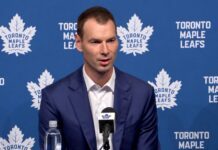













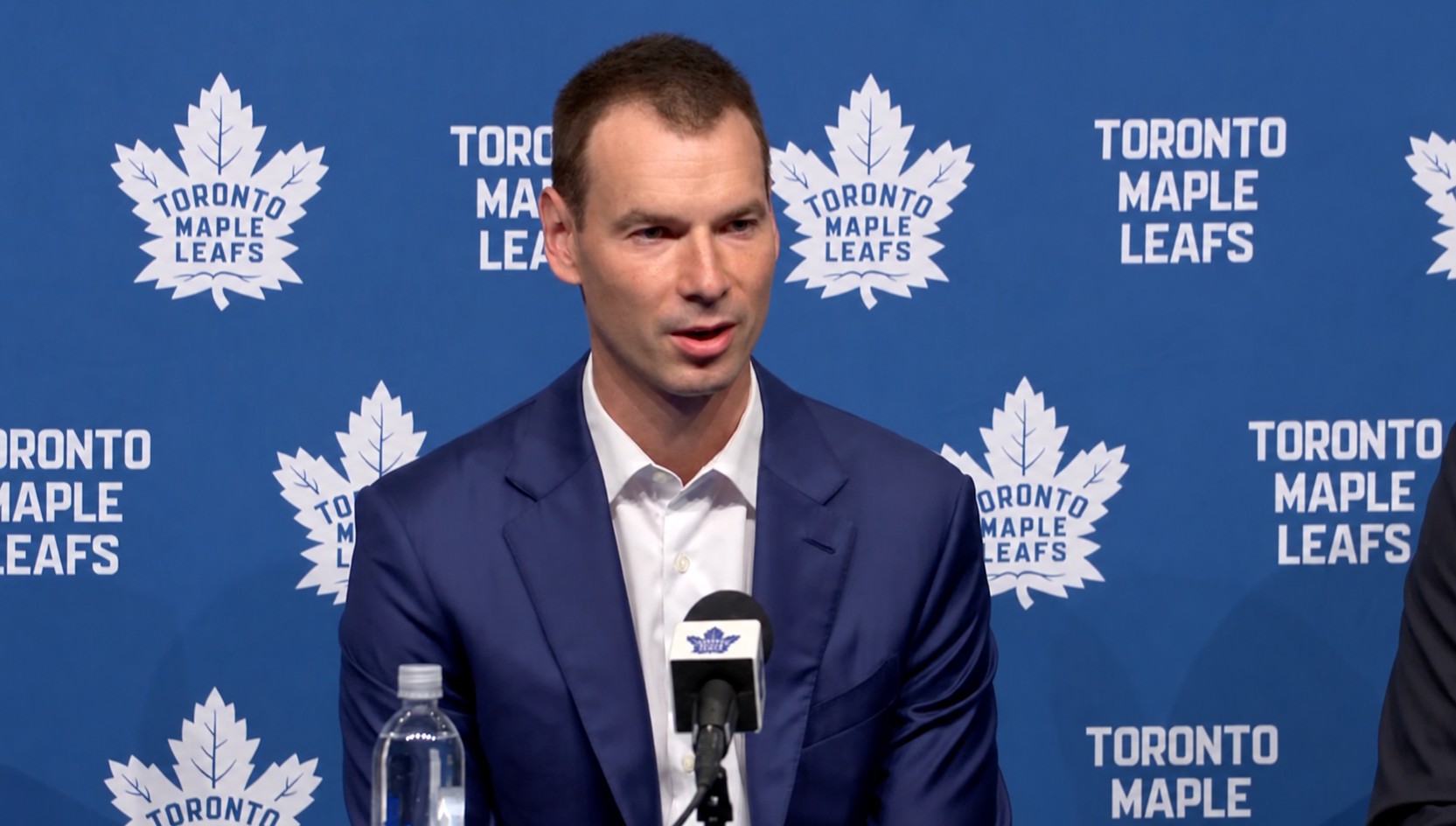
John Chayka joined TSN OverDrive to discuss the Kirill Marchenko trade, the many changes he has made since taking over as Maple Leafs GM, expectations for Gavin McKenna, the defense corps, and managing the goaltenders’ workload.
With two veteran goaltenders who are familiar with each other, did you have a specific number of games in mind for Sergei Bobrovsky when you signed him? Is there a certain number he should play to get full value out of him?
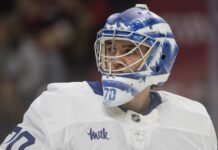
Chayka: I’d say what we’ve landed on is less about the number of starts and more just thinking through rest and the cadence of rest. How do you put these goaltenders in positions to be rested when they do play?
Sometimes that sounds like more games, and sometimes it’s actually just the different set of games they play. Bob, obviously, has played a lot of games over a long period of time now. We feel it’s important that we get him quality starts and starts where he is in a position to have success.
We have some flexibility to all that, of course. It depends on how he feels and how Anthony and Artur feel and how that whole group works. But the goaltending group, the coaches, R&D, and sports science are all continually having this conversation of how we put these guys in the best position to stop the puck consistently. So far, they look good.
Now that you’re a couple of games in and have seen your team and others around the league, how do you view the shortened camp? Would you have liked more time, given some of the wild games to start the season?
Chayka: It’s a great question. I don’t really have an answer. We’ve been talking about it internally.
To me, you can call it regular season, you can call it preseason. These are everyone’s third and fourth games, regardless of what they’re termed. I just think there are still some guys working out the kinks. There are some teams that are in different spots.
With our group specifically, which is all that really matters to me, we’ve got new coaches, new systems, and a lot of new faces. You’re building the plane as you’re flying it, no doubt about it.
As much as we’re trying to get into the minutiae of these little tactics and all these details, I think for now, it’s making sure we just have a consistent base that we’re playing against and consistent effort. If we can start with that, then as the season progresses, hopefully we can clean some things up.
It’s definitely been a little bit more chaotic to start the season. I think it makes sense. It’s the new format for everybody, but certainly a little bit more disorganized than typically I’d see.
You made the Marchenko deal 24 hours before your first game. He’s looked really good through two games, and a lot of Leafs fans are still learning about him. What made him so attractive that you were willing to pay a significant price to get him?
Chayka: It was part of a bigger picture. Obviously, he’s a player that we deliberately targeted. We just felt like, with our group, we needed another player that could dictate play, someone that could transport pucks and be a bit of a dual threat offensively.
As we looked at our forward group, we felt we were one short in terms of the ability to do those types of things and do it at the highest level. Kirill can do that.
Make no mistake about that, though: Matthew Knies is a quality player, and this was giving up a quality player to get a quality player. Obviously, they’re doing the same thing we’re doing in terms of a new environment, a different fit, and trying to project what the player can do.
Our goal is to not only acquire players for what they are, but acquire players that we believe can become something in our group, with our environment. Kirill’s a special talent. He’s a guy who loves hockey. We think he’d be a nice complement for some of our centers. To get him in his prime wasn’t going to be easy.
I’ll also add just the realities of the Fantilli situation and Columbus trying to sort through their cap situation. Don Waddell was always upfront about that being the first step of him even considering anything.
Until that was settled, and then we had the endpoint of opening-season rosters, and we both had cap situations to juggle—those were kind of the beginning and endpoints that we were both, I’d say, forced to try to make this work. We were able to do that.
It wasn’t that we were sitting around waiting for things. There were realities that had to occur to try to figure that out.
How much are numbers part of a transaction like that—Marchenko’s versus Knies’s and what they might look like in the future? Or is it a matter of liking the player and thinking he’ll be good with Auston Matthews?
Chayka: I hope it’s deeper than the latter. If we’re going to make a decision at that level, we think about everything, honestly. You’re trying to get as much information as possible.
We talked to as many people throughout Russia as we have connectivity to. I personally was able to see the player train and skate as a young player coming up, so I had some ground intel on that. Mats Sundin was working all his avenues to just understand the type of person we were acquiring.
I’d say that would be table stakes. If we didn’t believe this was a player who would be a good fit, was willing to come into a market like Toronto, and was really passionate about trying to win a Stanley Cup, then that wouldn’t be on the table for us, especially a transaction at this level.
As you’re working your way through, we have a great pro scouting staff that’s constantly evaluating the player, not only for what they are, but what they’ve done over their history and what they believe they can become.
Then you marry that with some more technical data, like you’re talking about, and you try to form the best picture on the player. Ultimately, it’s a bit of a judgment call, right? It’s a hockey trade, and these players are now going to change environments and go have different coaches and different teammates.
We hope it’s something that works out well for Matthew and the Columbus Blue Jackets. Obviously, we feel thrilled about the opportunity to have Kirill.
You’ve made a lot of moves since getting the job—trades, signings, firings, and hirings. Was that always your intention when you pitched yourself to Keith Pelley and MLSE, or did those changes materialize over time?
Chayka: It definitely was not change for change’s sake. That’s for sure. I think that’s where mistakes can happen.
Mats and I got together the first day. We met with as many people as we could. I thought it might take us a day or two to get through and talk to everybody. It ended up being more like a week, 10 days. Big staff, a lot of people, a lot of conversations, and it was just a listening tour.
Through that, we learned a lot. We learned there are a lot of great people. There are a lot of great things that have occurred over a long period of time here. Our first question was, “What don’t we change? What’s going well? What should we do more of?”
Again, small things, but you get Bobby Hastings, one of the best equipment managers, hardest-working guys. Everybody loves him. Brings energy and a smile to the rink. Those are important things to maintain and emphasize.
But then there were opportunities where guys felt like there were things that were missed. There were things that got away from them in that season, or crept over a number of years.
I think as a leader and a manager, everyone wants to talk about stuff and likes to do things. If they’re going to complain, or we’re going to raise an issue that we think could be better, let’s fix it.
We just got to work trying to figure out ways in which we could improve the group, not only for a season, but trying to have some foresight and trying to put together a group of people and an organization that we think could be world-class.
As you talk about a directive from ownership, or any of those discussions from Edward Rogers, it’s always been just to win and build the best possible team. That’s what Mats and I have kind of gotten to work doing.
Some of the change, honestly, was—we make a change, and if you change a department, then some change comes with that. Some of that was a bit more of a downstream effect than something purposeful.
I think my job is to try to, if we make a change to a department, find a world-class person, recruit them, hire them, bring them in, and then allow them to do their job.
If they had a different approach, or they wanted to change the philosophy or different people, I was going to allow them to do that. That manifested, I think, in a little bit more change.
Gavin McKenna is clearly a very skilled player, and he’s playing with good players. What are reasonable expectations for such a talented young player? Is it about letting him get his feet underneath him for 10 games?
Chayka: For an 18-year-old, it’s tough to place too big of expectations on them. If you study it historically, even some of these top guys that have gone on to be superstars, it’s a tough season. That’s just the reality of it.
What we’ve seen is this kind of natural progression for him, kind of a learning curve. He comes in, has some skates, he’s trying to find the washroom, and then all of a sudden, he looks pretty good in those skates.
Then training camp starts, and he’s learning some things, and then it looks like he’s a pretty good player in training camp. I thought in preseason games one to two, he took a big step. Obviously, the regular season is another ramp-up.
Every test so far, he continues to show that he’s a really smart, talented player that problem-solves. Obviously, physically, he’s not at the NHL level that most people would be, but we still think he could be effective and play his game and continue to progress.
As you guys know as well, it’s going to ramp up as we get past Christmas, and then it’ll ramp up again as you’re going into the playoffs. He’s going to have to continue to elevate his game and learn.
What we’ve seen is he continues to learn every day. As long as he does that, we expect him to be an impact player for us.
You have one of the oldest and slower defense corps in the league. How can that work in terms of success, with the need to defend and transport pucks?
Chayka: I think when you add Chris Tanev back from last season, he makes a substantial difference. He’s not a young defenseman anymore, but I’ll take him on my team any day. He’s one of the best defensive defensemen. I think he moves the puck incredibly efficiently, and he’s playing on the game’s top lines every single night.
I think when Darren Raddysh gets acclimated and can play the way he can play, he brings a lot to our back end as well. Overall, I’m pretty bullish on our defense.
As we work through a season and continue to evaluate different ways in which we can improve, we’re always going to be open to adding in different areas. Defense could be one, but at the same time, I think we need to give this group some time to show us where they’re at and what they can do.
What we’ve seen from the first couple of games—and obviously, it’s early—we’ve been able to defend much more effectively than we have in the last few years. If we can continue to do that and continue to move pucks and get them in the forwards’ hands, that would be a good recipe for us.
You’ve mentioned you still have assets to make a deal. Knies was a premium one, with his contract and no trade protection. You don’t have your first-round picks for the next couple of years, and McKenna presumably isn’t going anywhere. How much collateral do you believe you have to make a significant trade if one presents itself?
Chayka: I guess that would be the key question: if it presents itself. From our side, we’re always having conversations with different managers. I think everyone sees prospects differently. There are some people that like prospects more or less.
As I have discussions with managers, one of the things we wanted to do this offseason was to add some prospects. We had 10 drafted players, and then we’ve added some draft picks as well.
We feel like we have enough future capital. As much as we’re trying to make a push here in this season—it’s an important season for the entire fan base and organization—there’s a next season as well. My job is always to build the best possible team today with an eye for the future.
I think we do have more than maybe what you’re suggesting in terms of dry powder. At the same time, if we end up using those players to be Toronto Maple Leafs and they evolve into being really good prospects and really good players, that would be a good outcome for us as well.
You talked last week about Auston Matthews being healthy and quicker. What have you made of the captain through training camp and the first couple of games?
Chayka: Through camp, he’s been phenomenal. Moving well and buying into everything that Jim’s asked of him, and just being the leader that he is. Everything’s been really positive.
Through the first few games, that line’s been dominant. They’ve really extended possessions and held play, and they haven’t really given up much defensively at the same time. If they can do that for a season, we’d be in a good spot. Obviously, the outcome hasn’t been a lot of goals at this stage, and over time, that’s going to matter a lot.
But as we sit here with two games, I’ll take the chances that line’s getting and the overall play they’ve created. If we can get that for a sustained period of time, we’d be thrilled.