For the second time this season, the Maple Leafs beat the Florida Panthers by a score of 4-1 thanks to a strong four-line effort.
Frankly, this scoreline, especially when it was sitting at 3-1 as the Panthers pulled their goalie with four minutes left, flattered Florida. While the first couple of minutes were a little shaky with some turnovers from the Leafs and zone time/shot-attempt volume from the Panthers, the Leafs mostly took over the game once they settled in, with the help of an actual momentum-building power play (what a fun, new concept!). The score could’ve been a runaway before the midway point of the second period.
The Cowan-Roy-Robertson line scored a big goal right at the end of the first period. Matthew Knies tipped one in (off a Troy Stecher shot), then set one up for Auston Matthews in quick succession early in the second period (a nice drive to the net off the wall + reverse pass for an easy Matthews finish). It was quickly 3-0, with the Leafs up 13-5 in shots at the time, and Toronto easily could’ve run it up to 5-0 afterward.
A puck hopped on Auston Matthews — who also didn’t convert a power-play breakaway in the first — on a likely goal following a Max Domi feed. Morgan Rielly didn’t bury a great look off a Matias Maccelli setup. Steven Lorentz went on a breakaway. Matthews was in alone yet again with eight minutes to play in the middle frame. The score remained 3-0.
Florida’s lone goal — like in December, when they scored a shorty due to the Leafs‘ power play’s incompetence at the time — was a gift in the final 10 minutes of the final frame, this time courtesy of Joseph Woll, who otherwise came up big, especially on the early third-period penalty kills.
Again, you’d like a little more clock-burning time in the offensive zone in the third period from the Leafs, but they didn’t give up a ton of quality looks at five-on-five, the close-out effort wasn’t too stressful, and the PK came up trumps again.
The Leafs were commonly labeled a “slow” team by critics in the first half of the season. Well, there are few teams that play a faster, more direct, north-south style than Florida when they’re on their game. Yet by no means did the Leafs look slow by comparison tonight. A Leafs team that is organized and building speed on its breakouts, and is dumping pucks in intelligently/forechecking diligently, looks fast. A Leafs team that can’t break out cleanly and dumps pucks in with no hope of a successful retrieval on the forecheck looks slow. It never had anything to do with the collective footspeed of their players. Faster play has everything to do with the team being more in sync and structurally sound at five-on-five of late.
The formula for this game followed a similar story to the early parts of the playoff series last spring: the Leafs were able to play from ahead in the game and then exploit the Panthers’ aggressive press for transition opportunities. If they had cashed in on a few more of their looks, this game would’ve been over inside 30 minutes. Even when they aren’t trailing, the Panthers take a lot of chances up the ice, and they rely on Sergei Bobrovsky to bail them out on more than his fair share of clean looks against opposing shooters. Bobrovsky was quite good in this game, but it still wasn’t enough. The Leafs were the flat-out better team tonight.
Post-Game Notes
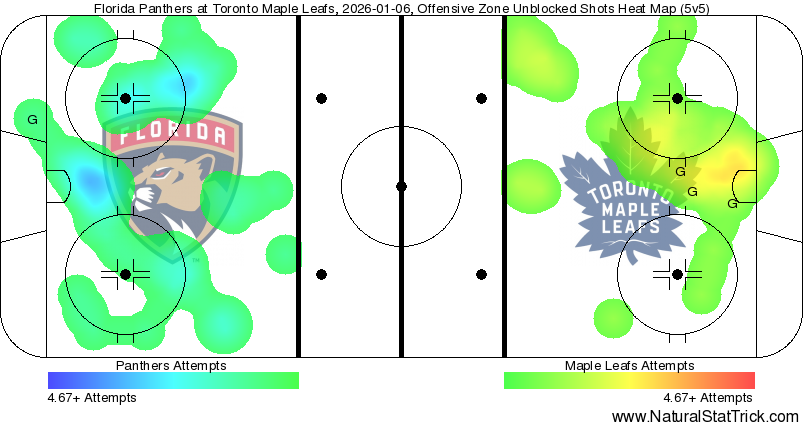
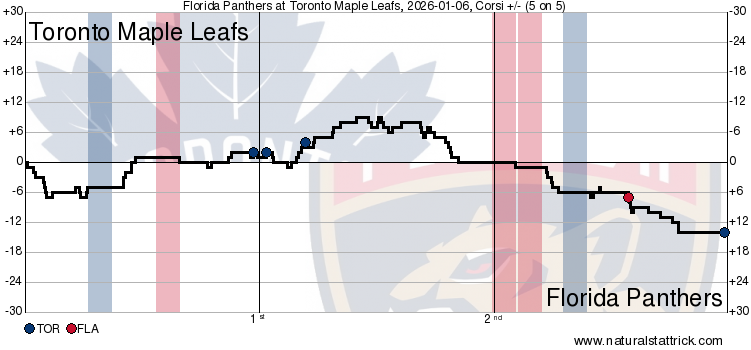
– It is easy to look at the overall five-on-five shot attempt share in games like this one, the win over the Devils, the win over the Senators, the win over the Penguins, or the OTLs to NYI and Detroit, and conclude that not much has improved in the five-on-five possession department during this winning streak by the Leafs, but this is worth keeping in mind: The Leafs have controlled over 51.5% of the shot attempts with the game tied during this stretch. When the Leafs went up 3-0 in this game, the shots were 13-5 in their favour. At the end of 40 minutes, home-plate shot attempts were 15-8 Leafs, who still held a three-goal lead. That’s not to excuse some bus parking in the third period, which drives some of the full-game numbers down, but they’re definitely playing better five-on-five hockey when the game is fully in the balance.
– One of the most competitive Leafs on the ice in the early parts of this game: their smallest player, Nick Robertson. This Nic Roy line was particularly dangerous throughout the opening frame. Robertson drew a penalty on a strong effort play, created a chance off of that play at five-on-five, fired a decent one-timer on the subsequent PP, didn’t back down in a cross-checking battle with Balinskis, and picked up a primary assist on the Leafs’ 1-0 goal by Easton Cowan to get the party started with the all-important opening goal right at the end of the first period. The pass Roy ripped through the seam on that Cowan goal was also really nice. Robertson has nine points in his last nine games, and Roy has six points in his last six. Depth! (and without Nylander).
– The explanation Scott Laughton received from the ref for the non-call on the hit from behind by Eetu Luostarinen is pure lunacy: “They said I saw him coming.” This does not make a blatant hit from behind legal, of course. Players do sometimes welcome a hit from their backside to absorb the contact and protect the puck along the boards, and it’s not always deserving of a penalty just because the “hit” technically came from behind. Sometimes, a receiving player even turns at the last second, putting the hitter in a tough position once they’ve committed to the check. This was neither of those situations. Laughton made a quick play on the puck to move it to his defenseman and was immediately hammered from behind by a player who had the time to identify Laughton’s numbers were facing him.
It is a dangerous hit — in the danger zone, a few feet from the boards — and fortunately, Laughton only suffered a cut on his nose. The ref, who clearly saw it from a few feet away, told Laughton it was his fault, basically. Officials should really be held accountable for this kind of thing. The Rielly penalty soon followed this, so it could’ve been a big swing in the game, beyond the obviously concerning player safety angle.
No call by the refs on this 🧐 pic.twitter.com/x1LzRWer58
— Jesse Blake (@JesseBlake) January 7, 2026
– There wasn’t an immediate response from the Leafs on Luostarinen himself for that hit. However, Bobby McMann tried to get to him and threw a bit of a slash his way as play carried on quickly, and then McMann got his pound of flesh later in the shift against Marchand, dropping him along the wall (Marchand left the game after the second period, although Paul Maurice noted he was already managing something, so the coach pulled the player out). Laughton tried to give Luostarinen some shots here and there where he could the rest of the way, without risking putting the team in a bad spot while the game was in a good place (up three goals). It doesn’t always work out that the exact player who threw the dirty hit receives immediate retribution, but there has to be some kind of response. I liked the one from McMann, who also threw a hard hit on Balinskis later in the game, drawing a reaction out of Florida. The Leafs didn’t just match Florida’s physicality but initiated it in some cases, which was good to see. A good power play is not your best/only response when faced with the antics of Florida, against whom you have to fight fire with fire.
McMann is playing excellent hockey right now in a lot of different areas of his game. It was well-deserved that he played 19 minutes and got to cap tonight’s win with the empty-netter. During an extended 6-on-5 kill, the Leafs went with a McMann-Matthews-Roy combination, a nod to both Roy and McMann’s reliability of late. Roy finished at a much more appropriate ~15 minutes in this game.
– In the game against the Panthers in Florida a month ago, Paul Maurice hard-matched the Lundell line (which had Reinhart and Marchand on it then, and Reinhart and Luostarinen on it now) against Matthews (who was with Knies and Domi at the time, not McMann and Domi). The top line had a good night territorially but didn’t break through offensively, as the Roy and Laughton lines provided the five-on-five goals that night. On home ice tonight, Matthews saw only three minutes of Lundell, though, funny enough, the Matthews goal set up by Knies came against them (the Leafs were mid-change). The Laughton and Tavares lines both saw more minutes against the Lundell line than Matthews did. This is how you free up your best offensive weapon on a night when there were plenty of matchups to exploit on the Panthers down the lineup: get him more minutes against the Rodrigues line than the Lundell one.
The Matthews line was a real threat in transition with its speed, and it caught Florida out several times as the Panthers pressed up ice. Matthews, in particular, could’ve left this game with a hat trick or more. He had a ton of good looks, including a breakaway on the power play and a few more clean looks in on the goalie, but he couldn’t solve Bobrovsky 1v1.
– The Scott Laughton–Steven Lorentz duo couldn’t impact a game much more positively without actually getting on the scoresheet at all. They are really in sync on the PK when taking away lanes and denying entries, and they created some opportunities at five-on-five, including a few quality ones/two breakaways for Lorentz. Laughton also saved a goal against with a good stick defensively during the 6-on-5 situation. They were trustworthy at five-on-five when soaking up some minutes against the Lundell line. This was a really good bottom-six game from the Leafs, between the contributions of this Laughton-Lorentz line and the Roy line opening the scoring. Laughton finished with nearly 18 minutes of ice time, his highest single-game TOI total as a Leaf, excluding one overtime playoff game against the Senators.
– Brandon Carlo played 17:41 in his return, second least among Leafs defensemen ahead of only Myers, but the coaching staff got him out there for 32 shifts, which was second most on the team (33 seconds per shift on average was the shortest of any Leaf). He played seven of those minutes in the third in the close-out effort. The pairing of Rielly-Carlo won its minutes on goals (1-0) and expected goals, and they were up 7-3 in shot attempts while the game was still within one (five minutes of five-on-five TOI). Against a Florida team that works pucks low to high and drives the net with the best of them, he was stiff when defending his net front and was a positive contributor on the penalty kill. His puck touches were pretty simple and clean overall. It was a good return, and a timely one with Jake McCabe leaving the lineup for at least a week (I don’t even want to picture the defense with all of McCabe, Carlo, and Tanev out). There was an untimely penalty at the end of the second with this pair on the ice, but Rielly was beaten by Lundell there (Florida also should’ve been on the PK, as mentioned).
– I understand the result was favourable, and the team played a good overall game in which everyone reasonably contributed. Still, I can’t get my head around dressing Philippe Myers over Matt Benning, who was solid in New York. I understand it is a physical Florida team against whom the net-front defense is critical, and Myers is the bigger defenseman. But it’s also important to move the puck cleanly and efficiently against the Panther forecheck. This same Benoit-Myers pairing got out-attempted 16-5 against Florida a month ago. The puck movement is too jerky coming out of the Leafs’ end with Benoit-Myers together. Myers iced it a couple of times and also took a delay-of-game penalty for a puck over the glass in the third period. To follow up the team’s early third-period kill with another penalty like that was tempting fate, but the Leafs’ PK and Woll bailed him out. Myers wasn’t playing at a level where it was merely a situation of, “hit the reset button for a game in the press box, then we will get you back in there right away.” He has been playing at a level where they should be looking at Benning instead for a fair run of time.
– This was one of Matias Maccelli‘s better games in a Leaf uniform, and it was a little unfair that he left with just one secondary assist. On the shift leading up to the Matthews 3-0 goal, he made a nice play into John Tavares for a one-timer, sauced an area pass to Troy Stecher at the backpost, checked back above the puck nicely to keep the pressure on, and kept the play alive along the wall despite taking a big hit, before Matthew Knies took over from there. His pass to Rielly not long after deserved a better outcome. He was on the puck and creating throughout, and he had some nice looks on the power play (should’ve done better with those). I don’t want to overstate the impact of a player who could see as little as 12 minutes of ice time on any given night, even when on a line with Knies and Tavares. But Maccelli has definitely helped the Leafs’ possession play, their number of completed passes through/into the slot, and their power play as the team has turned it around in the last seven games.
Game Flow: 5v5 Shot Attempts
Heat Map: 5v5 Shot Attempts