


















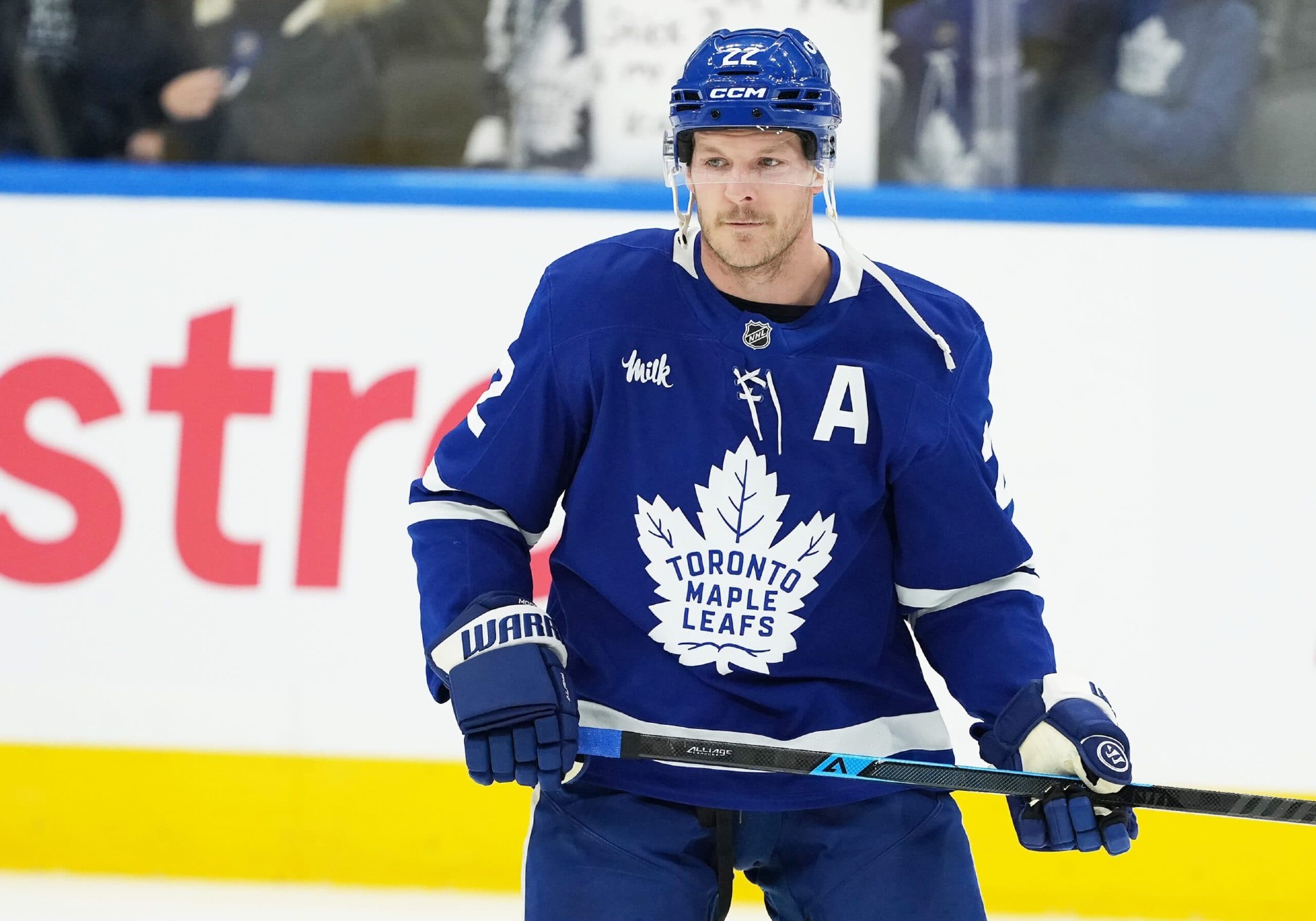
Jake McCabe’s 2025-26 season is a tricky one to unpack. It really was a tale of two halves.
Through the Christmas break, McCabe played 36 games, produced 15 points, and the Leafs outscored opponents 28-16 at even strength with him on the ice. The rest of the way, he played 44 games, produced 10 points, and was outscored 52-36 at even strength.
| Period | GP | Points | Even-strength GF-GA |
|---|---|---|---|
| Pre Christmas | 36 | 15 | 28-16 |
| After Christmas | 44 | 10 | 36-52 |
As Anthony Petrielli wrote about recently, those are pretty drastic splits. Some of it was undoubtedly percentages evening out, and it’s impossible to separate any individual Leaf’s second-half results from the fact that the team completely fell apart around them, but there is a fairly straightforward explanation for part of what happened with McCabe: The coaching staff asked too much of him.
McCabe averaged a career-high 22:24 per game and led the team in total ice time. He is a good top-four defenseman, but there is a difference between being a good top-four defenseman and being the player who leads the team in ice time while consistently taking on difficult assignments.
The Leafs effectively pushed McCabe too deeply into the latter role while Chris Tanev played just 11 games all season.
Tanev’s absence can’t be overstated here. McCabe and Tanev formed an excellent shutdown pairing the season prior, and their skill sets complemented each other extremely well. Tanev is excellent positionally, kills plays early, retrieves pucks cleanly, and generally makes the right decision with the puck. It lets McCabe be physical and assertive without asking him to be the primary stabilizing presence on the pairing every night.
Without Tanev, McCabe was completely overwhelmed at times. It didn’t help that the Leafs never really found him a consistent replacement partner. They spent extended stretches with McCabe next to Oliver Ekman-Larsson on his off-side, even though it was pretty clear the pairing wasn’t working. They would occasionally put McCabe with Brandon Carlo, see some promising results, and then inexplicably break them up again (no better an example than pre- and post-Olympic break).
There was simply no continuity. A sinking ship pulls down everybody — no one more than the hardest-leaned-on defenseman — and the structure (or lack thereof) around McCabe really didn’t help. The Leafs struggled all season to exit their zone cleanly and consistently provide organized support underneath the puck. There were plenty of examples where a defenseman would win the initial battle or retrieve the puck only to look up and have no good option available because the forwards had already vacated the zone.
That is going to make essentially any defenseman look worse, but it particularly exposed an overtaxed McCabe. He can move the puck reasonably well, but he is not a high-end puck-moving defenseman who will consistently beat pressure and manufacture clean exits on his own.
Eventually, all of it started catching up. As the team spiraled, McCabe’s admirable desire to lead and fix problems may have led him to overextend and step outside his game’s limits at times.
By January, the mistakes weren’t simply systemic anymore. McCabe was getting beaten cleanly, turning pucks over, taking unnecessary penalties, and generally looking like a player who had lost his game. By the final weeks of the season, he looked completely out of gas. At one point in April, he was averaging over 22 minutes per game and was -11 over a six-game stretch. There is an argument to be made that they should have simply shut him down at that point.
That’s why we’re not particularly concerned about McCabe entering next season, provided the Leafs actually put him in a more reasonable position to succeed. He didn’t suddenly become a bad defenseman. For the first 36 games of last season, he was playing over 22 minutes per night and crushing his minutes. The evidence that he can still be a good defenseman is right there.
What the forgettable 2025-26 season did reinforce is what McCabe is and what he isn’t. He’s a good top-four defenseman who can be part of a legitimate shutdown pairing. He’s physical, competitive, generally defends well, can kill penalties, and moves the puck well enough. What he probably isn’t is a defenseman you want leading your team in ice time while carrying a pairing through difficult matchups regardless of who is playing beside him.
There is nothing wrong with that. The issue was that the Leafs spent much of last season asking him to be exactly that.
This is where the Darren Raddysh addition and, hopefully, a healthy Tanev should make a significant difference. McCabe shouldn’t have to play 22-23 minutes every night anymore. If they can get him back to around 20 minutes, give him a stable partner, and clean up some of their puck support/five-on-five possession play under a new coaching staff, it’s perfectly reasonable to expect the 32-year-old to bounce back.
The Leafs can simply reunite McCabe-Tanev, which we already know works, or they can explore McCabe-Raddysh and give McCabe a legitimate puck mover beside him. Either way, they have options they simply didn’t have for most of last season. It’s hard to overstate the potential uplift of McCabe’s top two right-handed partner options evolving from Brandon Carlo and Troy Stecher last season to Tanev (if healthy) and Raddysh in 2026-27.
Ultimately, McCabe’s struggles in 2025-26 were a pretty good example of what can happen when a team takes a player who is very good within a certain role and continuously asks him to stretch beyond it, as said team badly underperforms and then ultimately quits on the season with a quarter of the season still to be played.
McCabe needs to own his part in it and play much better than his second half, but the Leafs needed to ask him to do less. Instead, they asked him to do more than ever before, without the partner who helped him play his best hockey, on a team that was unraveling around him.
By the end of the season, it showed. In that sense, there might not be a player on the defense who stands to benefit more from the fresh start of 2026-27 than McCabe. With a reduced workload, a more stable partner, and a team hopefully functioning better around him, he should have every opportunity to get back to being the dependable top-four defenseman the Leafs know he can be.