














With August halfway over, we’re only about a month away from the Maple Leafs’ first preseason game.
It is always amazing how quickly things shift from the dog days of summer right back into the thick of hockey season.
While we aren’t there just yet, the first sign for me personally is filing season previews. As has been the case for a few years running, I just completed the Leafs section for McKeen’s annual yearbook. Working through each player individually and charting their season is a helpful exercise, at least for me, to look at players through a bit of a different lens than simply considering the totality of their season within the context of the team at large.
With that work top of mind, I wanted to go through a number of items that I found interesting and worthy of discussion:
– The context of Darren Raddysh’s massive season is even funnier and/or stranger when we consider how it started. He sat as a healthy scratch in six of the Lightning’s first 13 games, and in the seven games he did play in October 2025, he averaged just 14:50 per game. In fact, even in his first two games in November, he played just 7:52 in the first one and 15:42 in the second.
After the Victor Hedman and Ryan McDonagh injuries, the Lightning basically had no choice but to play him. If you look at it from that point forward, the numbers are even more eye-popping. Raddysh averaged 23:54 per game — over two minutes more than anyone else on the team — while putting up 21 goals and 67 points in 64 games.
While I definitely wouldn’t bank on him replicating those numbers, his production was quite clearly tied to ice-time opportunity more than anything else. The consistent ice time and power-play opportunity should keep him productive; it’s just a question of how productive.
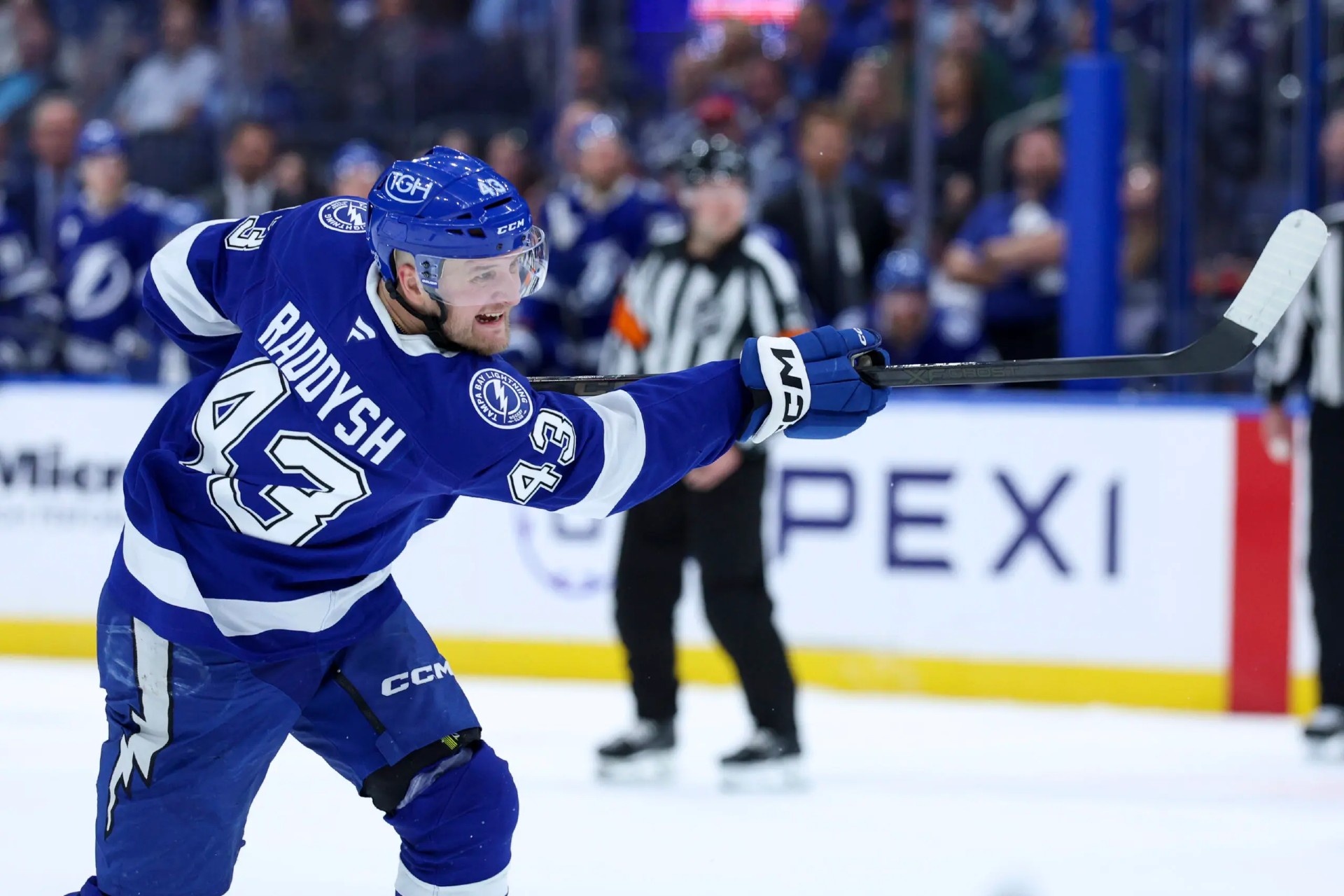
– Part of the confidence in Raddysh remaining productive is that Raddysh’s shot is the real deal. He has one of the hardest shots in the league, and he knows it. Raddysh clocked 96 shots between 90-100 MPH last season, while the next-highest mark in that range was Evan Bouchard with 51, followed by Tage Thompson with 44. That means Raddysh lapped the field by a significant margin.
Raddysh launched 115 slap shots, with Bouchard next at 100 and Josh Morrissey after him with 72. His 115 slap shots — which I know can be a bit of a spotty stat — were the highest recorded total since Brent Burns also fired 115 all the way back in the 2018-19 season. The last time a Leaf was even remotely in that conversation was Dion Phaneuf all the way back in 2011-12.
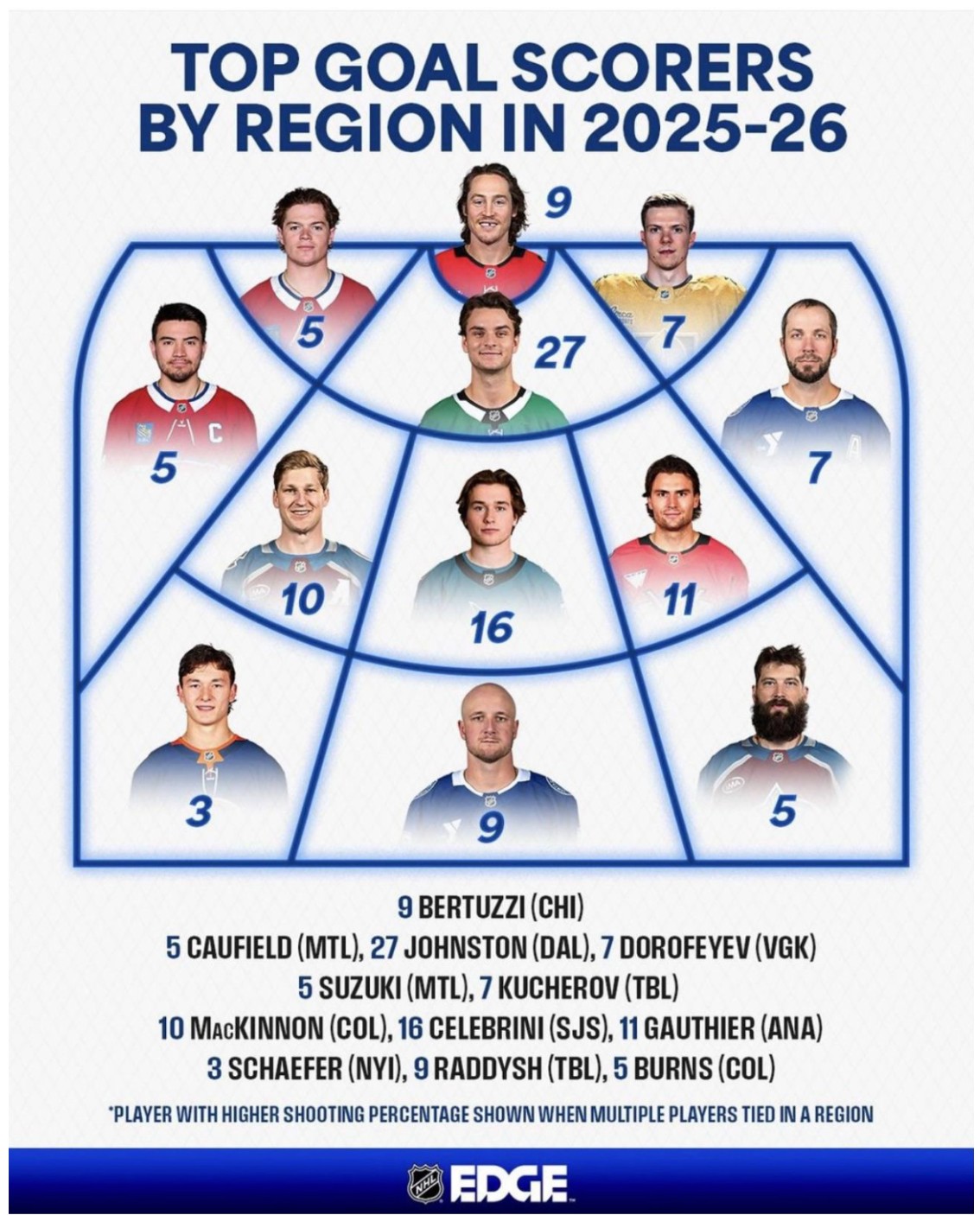
I’m sure there will be comments about Raddysh’s ability to hit the net, but the reality is he scored 12 goals last season, which ranked tied for sixth league-wide. A booming shot is not an exercise in shot quality; it’s a numbers game, and you just keep launching them until you either make teams pay or make them change their defensive alignment to give Matthews and Nylander more space on the half-walls.
I’m not going to do a full deep dive on this now, but coaching is going to be really important in how they configure their power play and which shots they focus on generating.
– Jack Roslovic’s season was fairly consistent with his career baseline at first glance, but there’s maybe a bit more there than meets the eye. He signed on opening night, which already put him behind the eight ball — no NHL training camp or preseason games compared to everyone else does hurt.
He started the season a week late, had one point in his first seven games, and then finally settled in. From there, he heated up and produced 17 points in 16 games before taking a puck to the groin and requiring surgery, which knocked him out for 11 games.
He returned right before Christmas and really struggled coming back from that injury, putting up just six points in 22 games. After the Olympic break, he regrouped and tallied 12 points in 24 games the rest of the way.
Roslovic has always been streaky. I don’t think the injury prevented him from suddenly achieving a point-per-game season or anything, but if he arrives on time for training camp and stays healthy, Roslovic should be more than a 30-40-point scorer.
– In this space, I have repeatedly flagged that Roslovic has never won his five-on-five minutes in a season in the NHL, a fact I find to be stunning and a real knock against him. He is talented, and he will definitely go on a heater or two throughout the season that helps over a six-plus-month grind, but you have to be realistic about it, and it also has to factor into any Patrik Laine conversation.
The only other natural right-shot right winger the Leafs have is William Nylander, and he hasn’t won his five-on-five minutes in two of the past three seasons. I don’t think anyone is going to suddenly confuse him for a 200-foot winger who is detailed in the defensive zone. He is a game-breaker and an elite scorer, and to a degree, you can live with that.
But the idea of Nylander, Roslovic — who has never won his five-on-five minutes — and Laine as the top three right wingers is hard to fathom if the team is serious about winning in this league. To say nothing of including John Tavares, who is not exactly strong defensively at this point in his career, and an 18-year-old Gavin McKenna, who is almost assuredly not walking into the league as even league-average defensively.
For all his talent, Laine has never been on the positive side of expected goals in his career, even when he took the league by storm. There are all sorts of holes in his game, and he got by largely because of his shot.
I don’t really doubt that Laine can regain some level of scoring in the league, and I get that watching his highlight reel is tantalizing, but it’s not winning hockey to have a bunch of players like this on your team.
– I did not realize just how stark the Matthew Knies splits were. He started the season with 26 points in his first 22 games through October and November. That means he produced just 40 points in 57 games the rest of the way.
Knies, you may recall, sat three games between November 18-26 with a knee injury that he battled through for the rest of the season. From December through February, he largely — and justifiably based on his play — lost his spot on the top line to Bobby McMann.
For long stretches, he really laboured around the ice, and accordingly, his shots and hits per 60 were way down from the previous two seasons. He still put up a new career high in points and blew away his previous assist high of 29 with 43, but he has a lot more to give, especially when the season was in the balance in January.
You can add Knies to the list of players you hope took advantage of the Leafs’ extended offseason to get healthy and ready to go — right behind Auston Matthews and Chris Tanev, with an honourable mention to Nick Paul.
– Jake McCabe‘s splits are similarly shocking. From the start of the season to the Christmas break, McCabe played 36 games, produced 15 points, and won his minutes 28-16 at even strength. The rest of the way, he played 44 games, put up 10 points, and was outscored 52-36 at even strength.
Some of it was the percentages evening out, some of it was Chris Tanev‘s absence, and some of it was the overall state of the team. Still, he led the team in total ice time last season and really struggled over the final four months.
McCabe played a career-high 22:24 per game last season, which is truthfully far too much for him. You would like to think Raddysh and a hopefully healthy Tanev push that number down to the ~20-minute mark, which is realistically where it should be.
– Throughout the offseason, we’ve monitored all the changes the Leafs made off the ice and whether any signs of cost-cutting would be present. Their newest notable hire, Vice President of Sports Performance Andy O’Brien, came with additional hires that remade their sports performance department entirely and actually grew it by two staff members from last season.
So far, that’s about the only department that has actually grown in terms of pure numbers. The previous front office included 14 staff members, and now that number is 11.
Then you just go down the line from there: The scouting staff is currently down from 20 to 16; the R&D team is down four, not including the AGM who was in the front office; the video staff is down one; player development is down five; even office operations is down three; and media relations is down one.
Maybe more hires are coming, and you can argue about certain roles merging or shifting or whatever, but that’s a lot of downsizing overall. Change was required, to be clear, but no matter how you slice it, you also can’t easily make up for losing ~19 people/jobs by simply asking others to take on more.