























With the Olympic break officially underway, all eyes in Leafs Nation have turned to the March 6 trade deadline.
I’ve already written on this subject and outlined the general strategy I’d follow if I were GM Brad Treliving. To summarize, can the Leafs combine selling off pieces for draft picks with taking back salary and/or leveraging salary retention slots to boost returns and potentially acquire a few young pieces who could become notable contributors moving forward?
Of course, I can talk about it until I’m blue in the face and rationalize it as best as I can, but it takes two to make a trade, and other teams could simply say, “No, we don’t want to trade an Isaac Howard or Pavel Mintyukov just because you are taking on a year of Andrew Mangiapane or Ryan Strome (or whoever else).” Of course, it takes two to tango.
Further, what if the returns the Leafs could yield are not that high in general? It’s a scenario worth considering, especially as reports trickle in about potential price tags for various Leafs players.
Bobby McMann
Let’s start with Bobby McMann.
Elliotte Friedman reported that “Toronto is looking for a first-rounder for Bobby McMann.” Meanwhile, Darren Dreger recently wondered about McMann potentially fetching a first-plus.
We’ve already seen Mason Marchment move for a second and fourth, and Kiefer Sherwood went for two second-rounders. I think McMann should net more than each of those players, but not every team will think the same. Compounding matters is how many teams even have the appropriate assets. Colorado, Dallas, Edmonton, Minnesota, and Vegas don’t own their first-round picks this season, and four of those teams — in my estimation — make the most sense as destinations for McMann.
While the Leafs can’t let McMann walk away for free in the summer — and something is better than nothing in such a case — it could eventually hit a point where the Leafs would need to ask themselves if it’s worth trading him versus working on the price it would take to retain him.
Among the many problems the Leafs are dealing with this season, McMann really isn’t one. He’s turning 30 this season, but he’s only played 196 NHL games, so there’s not a lot of mileage on his body, and he’s one of the fastest skaters in the league. He isn’t a retain-at-all-costs player, but there comes a price point where if he’s only netting a second and a depth pick, it’s worth contemplating if it’s better to work to retain him, provided he’d sign a reasonable extension (four years x $4-4.5 million).
If McMann is full-on pricing himself out of Toronto, fair enough; he goes to the highest bidder.
If McMann can yield a first-round pick, it becomes an interesting conversation. On the one hand, the first-round pick would likely be a late one and not help the NHL roster for years.
There is an example of a late-first-round best-case scenario already on the Leafs’ roster. The Leafs drafted Easton Cowan 29th overall in 2023, and only one player selected after the 20th overall pick has played more NHL games than Cowan in his draft class to this point (Emmitt Finnie, a seventh-round steal by Detroit). Still, we can plainly see the patience required even with a really good draft pick from two years ago, as Cowan has faced frequent healthy scratches, committed plenty of rookie mistakes, and shown flashes of upside along the way. Matthews has two years remaining on his contract and will be 31 when it expires. The Leafs would have to unearth something really special with a late first-rounder in 2026 to remotely impact the NHL roster during this timeline.
On the flip side, potentially drafting good young players is never a bad thing for an organization. With or without Matthews and Nylander, stockpiling young talent and continuously growing the pipeline of talent isn’t a negative, especially when the franchise currently owns just a third, a fifth, and a sixth-round draft pick in the upcoming draft.
Outside of McMann, every other potential trade candidate is either signed beyond this season—so the Leafs can hold firm on their asking price —or a UFA they should probably sell.
Even Scott Laughton, whom I like and would be okay with keeping, has a replacement in the system in Jacob Quillan, who is 23 and is putting together an excellent season in the AHL. They are different players, granted; it would really hurt the Leafs’ penalty kill to lose Laughton, and they likely wouldn’t bury Quillan with defensive assignments as they do with Laughton. Still, it’s a like-for-like position replacement who can hedge the loss of Laughton reasonably well, especially when we consider that Nic Roy is still in the fold.
With McMann, there’s really no one else to hedge the loss. There is a collection of small wingers, two high-end wingers, and two bigger/slower bottom-six wingers on the team currently.
Long story short, if someone really wants McMann, it has to be worth the Leafs’ while, or else there’s probably little point in selling him just to sell him.
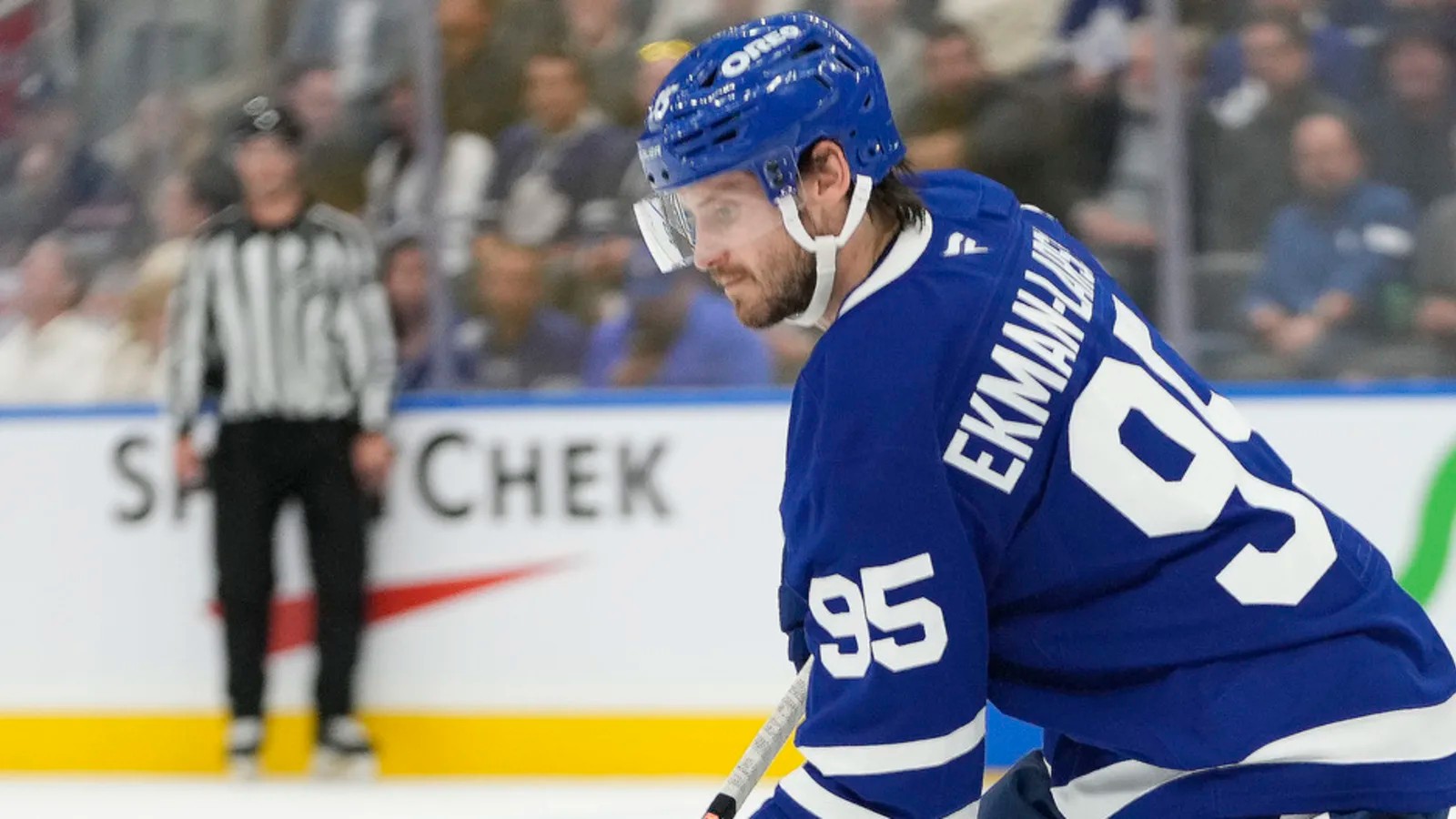
Oliver Ekman-Larsson
On defense, OEL is in a similar boat to McMann in that he’s enjoying a great season on a very team-friendly deal. By contrast, OEL is turning 35 this summer and has two years remaining on his contract.
In theory, OEL is a player the Leafs should try to sell high on. While the argument to keep him is a pretty simple one: Who is playing left defense for the Leafs next season, as they look to move off Morgan Rielly? (McCabe-Benoit-Thrun? Woof. The UFA left-shot market is also weak). Cashing in on OEL is very tempting, on paper.
In reality, who is likely to pay up handsomely for OEL? Even if we ignore the player’s 16-team no-trade clause list, it’s not immediately apparent which club would pay through the nose to acquire him.
In the West, it’s hard to picture heavy interest from almost any of the usual suspects. Vegas and Minnesota already made their big moves on defense. Colorado, LA, and even Seattle have veteran units already locked in.
There are teams OEL would absolutely help in Dallas, Edmonton, Utah, and Anaheim, but all of those teams are three-plus deep with left-shot defensemen. While OEL can play on the right, if I were managing one of those clubs, I wouldn’t exactly be lining up to spend significant assets on a left-shot instead of a right-hander. Maybe they see OEL as a good enough player not to care about handedness, but it feels like wishful thinking.
In the East, Carolina, Montreal, Tampa Bay, Buffalo, and the Islanders are in the same boat: fully accounted for on the left side, and very unlikely to even consider OEL.
That leaves who, exactly? Boston, Detroit, and Pittsburgh? OEL would clearly help the Penguins, but it’s hard to picture them buying a 34-year-old defenseman (all the power to them if they want to; draw up the deal right now!). This leaves Detroit and Boston. OEL would really help both of those teams, but could the Leafs create a real bidding war between those two, plus maybe a team in the West, to drum up a significant enough return?
That’s not so easy for me to envision. As much as there seems to be a perception that OEL will command a heavy return due to this solid season, Cup experience, and appealing AAV, identifying the specific fit with a team likely to pay up big isn’t so clear. I’d imagine teams would view OEL as a nice-to-have rather than a need-to-have, although maybe a big Olympic showing would help the Leafs’ cause here.
From the Leafs’ perspective, OEL is certainly not a player they should give away for the sake of selling. They’d need to return a first-rounder and a prospect/roster player of some significance to justify it. If it’s for a lesser draft pick(s) package(s), they could play out the exact same song and dance next deadline. He’d be a year older, but he’d only have one season remaining on his deal, and the Leafs can always retain salary, too.
Eliminating deadweight and roster redundancies
OEL and McMann represent two of the Leafs’ best trade assets on paper, given their strong seasons and good-value contracts. But what if they’re unable to force teams to pay up appropriately for them? The GM must pivot in such a scenario.
Even if the Leafs look around and conclude it’s not worth trading McMann, given the returns offered, and decide to extend him instead, it would give them too many forwards under contract. If they were to retain their RFAs (Nick Robertson, Matias Maccelli, and Quillan), they’re at 13 forwards under contract for 2026-27.
On defense, if the Leafs do nothing — and I’d argue they should, at a minimum, retain Troy Stecher rather than trade him for a fourth-rounder or something — they already have six under contract. It would be seven with Strecher.
In goal, the Leafs have three goalies under contract without the ability to freely send one down to the minors next season.
It’s a logjammed roster, and it’s not a good enough one to justify it. The returns might not be significant, but the Leafs could complete an effective deadline by simply relieving some of the logjams to open up roster flexibility moving forward. It won’t be sexy or lauded by the masses, but simply removing a collection of under-performing players would probably make the team better almost immediately and also better set up their roster heading into the offseason.
The Leafs currently dress four offense-first, undersized wingers in Domi, Maccelli, Robertson, and Cowan. They won’t go anywhere serious with all four of those players in their lineup, and I’d argue they probably can’t win with three playing at once, either. All of them are under team control this summer. Cowan isn’t going anywhere, but shedding two of the other three players between now and the start of next season would make a lot of sense.
Similarly, down the lineup, Dakota Joshua and Steven Lorentz feel redundant as two big wingers who are decent defensively but don’t produce enough offensively. It’s hard to imagine trading Joshua right now, given his contract and injury-plagued season, but Lorentz is a good penalty killer on a cheap deal with a Cup ring, so he might fetch the Leafs something. It’s not the end of the world if both return, but again, for a team that has too many roster spots accounted for, it’s a straightforward move to add a pick and clear a roster spot with a minimal negative impact to the current team, especially if Joshua can return after the Olympics.
For all the talk of moving McMann and Laughton as pending UFAs, this aforementioned group of six forwards is much more problematic than their two forwards with expiring contracts. Trading the pending UFAs and keeping the rest of it intact for the rest of the season would be pretty lame management overall.
The only caveat with Laughton is that the Leafs shouldn’t pay him and also keep Nic Roy. It is worth exploring the trade value of both, along with the price of a Laughton contract extension, and deciding from there. For me, it wouldn’t be a black-and-white, he-stays-and-he-goes situation.
On defense, Jake McCabe is back next season, presumably Chris Tanev will return, and, as mentioned, I’d keep Stecher around as a low-cost veteran defenseman. Beyond those players, we’re back to the question of whether OEL truly has exceptional value in the trade market. If OEL doesn’t, does Carlo, as a right-hand shot? (Edmonton, Dallas, and Anaheim should be desperate for a righty like Carlo, to my eye). Unless the Leafs genuinely don’t know yet if Tanev can return next season, it’s hard to justify keeping those five 30+ defensemen. Even two new defensemen can notably shake up a unit, which this blue-line group needs at this point.
In net, a goalie will need to move eventually, and perhaps in the process, they can plug one of those holes, be it on defense, on the wing, or at center.
There’s so much talk about selling, but the Leafs aren’t in a position where they should sell for selling’s sake. If the market is hot enough to justify it for certain players, great. If not, they will still need to move off of bodies and clear some of the deadweight and redundancies off the roster.
Ideally, Treliving can swing at least one move where he adds a potentially exciting roster piece back the other way, and he’ll likely need to move a solid veteran with term on his contract to do it. That’s more than fine.
The Leafs want to be back in the mix next season, regardless of how this one ends. This is abundantly clear. If they want any reasonable path to achieving this goal, it has to start at this trade deadline. Selling low on good players who they’ll end up overpaying in free agency to replace isn’t the solution. Neither is standing pat. Can they walk this tightrope and reset their lineup?