
























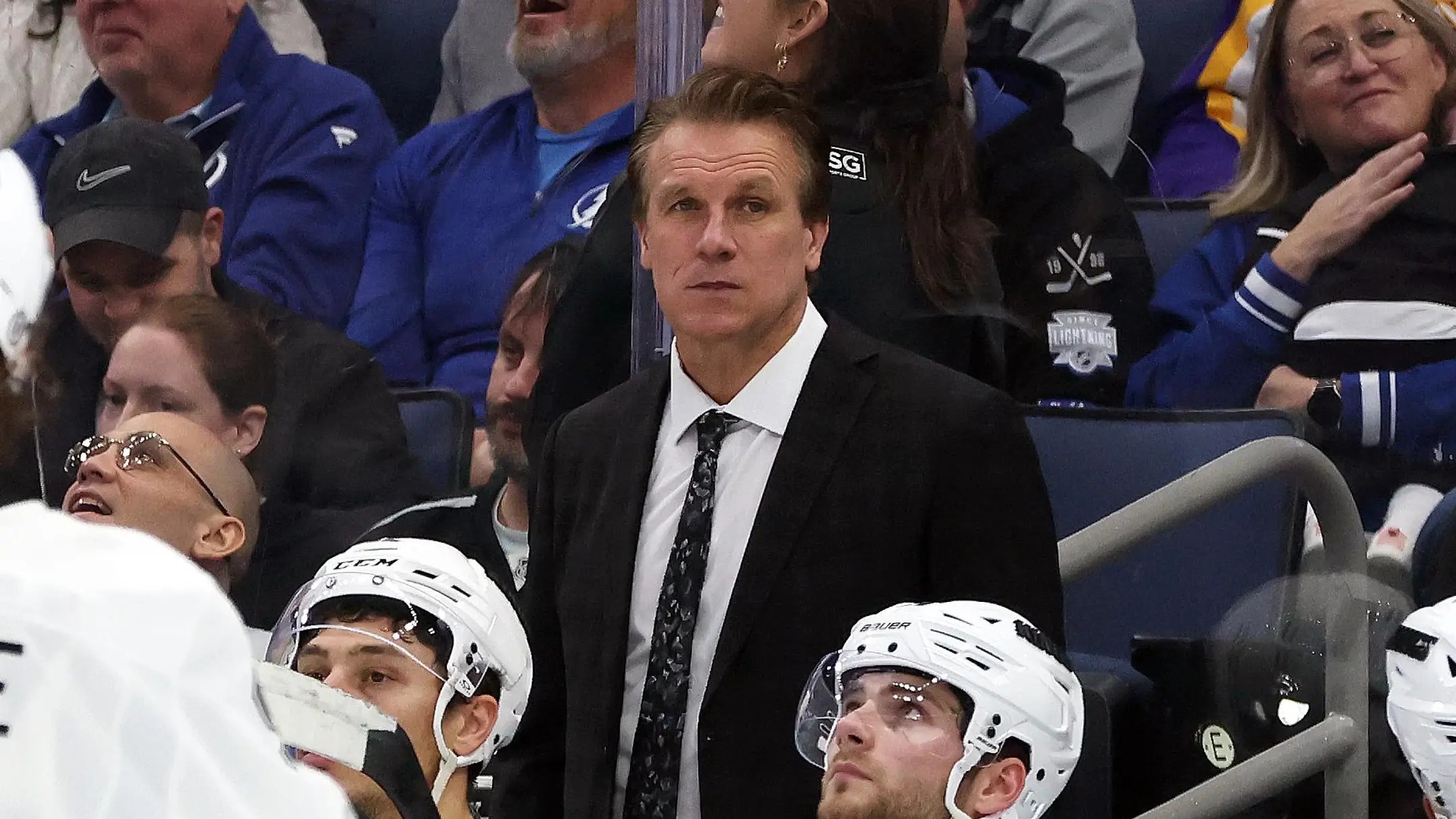
After a lengthy coaching search, the Maple Leafs landed on Jim Hiller as their 41st head coach in franchise history.
“Jim is an experienced coach with a strong understanding of what it takes to win in today’s NHL. He has worked with successful teams throughout his career, connects well with players and brings a clear approach behind the bench. We believe he’s the right person to lead our team and help us reach our goals.”
– John Chayka
“I’m incredibly excited for the opportunity to return to Toronto and lead the Maple Leafs. This is a special organization with great players, passionate fans and high expectations. I’m looking forward to getting to work with our players and staff and doing everything we can to help this team reach its full potential.”
– Jim Hiller
To our recollection, Hiller’s name was not mentioned in the media at any point during this protracted search, so the hire essentially comes out of left field. In that regard, kudos to the Leafs for keeping this completely quiet, as it has become quite clear that none of the insiders really have a read on what they are doing. That can be applied to yesterday’s trade with Philadelphia as well.
As for Hiller, he has quite the NHL résumé to sort through.
Hiller spent 10 years as an assistant coach in the league before getting his first NHL head coaching gig. He spent five of those years under Mike Babcock, including four with the Toronto Maple Leafs, where, among his duties, he oversaw the power play. After their tank year to land Auston Matthews, the Leafs’ power play finished second, second, and eighth under Hiller. Their entries were crisp during that time, and Matthews and William Nylander operated on their strong sides, looping high and attacking downhill with speed to shoot. They also consistently funneled pucks to the bumper for tips and deflections in the slot.
Hiller was then recruited by Islanders head coach Barry Trotz and general manager Lou Lamoriello to help fix a struggling Islanders man advantage, joining the club ahead of its back-to-back conference final appearances. A relevant note: This means Hiller was on the same coaching staff as current Marlies head coach John Gruden, so that is something to watch moving forward.
After his third season there, Trotz was let go, and Hiller moved to Los Angeles, where he coached under current Red Wings head coach Todd McLellan. That only lasted a year and a half because, midway through his second season, he took over for McLellan on an interim basis in February 2024 and coached the Kings to a 21-12-1 record to close out the season. The Kings removed the interim tag in May 2024, and Hiller led Los Angeles to a 48-25-9 record and a franchise-best 105 points in his first full season behind the bench.
That represents Hiller’s only full season as an NHL head coach, and the Kings were very good under him. Beyond their franchise-record 105 points, they finished fifth in the league in five-on-five Corsi and fourth in expected goals.
That is likely the impetus for this hiring. The Kings’ roster was genuinely not that impressive on paper. They had only one player eclipse 70 points (Adrian Kempe at 73), and their top-line center was a 37-year-old Anze Kopitar. Even with that roster, their results had them in the playoffs as a legitimate contender, and they looked the part early, building a 2-0 series lead over the Edmonton Oilers.
Then the series went to Edmonton, where everything fell apart for the Kings.
In Game 3, LA held 3-2 and 4-3 leads before Hiller challenged a goal and got it wrong. That meant Edmonton was awarded the goal and a power play, which took all of 10 seconds to convert. It was a puzzling challenge in real time, and Edmonton never looked back.
Then, in Game 4, the Kings were protecting a late lead when Quinton Byfield had the puck with ample time and space and an empty Oilers net waiting at the other end. Somehow, he failed to get the puck out, leading to Edmonton tying the game before eventually winning in overtime. You cannot really pin that sequence on Hiller, but the Kings seemingly never recovered from it as a team, either in that playoff series or into the following season.
When Hiller was fired and D.J. Smith took over, Smith — who had been an assistant coach at the time — addressed the lingering effects of that loss:
“I think that particular loss, the way we lost, somehow carried on to this season. And it ends now. Unfortunately, the way we lost, you could feel it. You could feel it maybe dragging the group down. Maybe we didn’t believe in ourselves. It’s over. That has ended, and today is a brand-new, fresh start. We got to look at it that way.”
Kings fans were chanting for Hiller’s firing by the end, which, to be fair, is not uncommon for NHL coaches. The season simply felt lifeless and disappointing. Following a franchise-record campaign, the Kings finished third-last in the league in regulation wins. Beyond the weight of last spring’s disappointment, they also endured an offseason in which they added Cody Ceci and Brian Dumoulin while losing Vladislav Gavrikov and trading Jordan Spence. That is a significant downgrade across the board, and the Kings played like it. Kopitar, in what may be the final season of his career, dropped from 67 points to 38. Kevin Fiala tore his ACL at the Olympics. It was a mess across the board.
And now Hiller arrives in Toronto.
If the Leafs had hired him after last season, it would have looked like a home run. He won a lot in his first full season, and the team posted excellent underlying metrics. It fell apart in the playoffs, the Kings made some questionable offseason moves, and they were unable to recapture their previous standard.
The Kings often played a rather boring 1-3-1 system under Hiller, which some players criticized before his first full season:
Fiala is bang on. Kings mgmt and coaching staff need to realize the 1-3-1 doesn’t work. Awful to watch and clearly no fun to play. pic.twitter.com/jDtieluLvi
— Jason Gregor (@JasonGregor) May 4, 2024
It was not always entertaining, but the Kings finished second in the league in goals against during Hiller’s lone full season. They were 14th in goals per game.
Hiller did have a good first season with the Kings, and there are positives you can point to. He also brings experience, which is important because John Chayka and Mats Sundin have not been involved in the day-to-day NHL grind for years. Also noteworthy, Hiller has long been viewed as an analytical coach. While coaching the WHL’s Tri-City Americans, he co-founded TruPerformance — a video-tracking company that provided detailed breakdowns of player performance — alongside former Northern Michigan teammate Brad Werenka.
Additionally, Hiller already knows several key Leafs players and has coached them before. It has been reported at various times that he maintained a strong relationship with Auston Matthews, which is obviously important. If the core players endorsed the move, that is a positive to some degree, but they will all need to deliver now.
We cannot sit here and write that this is a particularly inspiring hire loaded with pedigree. You can understand why and how the Leafs arrived at this decision, but there will be plenty of fair questions surrounding the hire as the organization heads into a season where everyone, top to bottom, has a lot to prove.