



















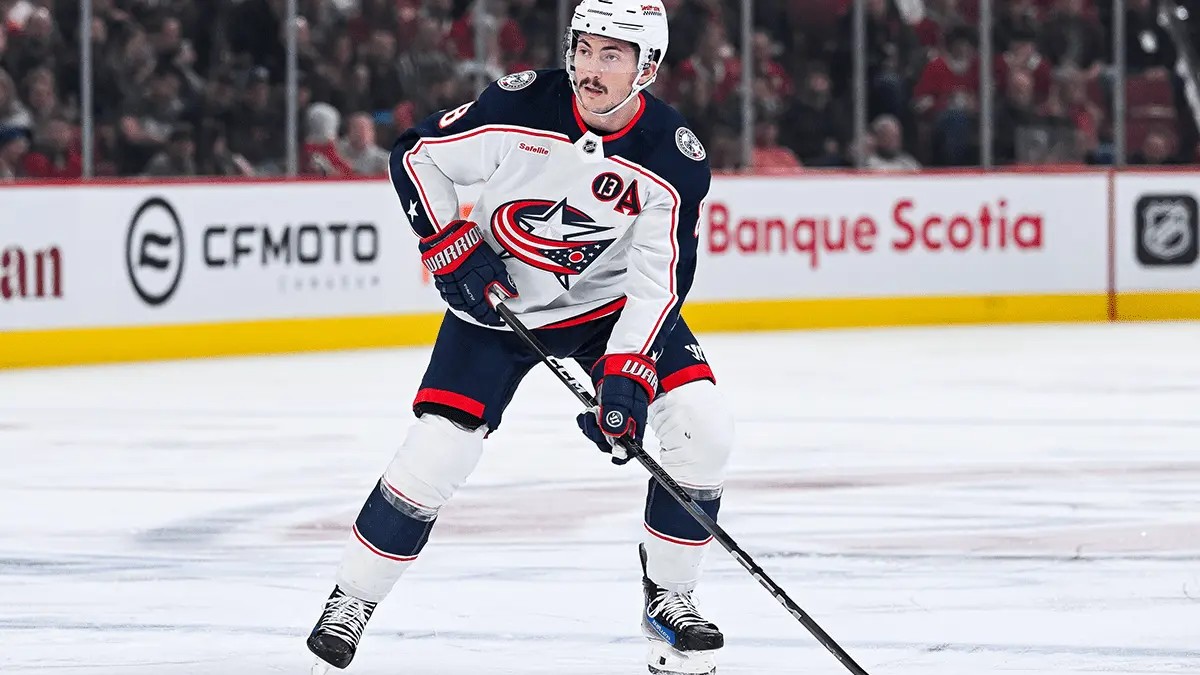
The Zach Werenski drama took an interesting turn late on Tuesday night: Werenski rejected a trade to the Dallas Stars, and the Tampa Bay Lightning and Toronto Maple Leafs are reportedly two of the top teams on Werenski’s list.
The rumours of Dallas’ keen interest and willingness to offer Thomas Harley in a package made us too skeptical about the Werenski-to-the-Leafs odds to write on this subject yet. The Leafs simply couldn’t offer a top-pairing-calibre defenseman — or even a center of substantial value — to a GM (Don Waddell) seeking a hockey trade for Werenski. The fit between Dallas and Columbus made all kinds of sense, which is why a deal got done tonight.
… Until Werenski kiboshed it, preferring to remain in the East, with Toronto and Tampa reportedly on his list of desirable destinations.
Extra spicy: Emotions among the parties seem to be boiling over now (“turning nasty,” according to Elliotte Friedman). Where does Don Waddell go from here? If he can’t get the right offer from Tampa, Toronto, or another Eastern team, would he even be open to Werenski returning in the fall? Werenski was previously fully prepared to play in Columbus this season, but he couldn’t commit to signing long-term there next summer, forcing Waddell to shop around. Now, both sides are seemingly pissed.
Notably, Werenski’s NMC converts to a modified NTC (10-team list) in the final year of his contract. Theoretically, Waddell could opt for a cooler-headed approach by waiting it out a year and seeing where the situation stands next offseason if he can’t get what he feels is a suitable offer roughly commensurate in value with the Dallas one he agreed to. Waddell does have a card to play that Senators GM Steve Staios did not have in his deck in the Brady Tkachuk scenario. But again, with the relationship deteriorating, how determined is Waddell to pivot and move Werenski to the highest bidder in the East among Werenski’s approved destinations? Does he want to risk a potentially discontented Werenski playing out a year knowing he’s gone sooner than later — knowing how that might impact player performance and, by extension, trade leverage — or does he want to simply get this done right now while Werenski is still the 2025-26 Norris Trophy winner with two full years left on his contract?
At the very least, there is certainly now an avenue for the Leafs to swoop in and become a major player in these sweepstakes.
First things first, the seriousness of the Leafs’ interest should not even be in question. Should a team with a relative weakness on the back end — one without an elite No. 1 defenseman for literal decades — be keenly interested in a 20-plus-goal-scoring, better-than-point-per-game-producing, Norris Trophy-winning defenseman who played nearly 27 minutes a night last season? Not a tough call.
It’s hard to fully measure or put into words what a No. 1 defenseman of Werenski’s calibre playing for nearly half the game each night can do for a franchise. We should all properly respect the Leafs franchise’s all-time greats, such as Borje Salming, and until there are significant accomplishments in Toronto first, these statements can be uncomfortable to make. But there is a strong argument that Werenski would be the most talented defenseman to ever wear the blue and white.
The Blue Jackets haven’t achieved anything of note during Werenski’s tenure, failing to even make the playoffs as he’s entered his prime years, but he’s certainly the primary reason they were in the playoff mix at all last season: He set a career high in points and goals per game while playing 26:37 per night, and the Jackets outscored the opposition 81-66 at five-on-five with Werenski on the ice (CBJ were outscored without him on the ice).
The Leafs have never had the stud defenseman who can play half the game to lean on in those critical playoff games that have so often broken against them during the Matthews era. Darren Raddysh is a totally credible 20-plus-minute guy who is highly productive in those minutes, but he is not in this upper-echelon “stud 1D” category (nor is he paid as one on his new $8.5 million AAV contract). Between Raddysh and Werenski, the Leafs would go from one of the least productive defense corps to the complete opposite, and the benefits to the Leafs’ top offensive producers up front of having such dynamic puck movers and shooters (one lefty, one righty) driving offense from the back end would be immense. There might be some uncomfortable conversations around PPQB1, but you’ll chalk that up under “good problems to have” any day.
On paper, this is one of the best defense corps in the league, with lots of options within it:
Werenski – Raddysh
McCabe – Tanev
OEL – Andrae/Stecher
Almost certainly at the center of the package in the Leafs’ offer would be Matthew Knies. No one sensible wants to see Knies leave Toronto, to be clear; he is a unique, productive winger at a good age, signed long-term at a solid number. He loves being a Leaf and all that comes with it. But this possibility is also exactly why John Chayka was wise to hold a hard line on Knies’ value as he received offers in the lead-up to the draft. You simply don’t move Knies unless there is a stud D or stud C potentially on the table. Werenski is certainly one of the former.
On Tampa’s end, they are likely looking at JJ Moser as a major piece in any potential offer. Neither Tampa nor Toronto owns its own first-round draft choice in 2027, but the Leafs own Colorado’s. The Leafs can’t offer a mid-20s, 20-plus-minute-eating, under-contract-at-a-good-number defenseman like Moser, and that is definitely noteworthy, as Waddell pursued Harley as a centerpiece in his near-completed deal with Dallas. But Moser isn’t nearly as productive offensively as Harley, at least before Harley’s recent down season. We don’t know how Waddell rates Moser, Knies, or whatever other pieces these two teams will certainly need to add to this deal, but the reality is that the Leafs could compete with Tampa more feasibly than they could with a Harley-centered offer from Dallas.
Both teams can easily justify adding that extra bit of value to their offer if it keeps Werenski away from a division rival. Obviously, the Leafs won’t want to get too carried away here — as Chayka has said, be aggressive, but do it sensibly, with an eye to the near and long term — but there are some top-six wingers available to help backfill some of the lost Knies production, hypothetically.
The Leafs should already have varying degrees of interest in Mason Marchment, Viktor Arvidsson, Mats Zuccarello, Eeli Tolvanen, and maybe even Michael Bunting. They potentially have the cap space available to add two of them, should Knies depart in a hypothetical Werenski deal, as the difference in the 2026-27 cap designation between Knies and Werenski (signed for two more seasons at $9.58M) is under two million, and that is without knowing if any other roster pieces are moving in the deal. None of these players replace Knies — and especially not what Knies likely will become at the height of his career — but when the return is Werenski, the case for making your team better overall makes itself. Knies, at the end of the day, is a winger — a unique and valuable one, but a winger nonetheless, and there is little evidence as of yet that he is an elite play-driver.
Chayka does need to keep firmly in mind that he would only have cost certainty on Werenski for this season and next before he mortgages the team’s future to an extreme degree (Cowan, picks, Danford, Koblar, etc.). Whether Werenski wants to stay long-term is part one of this question regarding risk management, and you can only have a positive vibe at most at this stage, without the ability to negotiate a contract until next summer. It will likely depend heavily on how the 2026-27 season plays out on the ice. Part two is that even if Werenski likes it in Toronto after a year, he can ask for the moon and the stars, knowing he will get it on the open market under a $113.5+ million cap.
I’d also caution against giving too much weight to the argument that Werenski helps the case for keeping Matthews around. They’re good friends, and if Matthews has helped (or is actively helping) sell Werenski on Toronto, that’s fantastic for the Leafs. But Chayka should also account for a post-Matthews eventuality here, too.
Defensemen of Werenski’s ilk tend to age pretty gracefully, and the timing of Werenski entering his early-to-mid-30s on his next (massive) contract as Gavin McKenna (hopefully) reaches the height of his powers is not necessarily misaligned. But if Matthews doesn’t bounce back to the degree hoped for in 2026-27, there could be some real implications there as far as Matthews’ and Werenski’s futures in Toronto are concerned, and the Leafs don’t want to have mortgaged a ton of futures if this next year with Matthews-Werenski-[seemingly, Bobrovsky] as the 1C-1D-1G does not play out as hoped.
Of course, it’s easy to assume that Matthews’ game and overall perspective on committing long-term to the Leafs will be rejuvenated by all of this offseason’s developments, particularly if Werenski ever comes to town. There are plenty of reasons to be encouraged already — the removal of Craig Berube, likely more offensive usage, a (hopefully) improved five-on-five structure and power play, a strong relationship with Jim Hiller, and the additions of Raddysh and McKenna to the roster and power play. Sitting here today, I do buy the argument that these factors will rejuvenate the captain to a notable degree, let alone if Werenski ever joins the fold.
But we can’t totally kid ourselves, either: Matthews genuinely has something to prove this season, and the Leafs’ fortunes in 2026-27 rely on marked improvement from him. It’s been highly convenient to blame Berube for Matthews’ declining production and overall impact because a) there is definitely some level of truth to it, and b) it makes the solution to this existential question about the Matthews-era Leafs simple and already complete (Berube’s gone!). But we can’t ignore this, either: Matthews has rarely been fully healthy the past few years. His shot has recently lacked the same juice, and his ability to tilt the ice with the puck on his stick and take over shifts/games has been only a faint shadow of what it was earlier in his career. That’s probably not all on the former coach or GM.
Matthews will need to show that he can stay healthy and return to elite-level scoring and play-driving. Certainly, the conditions around him should be much more conducive to doing so. If he doesn’t, though, the team’s contention aspirations in 2026-27 aren’t as viable (especially with a 35-plus-year-old Tavares behind him and no stud Cs on the rise), and the entire concept of going all in on the remaining Matthews window starts to shatter.
I’m not writing this just to be cynical for the sake of it; I find the “Matthews will be back” argument more convincing than the “Matthews is simply over the hill now” one, on balance. But all of this needs to be factored into the eventualities over the long term when weighing a massive trade for Werenski and just how many chips Chayka should push into the middle.
Between the Leafs’ $20+ million in cap space and Tuesday night’s Werenski developments, strap yourselves in for a fascinating start to July.