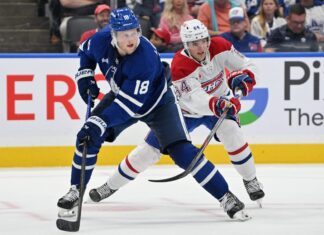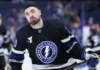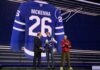




















The 2026 NHL Draft is two weeks away, and the Toronto Maple Leafs have been blessed with the opportunity to select a franchise player with the first overall pick.
According to most scouts, the best available player is winger Gavin McKenna, a native of Whitehorse who most recently played at Penn State University in the NCAA. Also, according to most with an ear to the situation, McKenna is likely to be Toronto’s choice — speculation that gained traction when it was learned that GM John Chayka recently traveled to the Yukon to visit McKenna’s family. As it stands now, it would be a sizable surprise if McKenna is not wearing a blue & white sweater in Buffalo in two weeks.
Your author is not an amateur scout by trade, but in addition to my contributions to MLHS, I cover the University of Michigan hockey team — a team, it’s important to note, that is a conference rival of Penn State and, as a perennial national contender, one that I follow closely along with the college hockey landscape more broadly. I’ve covered Adam Fantilli, Matty Beniers, Owen Power, and Quinn Hughes at Michigan over nearly a decade on the beat, and I’ve watched the likes of Macklin Celebrini, Lane Hutson, and Cale Makar rise through the college ranks.
That focus has given me a great deal of familiarity with McKenna’s game. He wasn’t just the most-watched name in the Big Ten this season, but arguably in the country. McKenna played Michigan five times during the regular season, and I watched several of his other games, including the outdoor game against MSU, the NCAA Tournament game against Duluth, and the World Juniors, which gave me a substantial number of viewings to draw on for this scouting report. Today, we’ll look at all angles of McKenna as a college hockey prospect.
I’m putting aside his career at Medicine Hat in the WHL, which was, by all accounts, illustrious. He was a phenom prospect in Canada, but that much is already known, and I don’t have enough firsthand experience watching him there. Rather, we will focus on what I saw and heard this season in the NCAA to determine A) what happened to make McKenna go from “generational” to being questioned as the first overall pick, B) why he should still go first overall, and C) how he fits with the Toronto Maple Leafs.
The Backstory
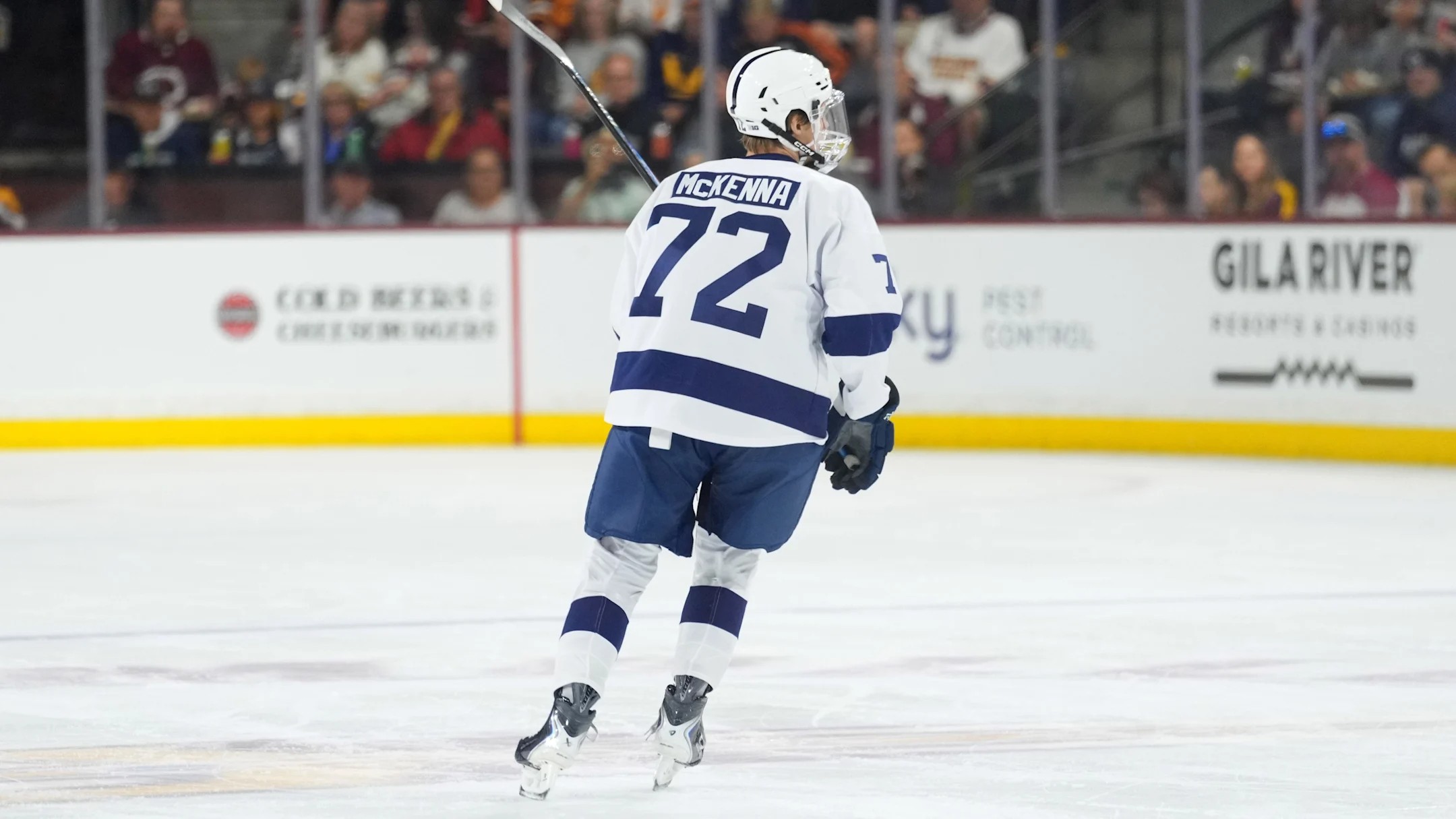
Before we get into Gavin McKenna the player, there’s some important backstory we need to discuss — information that is relevant if you are not a college hockey fan and are a little unfamiliar with the NCAA. McKenna was in the first wave of players who came over from the CHL to play in the NCAA after a rule change made them eligible, as they had previously been prohibited because the NCAA deemed them not to be “amateurs” for receiving financial compensation. The opening of the CHL as a pathway to the NCAA is in the process of changing college hockey forever, and McKenna was the most interesting test case.
As early as the start of the 2024-25 season, there were rumblings that McKenna could come to college hockey, as it appeared the WHL was no longer much of a challenge for him. Many quickly began to speculate about where McKenna could go, and the usual suspects surfaced in his recruitment: Michigan, Michigan State, Boston College, and BU. These are the historic, legacy programs that are usually loaded with NHL-ready talent, and at the beginning, it seemed likely that McKenna would end up at one of those four.
Enter Penn State. The Nittany Lions are a newer college hockey program, having moved up from club hockey to Division I in 2012-13. In their second season, 2013-14, major conference realignment in college hockey followed, as the schools that competed in the football and basketball Big Ten broke away from their previous conferences to form a six-team hockey Big Ten (which later became seven when Notre Dame joined). It took PSU time to get going at the Division I level, as you would expect, but they became competitive by 2014-15 and made the NCAA Tournament for the first time in 2016-17 after winning the Big Ten Tournament. They beat Union before losing to Denver in the regional final.
Over the next seven seasons, Penn State settled into an equilibrium. They seldom had NHL-calibre players, but when they had a roster full of seniors and juniors, they could lean on their experience and system to field a good team capable of making the NCAA Tournament. Coach Guy Gadowsky built a shoot-from-anywhere approach that was as distinctive a system as any in college hockey. PSU peppered opposing goalies with low-danger shots and ranked near the top of the NCAA in shots attempted almost every year. The team was never particularly strong defensively, but with strong goaltending, they could get enough stops to make the NCAA Tournament.
Their best team in that period was probably the 2022-23 squad, which obliterated Michigan Tech in the tournament and then came within a goal of the Frozen Four, losing in overtime to Michigan after Mackie Samoskevich ripped a shot from just inside the blue line in the opening minute of extra time. Their 2024-25 team was a ho-hum squad, sitting squarely on the bubble heading into the Big Ten Tournament. A loss in the quarterfinal series would have knocked them out of NCAA contention, but they stunningly swept Michigan in Ann Arbor.
The team lost to Ohio State in the next round in overtime, but the two wins over the Wolverines knocked Michigan out and sent PSU to the big dance, where they beat Maine and then UConn (in overtime) to reach the program’s first-ever Frozen Four. The Nittany Lions lost in the Frozen Four to Boston University, but it had been a March for the ages — a hot streak that put the program firmly on the map.
A map that Gavin McKenna may have been holding. The other dimension that has shaken up college hockey is NIL money, with NIL standing for “Name, Image, and Likeness.” In other words, cold hard cash. The legalization of NIL in the early 2020s means college athletes in the United States can now be paid for their play, which has radically altered NCAA athletics. NIL is not a major component of college hockey at present — few players are receiving substantial pay, and even the top players are getting less than some of the best college softball players receive. None of these numbers are public, but this is my inside information speaking.
College hockey is still a low-rent endeavour in the United States, with limited money involved, but if there is one player to open the checkbook for, it is Gavin McKenna. And PSU has as big a checkbook as anyone, as the program has been something of a pet project for Terry Pegula, billionaire owner of the Buffalo Sabres and Buffalo Bills. It was Pegula’s donations that paved the pathway for PSU to move up to the Division I level, including funding for a stadium and facilities that some say are among the best in the country.
It is also likely that Pegula’s money allowed PSU to make what many believe was a larger offer than Michigan State or any other college for McKenna’s services. The combination of money, PSU’s program looking sexy after a deep NCAA Tournament run, and the argument that McKenna would become the face of Penn State hockey — as opposed to just another star in a long line of legends at the legacy schools — won out in the mind of the 17-year-old Yukoner. In July 2025, McKenna committed to Penn State over runner-up Michigan State in the biggest recruiting win in Nittany Lion hockey history.
Gavin McKenna: the Producer and the Villain

From the moment that Gavin McKenna committed to Penn State Nittany Lions, it became the biggest story in college hockey nationally. After all, this is a player who exited the WHL with comparisons to Connor Bedard and Connor McDavid. The hype was immense, and the media quickly moved to coronate McKenna. He received a spotlight that was unusually bright for the relatively small media environment that is college hockey, with some calling him the “best” or “most talented” player to ever play in the NCAA. Alongside that, many anointed Penn State as the national title favorite. After all, this was a team that had made the Frozen Four, added the blue-chip prospect to end all blue-chip prospects, and brought in a few other CHL prospects as well.
That naturally made Penn State a team with a target on its back, and McKenna in particular became a lightning rod for ire from other fanbases. Fans of other college hockey programs felt that the fawning praise around McKenna was excessive, especially given that college hockey has had plenty of recent stars, including Macklin Celebrini. The belief, often repeated in hockey media, that McKenna was something college hockey had never seen before—a tier above Celebrini—was ridiculous hype he never really had a chance to live up to. And likewise, it created a lot of hostility toward the player and his team.
I will fully admit that I am not exempt from that. As a fan of a PSU rival, I was rooting for McKenna and Penn State’s demise all the way. “F*** McKenna and F*** Penn State” was pretty much the one thing that everyone—from Minnesota to Michigan, Michigan State, Boston University, Boston College, Denver, North Dakota, and Quinnipiac fans—could all agree on this season: the embodiment of a synthetic, new-money program without the results to back it up.
So when things didn’t go smoothly for Penn State to start, most of us reveled in it. The team had to rally to escape its first weekend series against a weak Arizona State team and then was stunned by middling Clarkson in the home opener. For the next few weeks, Penn State faced its usual schedule of tomato-can opponents (don’t get me started on Penn State’s tendency to avoid quality non-conference opposition), and McKenna piled up points. But once Big Ten play began, the Nittany Lions were exposed. They lost three of four to fellow national contenders Michigan and Michigan State, being outscored 16–6 in the process, with multiple ugly, non-competitive losses. After splitting with an unusually poor Minnesota team, Penn State headed into the Christmas break looking anything but a national threat.
Nor did McKenna look like a first-overall pick. He had a stat line of 4–14–18 in 16 games, but had managed just two points in those four big games against Michigan State and Michigan. I watched both Michigan–Penn State games, and McKenna was, at times, completely invisible. His only noticeable moments came on solo rushes, where he often opted for the sickest deke you’ve ever seen, only to have it easily shut down by a veteran Michigan defender who took away his time and space. It was, at times, a painful adjustment, and it didn’t help that he arrived in college with questions around his defensive and physical game. After Ivar Stenberg dominated at the World Juniors, I was in the camp of scouts ready to place Stenberg ahead of McKenna on draft rankings.
The first two games of the second half for Penn State came against that same lowly Minnesota team, and McKenna managed just a single assist. Then the lightbulb came on. From that point forward in the 2025–26 season, McKenna scored 11 goals and 21 assists for 32 points in 17 games. That 1.88 points-per-game clip compares favorably to Celebrini’s 1.68, Fantilli’s 1.81, and Logan Cooley’s 1.54, and all 17 of those games came against power conference opposition—no punching bags.
Some will point to McKenna’s eight-point game against Ohio State, but even if you remove that (hard to ignore, but still), 24 points in 16 games is a 1.5 points-per-game pace—very strong for that level of competition. Penn State’s team results didn’t meaningfully improve, as the roster remained flawed and clearly a tier below the two Michigan schools in the Big Ten and not a legitimate national contender. They did enough to secure an NCAA Tournament bid, but did not seriously contend for hardware in either the Big Ten regular season or tournament.
After a loss to Michigan in the Big Ten Tournament semifinals, Penn State entered the NCAA Tournament as the No. 10 seed, where they faced Minnesota-Duluth. Penn State played a solid game, but the Bulldogs were simply better, earning a 3–1 win. McKenna was visibly upset after the final buzzer. Your author was not; I took one final victory-lap troll on social media of Penn State because I am, unfortunately, not above the passions that come with college hockey rivalries. Gavin McKenna’s college career was over, finishing with 51 points in 35 games, second-best in the country on a per-game basis.
The Scouting Report
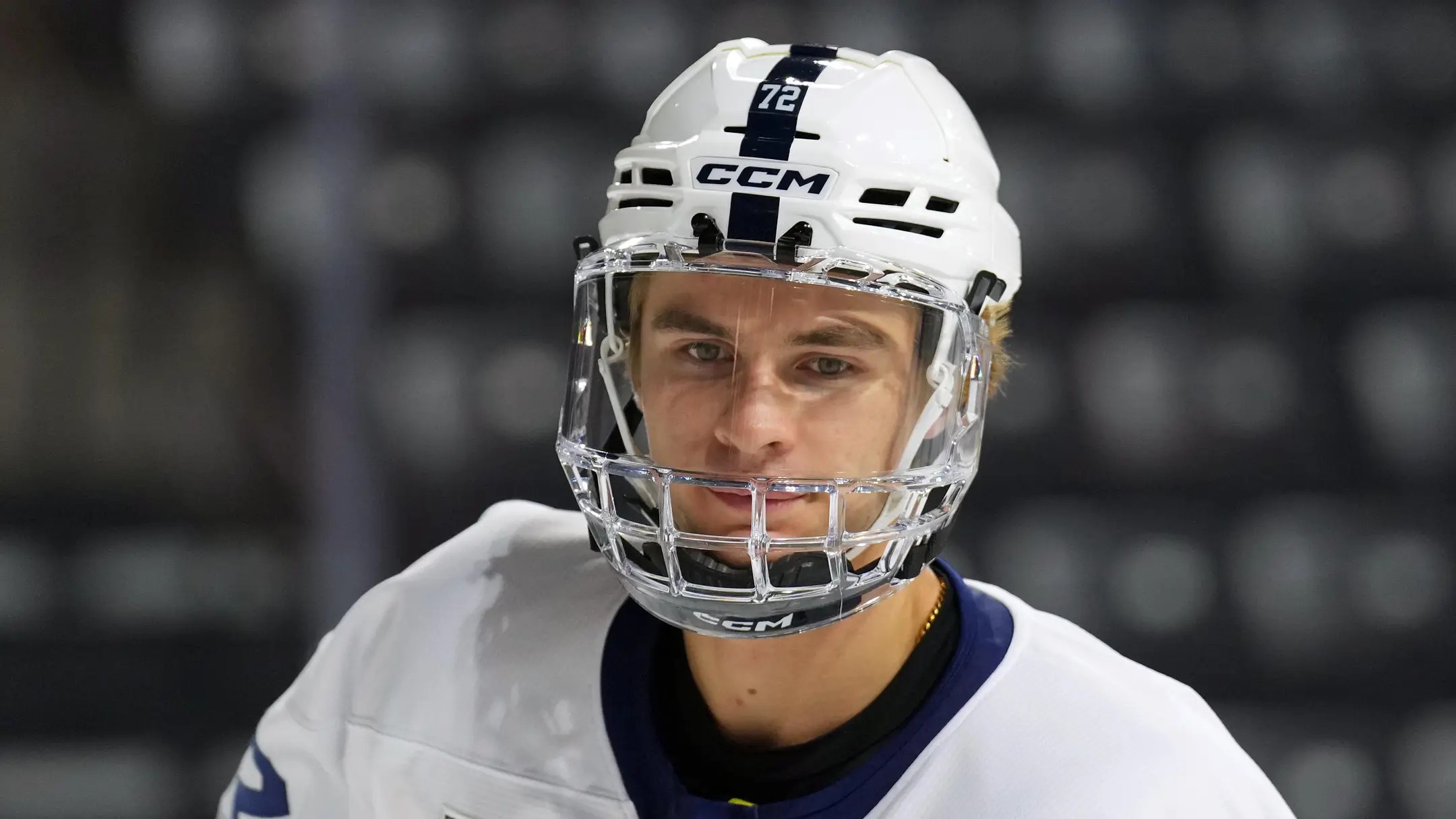
With all of that in mind, let’s talk about McKenna the player. The first thing I want to say, relevant to everything in the last two sections, is this: McKenna made a sizable mistake going to Penn State. I don’t think Guy Gadowsky is a bad hockey coach; what he has accomplished with a nascent program is no easy feat. But I’m not sure he’s the right coach for a player as skilled as McKenna, or for a team as talented as the 2025–26 PSU roster. Remember, the Nittany Lions had never previously had a team with anywhere close to that level of talent.
The team was, all season, less than the sum of its parts. As a matter of fact, I was told by someone with access to private data that PSU’s defensive numbers were among the worst in college hockey (believable on the eye test). Excellent goaltending from Josh Fleming covered it up and got them into the Big Dance, but when you consider they had a top-three most talented roster in the country, this was not a well-coached team. McKenna struggled to adjust to PSU’s system and the teammates around him early in the season, and Gadowsky was definitely not the right coach to help address McKenna’s defensive issues.
When you look at Michigan State and Adam Nightingale, there’s really no contest. Nightingale is a coach I think could be behind an NHL bench right now, and the work he did with Porter Martone was remarkable—getting Martone ready to be an impactful NHLer who could score big goals in a playoff chase. McKenna going to PSU, in my eyes, more or less cost him a year of development that he could have gotten had he gone to Michigan State. Coming from a Wolverine and not a Spartan, that sentence means something.
Yet despite all of that, I think McKenna did improve somewhat as a defensive player as the year went along. He back-checked more, and his defensive stick wasn’t half bad. It’s just that he started from an extremely rough place. The comparisons to Nikita Kucherov and Patrick Kane in that regard are very apt. McKenna’s physical game is also essentially non-existent. He’s a skinny 5’11”, and he seemed largely uninterested in engaging physically on the forecheck or in the dirty areas. That contributed to the feeling of invisibility in his worst moments.
All of that said, the Nikita Kucherov and Patrick Kane comparisons are also apt for positive reasons. Gavin McKenna can do things with the puck that no one else in college hockey can, and few other players in the world can. His NCAA tape is “human highlight reel” stuff.
McKenna’s vision, puck skill, and offensive hockey IQ are things you simply cannot teach. They are special gifts—the ability to use all the time and space given to open up devastating passing lanes for teammates. At his best, McKenna reminds me a little bit (in a cross-sport comparison) of Cade Cunningham of the Detroit Pistons, in that when Cade is at his peak, he slows the rapid, breakneck game down and makes everyone else play at his pace. McKenna can come in on a rush, with every other player on the ice sprinting at top speed, and calmly slow it down, probe, and then slip a pass seemingly out of nowhere.
When McKenna is on the puck, he controls the tempo, and everyone else follows. His challenge won’t be going too fast or playing wild as many young players do. His challenge will be adjusting to defenses taking away time and space and learning how to create it for himself in the NHL—a process he also went through this season at the NCAA level. Playing a bit more directly will be part of that evolution as well, because, as I noted, he sometimes went for the most difficult deke rather than the simple (and correct) play.
In terms of other skills, I wouldn’t say McKenna is a particularly fast skater—better on his edges than in a straight line. He’s not a poor skater either. His shot is worth discussing; he shot only 9.9% this season. When you compare that to other top forwards who played college hockey, his finishing numbers were relatively modest. I’m not entirely sure what to make of that, though at times he did overuse the shot for my liking. When you look at his WHL numbers, I think it’s fair to bring up the Patrick Kane comparisons in that he’s probably more of a 25–30 goal scorer who piles up assists than a pure finisher, as his shot is merely fine.
If there’s one concern about Gavin McKenna, it’s his performance in the biggest games. I don’t really blame him for Penn State not winning anything despite having him on the roster, because that feels more like a broader coaching and roster-development issue. But I would have liked to see more in the big games. He had a three-point game in the outdoor game against MSU, but just four points in the other eight games against Michigan and MSU, and he did not record a point in the NCAA Tournament game. McKenna wasn’t exclusively stat-padding against weaker teams, but I would have liked a bit more in the biggest matchups against elite competition.
Of course, it should also be said that Gadowsky played McKenna far too much. In the Big Ten semifinals, McKenna played 27:30 in a 60-minute regulation game, and a month prior, also against Michigan, he played a ridiculous 28:07. He regularly played between 23 and 25 minutes per night down the stretch, and I wonder how much the constant double shifting forced him to conserve energy on some shifts or contributed to some of the more disengaged stretches. Or whether he simply ran out of gas late in games. The structure at PSU around McKenna did him no favors, and it’s on his NHL team to help correct that in 2026–27.
Gavin McKenna, the Toronto Maple Leaf
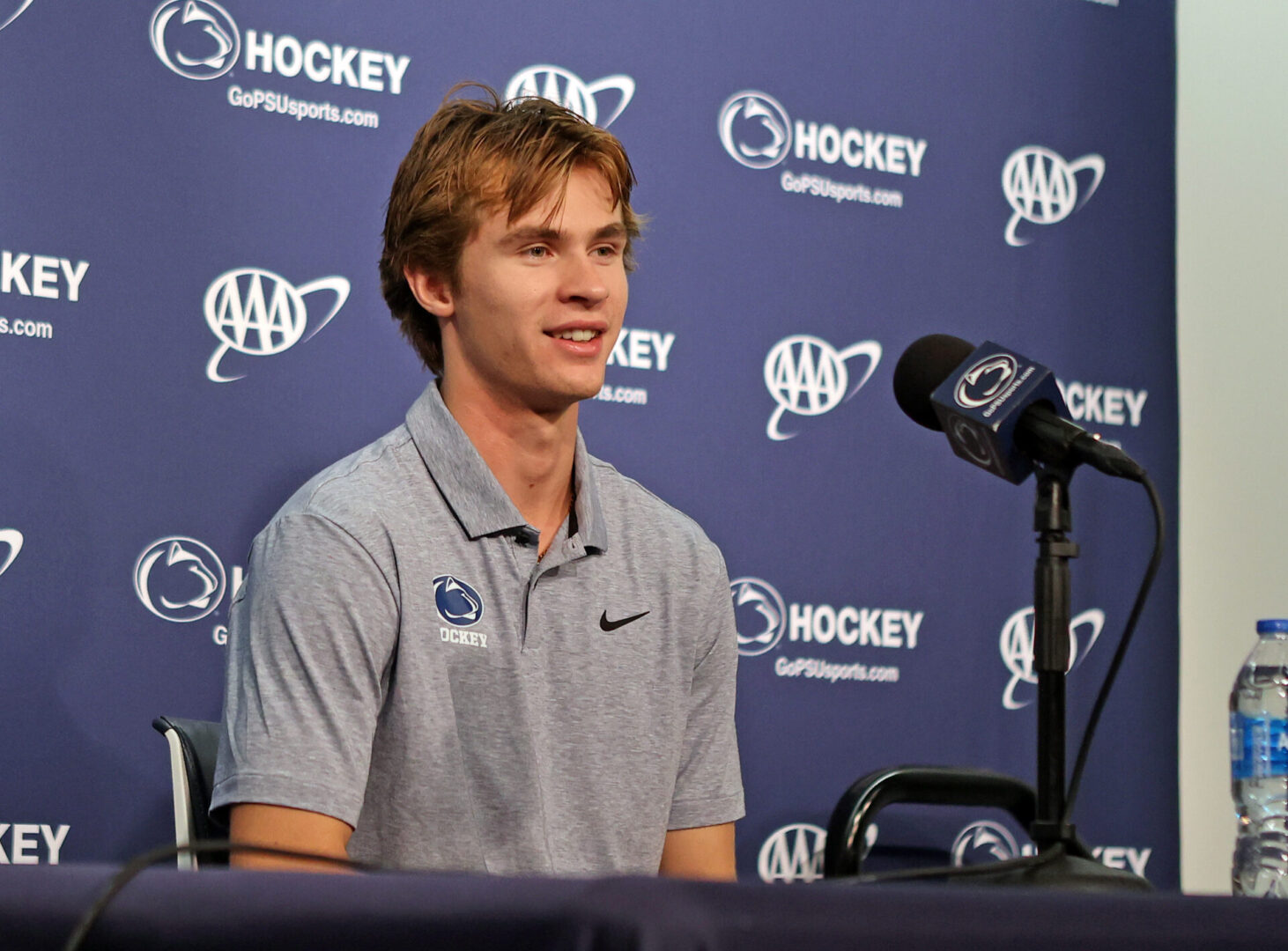
I believe that McKenna will be selected first overall. I also believe, as someone who cheered against McKenna all season long, that he is the obviously correct choice at first overall. I really like Ivar Stenberg and rate him as clearly the #2 player in this draft. But McKenna has the highest upside in this class. Players who have the potential to score 100 points are incredibly rare, and I firmly believe McKenna is one of those players. As they say, you can’t teach grit to skill, but you can teach skill to grit. McKenna’s skill is as good as it gets for an 18-year-old, and his age 15-18 scoring rates, even with a choppy NCAA season, indicate a future superstar.
One must understand that it might take some time. Whoever coaches him will have to be willing to work with his rough edges defensively and coach out his bad habits. McKenna will have to buy in himself and be more willing to go into hard areas. I’d like to see him add a little more muscle to help with those pursuits, but much of it is mentality — becoming a bit more of a bulldog who plays a little simpler and more directly when the time is right.
There is a chance that McKenna could struggle in his rookie season, as Jack Hughes did. I had a scout (former coach, for context) tell me that McKenna should go back to Penn State to refine his habits, which is not going to happen but speaks to what McKenna needs to work on. A Craig Berube-Gavin McKenna tandem would have been a bad sitcom premise, so it’s important that the Leafs get this coaching hire right because McKenna isn’t a ready-made prospect. He still needs development. I am admittedly intrigued about the idea of Joe Pavelski as a coach to help develop McKenna.
But I also think that playing with Auston Matthews in some amount could be great for McKenna — a hyper-talented and skilled teammate who knows how to get open to receive passes will be a welcome improvement after the Penn State experience. On the Vancouver Canucks, I’d have imagined McKenna having a rough go of things as a rookie, but on a team with more talent like the Leafs, I think he should be able to do okay as a first-year pro. At the very least, rookie McKenna should instantly be a staple of the power play, as he ascends to a player who, in his prime, ought to be one of the best power play wizards in the NHL.
There’s one final thing I want to mention about McKenna: his fit with Toronto. The whole Mitch Marner experience has made us acutely aware of the need to find players who have the right mindset to play in this market, and on this note, I have good news: There are few top NHL prospects in recent memory that I think are a better fit for the Toronto market than Gavin McKenna. This is a player who chose Penn State in part because he wanted to be a face of Penn State Hockey. The rest of college hockey jeered him as an attention-hog when camera crews followed him around to film a documentary about himself, which I don’t recall any other top college hockey prospect having done. This is a player who, after the bar-fight arrest, did the Conor McGregor strut as his goal celly.
In an era when so many hockey players glowingly talk about southern markets with no pressure and a desire to hide from the media, McKenna is as comfortable with the spotlight as any young hockey player I have seen come through the NCAA. Some would even suggest that he craves it. Which I don’t think is a bad thing, even if I painted it as such when I was a fan cheering against him. Patrick Kane also loves the spotlight, eschewing Tampa and Florida to play in Detroit because it’s a famed hockey market. So does Artemi Panarin, who, when given the chance to choose where to play, has only ever selected three cities: Chicago, NYC, and LA. I think McKenna is clearly in that mold: a kid who likes the big stage.
Which is great for the Toronto Maple Leafs. All the reasons why we non-PSU fans disliked him are why he’s a perfect fit for this franchise. And to be clear, I have never heard anything bad about McKenna. In fact, one person told me after the arrest that he’s a great kid. There’s nothing wrong with having a personality and liking the media. We need more of those players in the NHL, and we need more of those players in Toronto.
The Leafs should select Gavin McKenna because he’s the highest upside player in this draft. The one with the best chance of winning a Hart Trophy and a player who, if nurtured properly, could challenge franchise scoring records set by Matthews and Marner. It may take a bit of time, but I think that if the Leafs nail the coaching hire, this could be the beginning of a beautiful relationship between player and team.
There’s a world where McKenna falls short and becomes an enigmatic but hyper-skilled Alexei Kovalev type (worst case is Alexis Lafrenière, I guess). There’s also a world where he’s a Kucherov or Kane and a Hockey Hall of Famer. The middle ground is probably closer to Panarin. Which is an incredible prize that the draft lottery gods bestowed upon the Leafs.
You have to accept that McKenna will never be a bruising power forward nor a hustling two-way master, but if he works hard enough at improving in those areas and his brain and hands click at the NHL level, this could be Toronto’s new franchise player and one of the best players in the world in five or 10 years’ time.