



















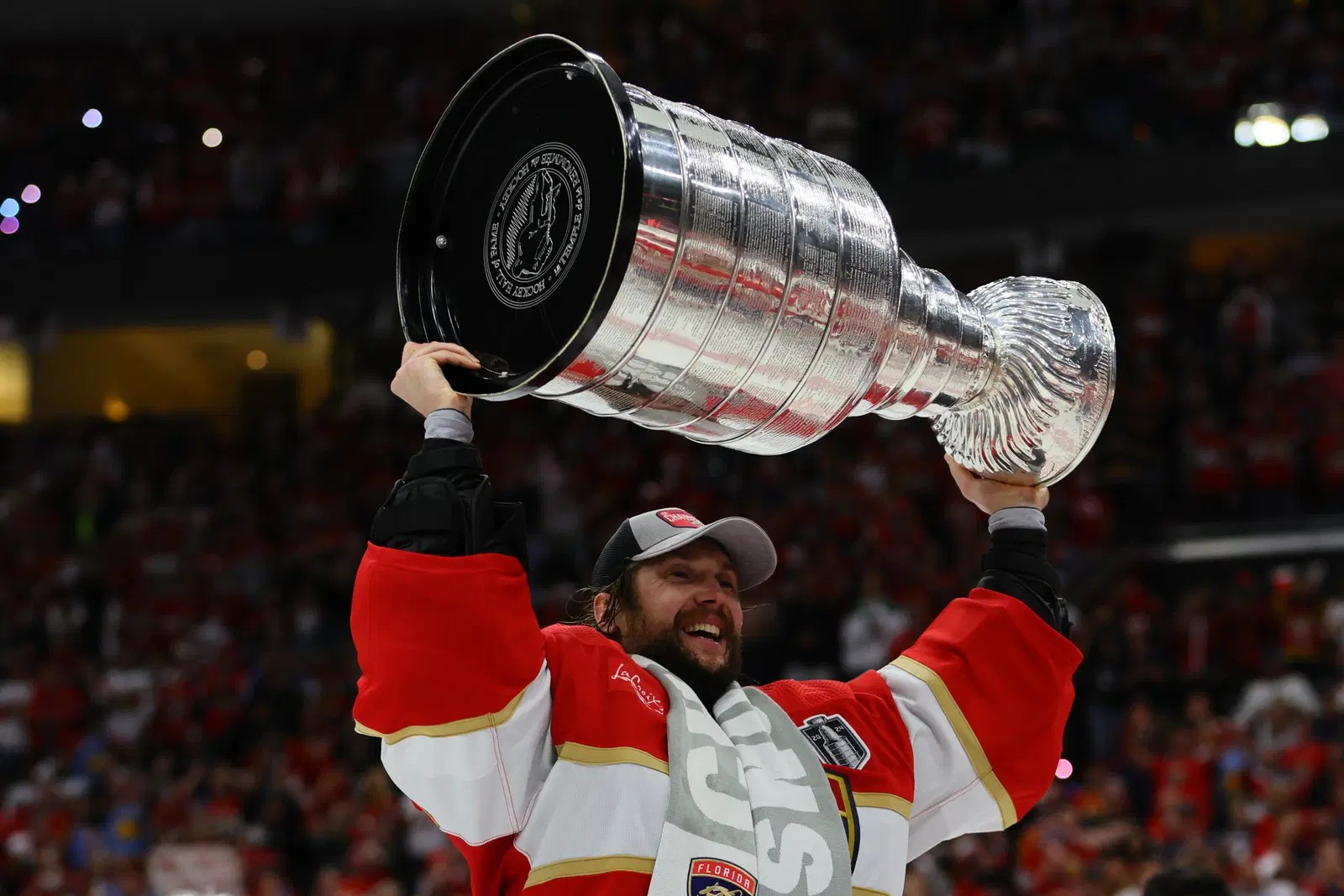
Former Maple Leaf playoff villain Sergei Bobrovsky is changing sides and signing with the Toronto Maple Leafs.
After days of intense speculation, the likeliest outcome came true on Canada Day when the famed goalie signed in Toronto. The terms: three years, $7 million AAV.
Who is Sergei Bobrovsky?
This header feels a little redundant for devoted Leafs fans—or really hockey fans in general—knowing Bobrovsky has two Vezina Trophies, two Stanley Cups, and 456 career wins. But it’s worth digging a little deeper into Bobrovsky’s recent record and what it could mean for his fit in Toronto.
As has been stated frequently over the last few days, Bobrovsky turns 38 in September and was the fourth-oldest goalie in the NHL this year behind the now-retired Jonathan Quick, Cam Talbot, and ex-Leaf James Reimer. At face value, that’s a little concerning. When you see his .877 SV% from this past season, it’s even more concerning.
But let’s dig deeper.
As a quick summary of his early career, Bobrovsky came into the NHL with the Philadelphia Flyers, but after two seasons, he was traded to the Columbus Blue Jackets for a collection of draft picks (one of which became Anthony Stolarz). None of those picks were first-rounders, which made it a massive heist for Columbus when Bobrovsky proceeded to post a .932 SV% and collect his first Vezina Trophy in his first season in Ohio. The advanced numbers weren’t as kind over the next few seasons before Bobrovsky rebounded in 2016-17 with a season for the ages, going 41-17-5 with a league-leading .931 SV% and a league-leading 2.06 GAA. That was Bobrovsky’s second Vezina win, cementing him as one of the best goalies of the decade.
After two more solid years in Columbus, including leading the Blue Jackets to their first playoff series win in the stunning upset over Tampa Bay, Bobrovsky signed a massive contract as a free agent with the Florida Panthers. His first two seasons with the Panthers were not strong. In the 2021 Stanley Cup Playoffs, the Panthers started three different goalies for two games apiece in their first-round series against Tampa Bay, and many envisioned a future in which top prospect Spencer Knight would soon surpass Bobrovsky as the team’s starter. At that time, you could find articles suggesting that Bobrovsky’s contract was among the worst in the NHL.
Then things changed.
Bobrovsky had a strong bounce-back season in 2021-22, backstopping the Panthers to the Presidents’ Trophy while leading the NHL with 39 wins. The team fell short in the playoffs, but he proceeded to right that wrong over the next three postseasons, twice to the chagrin of Leafs fans. He was consistently steady in the regular season, highlighted by an outstanding 2023-24 campaign in which he made the All-Star Game and led the league with six shutouts.
Bobrovsky reached another level in the playoffs. From 2023 to 2025, he went 44-21 in the postseason with a .912 SV%, a 2.41 GAA, and six shutouts. Of course, the most important part is that he led the Panthers to two Stanley Cups while reaching a third Stanley Cup Final. Evolving Hockey credits him with 41.25 goals saved above expected in those 65 playoff games, an outstanding rate on a per-game basis. His 2023 playoff series against the Maple Leafs still stands out, as Bobrovsky posted a .943 SV% and was outstanding. At times, he benefited from Florida’s excellent defensive structure, but he was also capable of stealing games on his own.
Up through the 2025 season, Bobrovsky’s credentials were unassailable. He had cemented his status as a future Hall of Famer and sat atop the hockey world as a two-time Stanley Cup champion. But, to many, the bill eventually came due.
Bobrovsky is a certified workhorse, averaging 54 starts per season over the last four years. Add in three deep playoff runs, and the amount of hockey he played from 2023-25 was extreme.
Injuries didn’t derail him this past season, as Bobrovsky still played 52 games for Florida. But his play declined precipitously, with his SV% dropping from .905 to .877. He still won 27 of 51 games, but the Panthers missed the playoffs as his GAA climbed above 3.00. After the season, he was unable to reach a new contract with the Panthers, who instead acquired Jacob Markstrom and Akira Schmid to reshape its crease, allowing a franchise icon who will likely have his jersey retired in South Florida to walk out the door—to a division rival.
Bobrovsky’s fit in Toronto
At face value, the combination of poor play last season and his advanced age makes Sergei Bobrovsky an unappealing target. However, there is logic to the move. As our own Anthony Petrielli wrote recently, the Maple Leafs are desperately in need of a proven NHL goalie who actually plays hockey games. Anthony Stolarz has generally been very good throughout his NHL career when healthy, but he cannot be counted on for more than about 30 games in a season. Artur Akhtyamov is a promising young goalie, but he remains unproven at the NHL level. With Joe Woll now in Philadelphia, the Leafs lack a goalie they trust to shoulder a starter’s workload—or even one they feel comfortable playing 40-plus games.
Bobrovsky, whether he’s good or bad, is going to play 40-plus games. He’s been durable throughout his career and is renowned for his meticulous preparation and conditioning. Over the past 14 seasons, only once has he failed to handle a starter’s workload, and he’s reached that mark in each of the last four seasons. Reliability has real value, and the Leafs need it.
The Leafs would have received many green lights and character references not only from his former Blue Jackets backup in Curtis McElhinney — who now scouts and develops goalies for the organization — but also from the likes of former Florida teammates OEL and Steven Lorentz, and they must also like the odds of Bobrovsky’s experience, pedigree, and mental makeup suiting the Toronto pressure cooker perfectly.
Of course, the Leafs also need someone who can stop the puck, and that’s the bigger question. This past season was undeniably poor. MoneyPuck credited Bobrovsky with -12.2 goals saved above expected, while Evolving Hockey had him at -1.75. The latter feels somewhat difficult to reconcile with a .877 SV% on a team that wasn’t a complete defensive disaster.
Still, there’s no question Florida’s defensive environment deteriorated without a healthy Aleksander Barkov, while Seth Jones, Brad Marchand, and Matthew Tkachuk all missed significant time. Both MoneyPuck and Evolving Hockey show the Panthers slipping from an elite defensive team to roughly league average. A tougher environment, combined with fatigue after three consecutive deep playoff runs, offers a plausible explanation for Bobrovsky’s decline.
We saw something similar with Andrei Vasilevskiy after Tampa Bay’s three straight Stanley Cup Final appearances. Eventually, the workload caught up to him before he rebounded to elite form.
The optimist’s case is that Vasilevskiy bounced back and won another Vezina Trophy. The pessimist’s case is that Bobrovsky’s decline was steeper, and he’s nearly eight years older than Vasilevskiy was during his downturn. Age-related decline is a legitimate concern.
I think there’s a reasonable case for both viewpoints. Leafs fans looking for hope will point to Ed Belfour, who followed a remarkably similar career arc before arriving in Toronto. After two declining seasons in Dallas, Belfour signed with the Leafs at age 37 and promptly turned back the clock with two outstanding seasons before the lockout.
That represents the best-case scenario. A year without playoff hockey allows Bobrovsky to recover; he arrives refreshed in a new market, and the Leafs manage his workload more effectively with help from Stolarz or one of their younger goalies. I don’t think Bobrovsky is winning another Vezina Trophy, but another one or two quality seasons aren’t impossible. Goalie aging curves can be unpredictable.
Besides Belfour, Tim Thomas, Dominik Hašek, Roberto Luongo, Martin Brodeur, and Johnny Bower all remained effective well into their late 30s or early 40s. Bobrovsky’s résumé belongs in that conversation. That doesn’t guarantee he’ll age similarly, but it does show it’s possible.
Perhaps the most likely outcome falls somewhere in the middle. Bobrovsky may no longer be the goalie who carried Florida to championships, but he also may not be finished. If the Leafs can get 40-50 starts with roughly league-average goaltending — with some valuable mentorship to their young goalies in the system along the way, with AA naturally springing to mind — they’d probably consider that a success. They need someone who can shoulder the workload without sinking the season. There’s certainly downside risk, but there is also a realistic path to this working out.
I don’t love this signing, but I don’t hate it, either. Alongside a new coach and Gavin McKenna, it adds another fascinating layer to an already intriguing offseason. Having a big-name, Cup-winning goalie arrive from a division rival will make this season worth watching.
Looking at the market, I didn’t see an obvious alternative I preferred. Stuart Skinner is younger, but is anyone truly excited about Stuart Skinner? Freddie Andersen? Connor Ingram? Cam Talbot, who’s somehow even older than Bobrovsky? It was a weak goalie market, and the Leafs took a swing at the biggest name available. At a three-year term, in a rapidly rising salary-cap environment, it shouldn’t be a franchise-wrecking gamble.