



















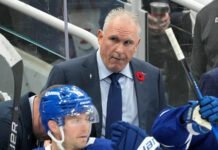




As the Maple Leafs’ struggles have mounted over the past few weeks, fan/media scrutiny has understandably escalated. As we all know, it will only get louder unless the team can somehow work its way out of its current funk in short order.
From what I’ve seen, most of the criticism has been fair. The team has played a poor brand of hockey on a fairly consistent basis, and too many players have provided nothing game after game. In times like these, though, it’s important to take a step back, take a deep breath, and zoom out to evaluate the bigger picture.
Just a few months ago, this team was unanimously regarded as a virtual playoff lock across the hockey world. You would have been hard-pressed to find any publication or predictive model that called the 2025-26 Maple Leafs a lottery team, let alone a bottom dweller.
Yes, the team lost Mitch Marner over the offseason (who is currently pacing for 14 goals and 78 points in Vegas, by the way), and they didn’t meaningfully replace him, a fact that has only become more painfully obvious over the first quarter of the season.
But even without Marner, the team still boasts a collection of key pieces who should be able to carry the mail. A 28-year-old top-line center, two top-line wingers in Matthew Knies and William Nylander (Nylander, in particular, is one of the best goal scorers in the entire league), a still-productive 2C in John Tavares (an understatement, given he’s top 10 in points), a defense pairing that was one of the best shutdown duos in the league last season, all backstopped by what was arguably the best goalie tandem in the league in 2024-25. Supporting those pieces are some established, productive veterans.
Obviously, it hasn’t remotely come together on the ice so far through 22 games.
The impact of injuries, and the role of coaching
The Leafs have not had Joseph Woll and Anthony Stolarz available to them at the same time for even one game this season, and it doesn’t appear they will any time soon, either.
Chris Tanev has played just eight of 22 games.
Auston Matthews has played under 80% of the games, and even when he did dress, he wasn’t performing anywhere close to expectations, producing under a point per game and failing to drive play at the level expected.
Almost none of the supporting-cast veterans have held up their end of the bargain, save for Oliver Ekman-Larsson (and if you consider Nick Robertson a “veteran” at this point, him, too).
At the same time, the team has also played a disorganized, and at times bordering on disinterested, brand of hockey. They’ve been routinely outplayed and have struggled to keep the puck out of their zone and out of their net. They’ve conceded the second-most goals against per game in the league.
At the other end of the rink, the Leafs are fifth in the league in goals per game, but it’s on the back of the fourth-highest shooting percentage. If their five-on-five shooting percentage crashes down to earth at some point, perhaps it can be offset by the coaching staff figuring out their 28th-ranked power play, which is clicking at an unacceptable 15.5% clip despite all the offensive talent at their disposal.
While there’s nothing Craig Berube and the coaching staff can do about the revolving door of injuries, they can at least deploy an organized, structured team that plays hard and holds players accountable. Critically, this is the foundation that allows a team to remain competitive throughout times of injury adversity.
In this regard, the Leafs haven’t been close, and if there was ever a quote from the principals involved that admitted as much, it was GM Brad Treliving’s last week:
Treliving: “As we sit here today, our record is indicative of how we’ve played. Obviously, we are in the results business, but there are nights when you play well and lose. There are nights when you just score more than the opponent, but you haven’t played well. Far too often, even in games that we have won, we haven’t won the game.”
While there are plenty of calls within the fan base to throw in the towel, declare the window closed, and tank away this season, the reality is that the organization isn’t going to do that right this second — not when it’s not even December yet, the lineup is chock-full of injuries, and the Eastern Conference is so tightly bunched. Truthfully, nor should they.
If this continues along the current path, it will be a simple conversation as the season progresses, and the goal will pivot to maximizing value for pending UFAs and veterans. Even if they wanted to do this right now, though, it’s not happening tomorrow, next week, or even next month. This is a job for February and March, when prices are at their highest.
Smaller, hockey-type trades in which the Leafs swap fringe players or remove some deadweight off the roster should be explored in the meantime. I won’t speculate as to what that might look like or who it might involve specifically, other than to suggest moving out certain players would be addition by subtraction.
That aside, there are two other options in the meantime as the Leafs try to right their ship before throwing in any towels: Hope you get healthy and rebound, and/or fire the coach. Of course, there is the option — and arguably, increasingly good evidence for — doing both.
On the health front, we are already seeing the early dividends from Joseph Woll returning. He’s been their best goalie by a mile in the four games since his return, and he can clean up a lot of messes for this team. Through no fault of his own, Woll is 1-2-1 in those games, so he can only take it so far himself, but we can already see the improvement, and additional help should be on the way shortly.
Auston Matthews and Matthew Knies have now practiced with the team three times in a row — maybe it’s enough evidence that they can return now? Nobody knows anything! — and Nic Roy is also back practicing, too. Missing two-thirds of the top line and two of the top three centers overall has a massive domino effect. The return of all three will make the team significantly better.
When those bodies do return, we’ll see who Berube has the stones to healthy scratch, but it shouldn’t be Easton Cowan. John Tavares and William Nylander are unquestionably safe, too. As is Scott Laughton, and I’d argue Steven Lorentz is for at least one game. Scratching Bobby McMann or Nick Robertson wouldn’t make much sense (although it wouldn’t be the first time they took the brunt of it rather than underperforming, higher-paid veterans). That leaves Berube to pick three from a group of Max Domi, Dakota Joshua, Mattias Maccelli, Calle Jarnkrok, and Sammy Blais.
This should be a good forward group:
Knies – Matthews – Robertson
McMann – Tavares – Nylander
Lorentz – Laughton – Cowan
Joshua/Blais – Roy – Jarnkrok/Maccelli
The Leafs won’t have the luxury of full health on defense anytime soon, unfortunately. The current group is likely the six-man unit for now. Brandon Carlo hasn’t practiced since a mystery injury, and Chris Tanev isn’t close to returning, either. Until further notice, they will need to figure it out as best as they can with the personnel available.
A healthy forward group and Woll go a long way, but you’d really want Tanev, in particular, back in the lineup to feel good about simply banking on players returning from injury and smoothing this out. He is their best defenseman, and we can’t understate his importance at this rate. Jake McCabe’s play has taken a big dip without him, and Simon Benoit is currently playing top-four minutes on a nightly basis. Adding Tanev back to the defense with the forward group above and a healthy Woll should produce a pretty good hockey team capable of turning their record around.
If it doesn’t, it would make the next decision all the clearer.
Myth: The Leafs have tried too many coaches
Frankly, I think the Leafs’ style of play has steadily trended down since Craig Berube was hired, even though the team won the division and advanced to the second round last season. Winning the division came in part thanks to the Florida Panthers resting all their key veterans down the stretch rather than pursuing the regular-season division title themselves. The Panthers were proven wise in their approach when they handily dismantled the Leafs in Games 5 and 7 on the road.
We aren’t the only ones asking the question about a coaching change, but I do see plenty of bizarre retorts that the Leafs can’t continually make changes to the coaching staff and thereby “let this core off the hook,” or that we’ve seen this team play under enough head coaches over the years to make definitive conclusions about the non-viability of the current Leafs. It doesn’t jive with the reality of the league and the average shelf life of coaches.
Since Auston Matthews entered the league, the Leafs have hired only two new head coaches, and Matthews has played under three in total, one of the lowest numbers in the league. In fact, only three organizations have made fewer head coaching changes, and two of them won the Cup. The other is the Carolina Hurricanes, who have enjoyed far more playoff success (albeit thanks to their relatively weak division, but the optics still matter).
Here is the head coach count for each NHL organization since Matthews broke the league:
| Team | Number of Head Coaches Since 2016-17 |
|---|---|
| Anaheim Ducks | 5 |
| Boston Bruins | 5 |
| Buffalo Sabres | 5 |
| Calgary Flames | 5 |
| Carolina Hurricanes | 2 |
| Chicago Blackhawks | 6 |
| Colorado Avalanche | 1 |
| Columbus Blue Jackets | 5 |
| Dallas Stars | 6 |
| Detroit Red Wings | 3 |
| Edmonton Oilers | 5 |
| Florida Panthers | 5 |
| Los Angeles Kings | 5 |
| Minnesota Wild | 3 |
| Montreal Canadiens | 4 |
| Nashville Predators | 3 |
| New Jersey Devils | 5 |
| New York Islanders | 5 |
| New York Rangers | 5 |
| Ottawa Senators | 5 |
| Philadelphia Flyers | 7 |
| Pittsburgh Penguins | 2 |
| San Jose Sharks | 4 |
| Seattle Kraken | 3 |
| St. Louis Blues | 5 |
| Tampa Bay Lightning | 1 |
| Toronto Maple Leafs | 3 |
| Utah/Arizona | 3 |
| Vancouver Canucks | 5 |
| Vegas Golden Knights | 3 |
| Washington Capitals | 4 |
| Winnipeg Jets | 4 |
On average, an NHL organization has rotated through four coaches in this time period. If we remove the Stanley Cup winners and the Leafs, the average nudges up to 4.5 coaches.
In the context of the league, it’s par for the course to bring in a new coach if a team isn’t performing to expectations, and if anything, the Leafs shade toward gun-shy in this department. Mike Babcock essentially forced their hand, and Sheldon Keefe lasted far longer than most coaches would, given the expectations and the playoff futility year after year during his tenure.
The injury excuses only go so far in the Leafs’ case. Their most recent game in Montreal was straight-up embarrassing. So were their losses to Carolina and LA (even though they were both technically one-goal games), plus their loss to New Jersey at home. Losing two of three to Boston in regulation in the manner they did wasn’t much better. That’s a quarter of the Leafs’ games to date, and the team was relatively healthy for most of those losses.
And yet, some fans and media are seemingly jumping to the conclusion that the organization should blow it all up 22 games into the season with a 28-year-old Auston Matthews under contract with term, a 29-year-old William Nylander tearing it up, a 22-year-old Matthew Knies producing at over a point per game, and John Tavares still very much an offensive force. Joseph Woll is 27. Easton Cowan is showing real promise. You would not find another organization in the league even remotely considering blowing it up with these pieces, at these ages, at its disposal. A step back, perhaps, but tearing it down to the studs is nonsense unless the team can pull in absurd hauls via trade
The Leafs are 1-6-0 on the road so far this season and just started a six-game road trip with a bad loss in Montreal. Injured players will start returning sooner rather than later. They can bide their time until they get healthier or force the issue with a new coach, but they aren’t going to trade their way out of this save for shaving off some deadweight in the near future.
The Leafs could hold off on a coaching change, wait to get healthy (hopefully), and see how the team rounds into form. There’s some justification to this approach, but starting some level of rebuilding without first entertaining a new head coach two months into a season where pretty well everyone and their mother viewed the Leafs as a playoff team is premature and foolhardy. The Leafs have shaded to the conservative side of coaching changes, and, again, teams benefit from new-coach bumps all the time.
Eventually, if the Leafs are still in a dark place when spring approaches, the time to sell will come, and we will discuss it if and when appropriate. We aren’t close to that stage yet, though, and in the meantime, they need to either get healthy and play better, find a different coach who can get more out of this group as constructed, or both.
Injuries are sometimes a valid excuse for lagging results, but they don’t excuse a lacklustre style of play or a poor process on the ice.