





















The narratives about the 2025-26 Maple Leafs have gotten out of control.
With the talk of rebuilds, tanks, and fire sales all over my social feeds, I can’t believe what some fans seem to be advocating for before they first see a new coaching staff behind the Leafs‘ bench.
Anthony Petrielli already did a great job of showing that the Leafs have been fairly gun-shy about coaching changes during this era and certainly haven’t given this player group “too many chances under too many coaches,” at least if you care at all about how the rest of the league operates. The idea that the question of whether a coaching upgrade might be beneficial has already been “asked and answered” with this Leafs team also doesn’t adequately account for the amount of roster turnover in the past couple of years, including the departure of a certain 21+ minute lineup centerpiece this past summer.
Petrielli: … Some fans and media are seemingly jumping to the conclusion that the organization should blow it all up 22 games into the season with a 28-year-old Auston Matthews under contract with term, a 29-year-old William Nylander tearing it up, a 22-year-old Matthew Knies producing at over a point per game, and John Tavares still very much an offensive force. Joseph Woll is 27. Easton Cowan is showing real promise. You would not find another organization in the league even remotely considering blowing it up with these pieces, at these ages, at its disposal. A step back, perhaps, but tearing it down to the studs is nonsense unless the team can pull in absurd hauls via trade.
Ahead of Leafs vs. Capitals on Black Friday in the States, I was awe-struck by the widening gap in the two teams’ five-on-five possession play over the season to date (you could fit a water buffalo inside this crocodile’s mouth!):
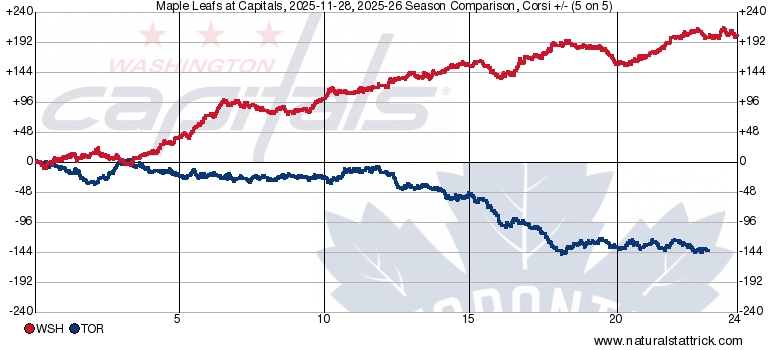 Now, the Capitals’ defense, especially with the Leafs’ current injuries to Chris Tanev and Brandon Carlo, is superior. It makes an obvious difference in many areas, including moving pucks out of their end.
But the Leafs are deeper up front, particularly at the center position, where the Capitals aren’t as strong anyway but are currently without Pierre-Luc Dubois as well. It’s also noteworthy that it’s a veteran group of centers in Toronto; its youngest member is the recently turned 28-year-old Matthews. Their center group should be good and experienced, and, in addition to the play-driving capabilities of an elite, puck-dominant forward like William Nylander off the wing, should be able to serve as the engine capable of driving play, if they played with good structure within their overall game.
Instead, I’ve seen a Leafs team that has often looked like it doesn’t value holding onto pucks enough. Even as I’ve seen more attempts to break out with possession of late, they frequently seem not to know or trust where each other is going to be on the ice. They’ve appeared disconnected, struggled to move up the ice cleanly, punted away possession too cheaply, and looked slow and disjointed for sizable spells within games. It’s become a common refrain to hear the Leafs described as “slow” this season. Their lack of structure on breakouts stalls the process of building speed, which in turn kills their forecheck and undermines their desired north-south game plan. This is why they’ve also often been described as lacking an identity this season.
At risk of pointing out the obvious example, look no further than the Florida Panthers, particularly when they’re healthy and rolling at their best. Everyone knows where the other is on the ice, and they support each other very well in all three zones with and without the puck. With the puck, they exit the zone together as a five-man unit extremely well, to the point where they can almost look like they’re on autopilot, advancing or bumping pucks to each other seamlessly. When they’re at their best, they can play extremely fast as a result, and it enables their vaunted forecheck when they’re frequently chipping pucks in (intelligently, another area in need of improvement for the Leafs), then recovering them with speed and physicality. While they are really banged up at the moment, the Panthers are still holding inside the top 10 in the key performance metrics at five-on-five thanks to their established structure under Paul Maurice.
There is a throughline that isn’t mentioned nearly enough in the conversation about the current state of the Leafs. It’s the way the team played as last season wore on, particularly into the playoffs, culminating in the Panthers series loss.
This was a Leafs team that still had Marner and was healthy (as realistic playoff standards go), one that was generally playing with good structure defensively all season. And yet they were embarrassed on home ice by Florida in Game 5 and Game 7 for one main reason (in my view): They didn’t possess the puck enough.
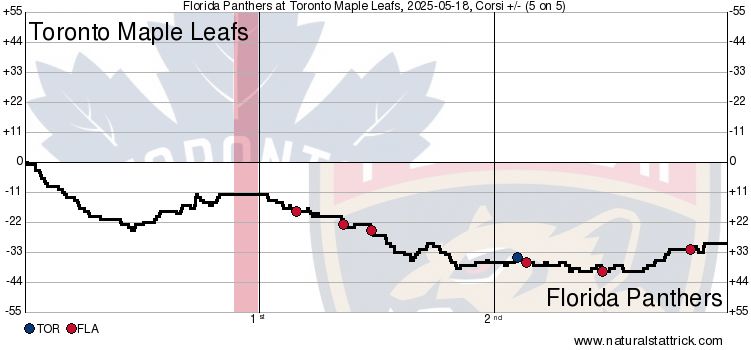
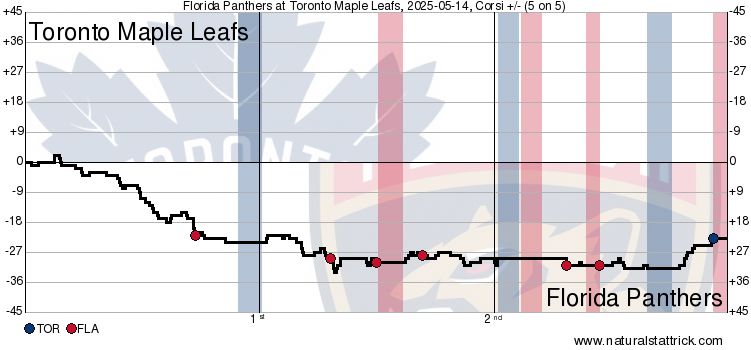 After the series, Berube talked a lot about the mental game and the team’s response in the “critical moments.” Look at the Game 5 and 7 five-on-five shot attempt charts above. Was this about critical moments, or one team tilting the other from start to finish more or less? Before there is a little bit of score effects at the very end in those blowout defeats, the Panthers ran up truly gargantuan shot-attempt differentials on the Leafs at five-on-five. Every Leafs fan remembers the stomach-turning feeling of watching the Panthers tilt the ice to a staggering degree in the first period of Game 7, running up a ridiculous 25-0 shot attempt advantage over the Leafs (I actually had a somewhat similar feeling recently in the second period against Montreal, who, unlike Florida, are no possession giant).
In Sheldon Keefe’s final three seasons as Leaf coach, the Leafs ranked third in the league in five-on-five scoring chance share, seventh in five-on-five shot share, and eighth in five-on-five shot-attempt share. Did the whole team get bumped on the head and can no longer control the puck, necessitating a lobotomy (in this metaphor) in the form of a rebuild? Does the coaching not play a clear and obvious role in this?
Now, I recognize there are tradeoffs in hockey when it comes to systems and what a team chooses to value. I’m often drawn back to this Andre Tourigny quote from a few years ago:
Tourigny: “If you want to have more possession off the rush, you’ll turn the puck over more. You will give up more chances against. It doesn’t matter which team you pick in the league; every metric has a downside.
If you want one of the best gaps in the league, no problem, you can do that. But you will be one of the worst teams on the breakout under pressure, because you’re gapped up. There are elite teams in the league who have really, really good gaps, but if you look at their metrics, they’re 29th in breakouts under pressure. The pressure is not a guy a stick length behind you. He is right on you.
There is no way I’ve found where you can have a really tight gap and be a leader in the league in loose-puck recovery breakouts. There is always a downside.
It is the same thing in the defensive zone. Okay, you want to pressure, but that will create some breakdowns that will create a quality scoring chance.
Dallas is one of the teams that applies the most pressure in the defensive zone, but they give up quality scoring chances. When you press really hard, the quality of the chance you give is higher, but they give less (volume).
Which one do you want? If you want to give less (volume), you need to apply more pressure. If you want less quality, you need to be a little more conservative and stay inside. You will give up more (volume), but less quality.
There is no way to do everything.”
Who can forget Sheldon Keefe’s famous quote about the opposition setting the game up for the Leafs to beat themselves? Under Berube, the Leafs eliminated some of the risk that led to the bigger breakdowns, between their north-south approach with the puck and protect-the-house mindset without it. This necessarily means conceding some zone time and possessing the puck less to some degree.
If the Leafs fell back toward middle of the pack-ish in some of the shot metrics at five-on-five under Berube, while controlling the critical areas of the ice pretty consistently, it all adds up to something that makes a good deal of sense. But we’re not currently living in that reality, as everyone who has watched the team this season knows. It’s tipped too far against the team from a possession standpoint.
As I said on a recent MLHS Podcast, “The Leafs, under Berube, stopped beating themselves last season, for the most part. The problem is, we’ve now reached a point where other teams are beating them flat out.” As I heard it, Brad Treliving shared a similar sentiment with his memorable “even in games we’ve won, we haven’t won the game” lamentation the other week.
We haven’t even gotten into some of the questionable line construction and accountability/culture pieces this season (you could tolerate a team that doesn’t excel at possession but works hard most nights and makes the other team leave the game with a bit of a limp, win or lose). We’ll leave those for another piece.
Berube is fairly owed a chance to right The Good Ship Maple Leaf with a healthy lineup, to clean up the breakouts, to make the forecheck more effective, and to find a solution on the power play. But the leash should be getting quite short as of American Thanksgiving, and progress needs to become readily visible, starting today.