








written in collaboration with Alec Brownscombe
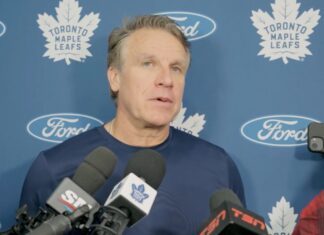
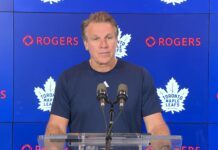
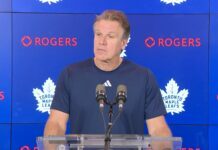
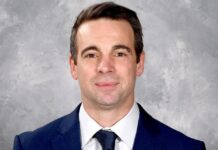
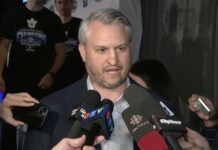
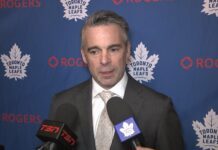
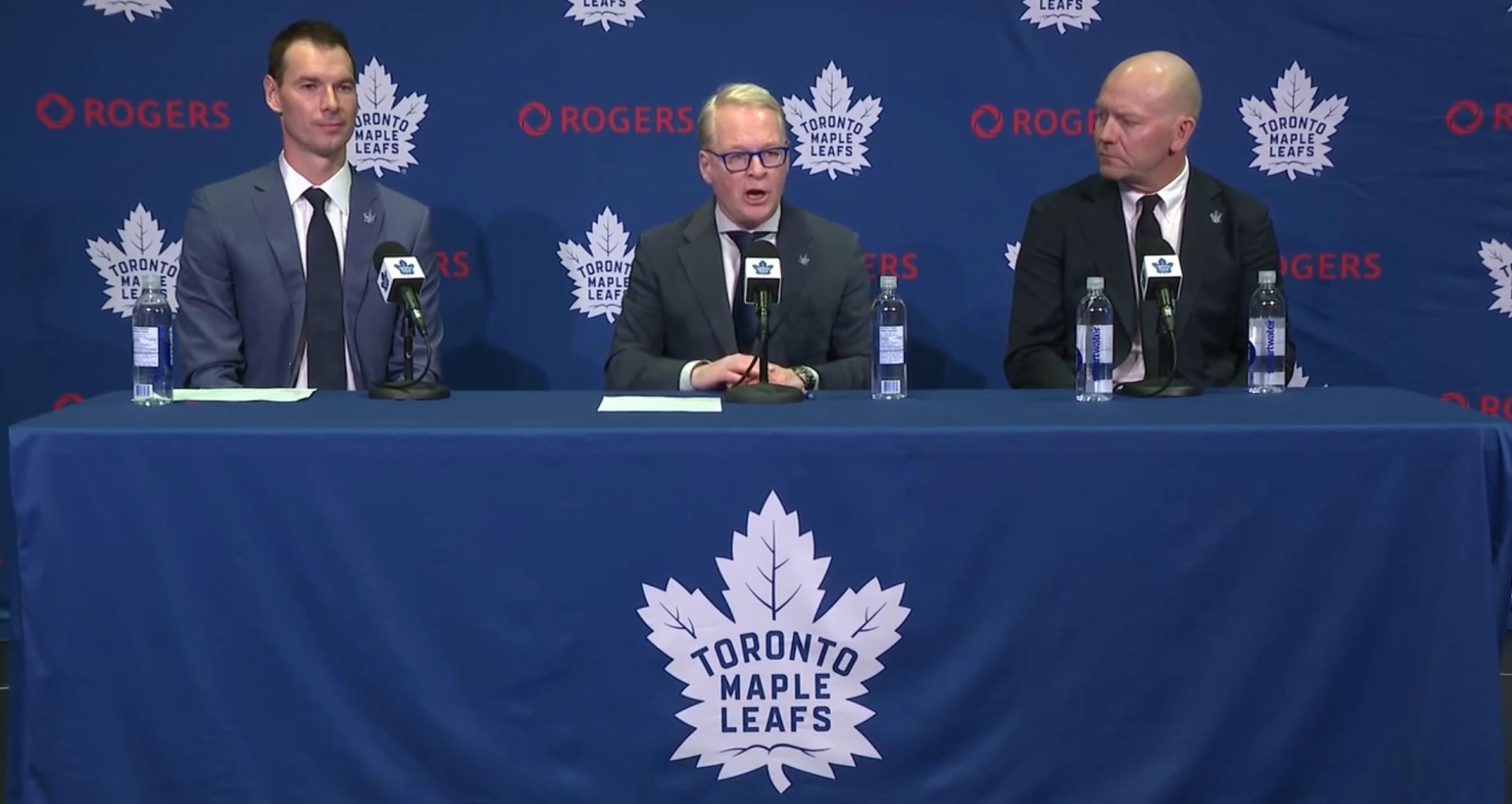
The Toronto Maple Leafs officially introduced John Chayka and Mats Sundin as GM and Senior Executive Advisor of Hockey Operations, respectively, on Monday. A lot was said, and a lot was still left to the imagination.
The introductory press conference featuring Keith Pelley, Sundin, and Chayka didn’t initially alleviate many of our concerns. Partly, it’s due to the format’s limitations, with many different reporters each asking one of three people a question on disparate topics within a 20-minute Q&A. Partly, it was due to Pelley’s demeanour and answers, which we will get into shortly.
As the day progressed and more interviews were conducted, Chayka acquitted himself reasonably, while Mats Sundin leaned on his experience of playing in Toronto, sounding more like a veteran hand there to help navigate the market at large, rather than a senior executive setting the vision or dictating the team’s transactions.
A few key tidbits stood out:
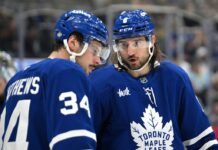
Auston Matthews and William Nylander are staying put
In case there was any uncertainty, Kyper and Bourne asked about it directly and received a direct answer in return:
We certainly get the sense that Auston Matthews and William Nylander aren’t going anywhere, and you are only interested in building around them. Is that fair?
Chayka: That’s a fair assessment, yep.
We are talking about world-class players. You can talk about no one being untouchable, but you are trying to get better. Moving world-class players makes it hard to get better. I would not anticipate that it is something that makes sense.
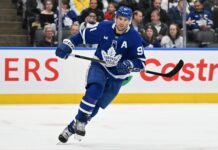
This doesn’t come as a surprise, given that Pelley previously stated, “I think we have some foundational pieces. We have generational pieces in #34, #88, #23, and #91. We have strong goaltending. There are a lot of positives. We now just have to surround those individuals with better pieces. That will be the decision and task of the new head of hockey operations.”
It does lend more credence to the theory that Pelley set the direction and interviewed candidates with that direction in mind.
Either way, the path forward will clearly include the Leafs’ handsomely paid stars, for now, so the questions turn to how Chayka plans to fill out the rest of the roster without a major shakeup. Clear issues on defense were acknowledged, and the team struggled to put together three cohesive forward lines throughout most of the season. A proper coach and some reasonable UFA signings can probably smooth over some of this, but the UFA class is weak, and they aren’t flush with futures to trade. It will require some real maneuvering and creativity.
No real plan for how to compete was properly outlined yet
Hiring a new person, or people, to run a pro sports franchise presents not just an opportunity to hire new leadership and decision-makers but also to sell hope and optimism to the fanbase.
This is something Leafs Nation badly needs right now, and Chayka himself spoke quite a bit about “generating momentum” in various interviews throughout the day. The Leafs are coming off a season in which they finished 5th-last, are in a precarious draft-pick situation, and own an aging player group. Many fans are down on this roster and/or confused by the franchise’s general direction.
While Chayka rightly acknowledged that nothing he could say yesterday would earn him instant credibility in the market, there is a line between making a grand, loud entrance (e.g., truculence, pugnacity, and testosterone) and going extremely vague:
Chayka: “The optimistic, hopeful side is that this team has a lot of latent upside. A lot of the players underperformed. I think there is a lot of opportunity to get in there and find ways to do a better job with the internal group.
Having said that, it is a reality that we will have to make some changes and fill some holes. There are some fundamental ways in which we’re going to have to change the team. That is what our goal is.
Every season is sacred to our fans, players, and ownership. It is incumbent on us to put the best team on the ice we can. It is going to take a high hit rate, it is going to have to take some creativity, and we are going to have to have some things go our way, but we certainly feel like we are well-positioned with a core group. We have some players who are some of the best in the world who wear this sweater. It is upon us — Mats and I — to put in place the structure, the principles, and give them the resources to go out and accomplish their goals.”
A lot of words, but not much substance. We gained no real idea of the type of team Chayka wants to build, how he wants them to look stylistically, what the expectations are across the board for players, coaches, management, scouts, or, honestly, much of anything at all. It was full of generalities rather than a clear, articulate plan. Ultimately, the proof will be in the pudding, but the fans were owed a little more than what they received here. To be fair, he did get into a little more detail in his later interviews.
Regarding the general sentiment around Chayka’s reputation in the hockey world/league, he was again vague in his response:
Chayka: “I’d just say that Arizona was a really complicated situation. It was the biggest challenge I’ve ever taken on in my life. It was honestly the hardest thing I’ve ever done, and also, in a lot of ways, the most rewarding.”
It’s a weak answer that glosses over behaviour that should be properly addressed, not completely disregarded. He didn’t need to detail an entire timeline of events, but a measured response of some kind is much better than brushing it aside altogether.
None of it would have meant much moving forward, but there’s no real point in an introductory press conference if you aren’t even going to attempt to sell some sort of plan/hope and address the major concerns of the fan base.
Keith Pelley does it again
While Chayka lacked clarity and Mats Sundin didn’t exactly make his full role clear, neither individual said anything egregiously wrong. In truth, they generally fared just fine with their answers, and once they stepped off the podium and conducted more in-depth interviews, Chayka was generally quite reasonable and measured in his responses.
The same cannot be said for Keith Pelley, who, for some reason, was sitting in the center between Sundin and Chayka.
While the Steve Simmons dust-up is receiving a lot of attention, Pelley was asked completely reasonable questions by TSN’s Gino Reda about Chayka’s time away from the league and the challenge of jumping back into it after so long on the sidelines:
“There is no concern from my side.”
When pressed further about Chayka’s knowledge of current players, Pelley reiterated:
“Still no concern from my side. He knows the players in the league.”
This was a fair question that deserved a proper response, certainly not a flippant one-sentence answer that Pelley then doubled down on.
The Simmons question aside, Chris Johnston circled back on it and, in a much more respectful manner, asked about the sanctions against Chayka:
Pelley: “As I have already said, I did deep due diligence. I’ve read all of the reports. I’ve talked to numerous people — I won’t reveal who I talked to — who were close to the process. We’ve done extensive due diligence, and I am very comfortable and confident in where we’ve landed.”
There’s nothing to this answer. Pelley could have talked about the Coyotes’ extenuating circumstances, believing in Chayka’s character, what specifically makes him comfortable and confident, Chayka’s growth in the years since, his budding relationship with Sundin, or any number of other points that would have at least feigned a proper response.
Finally, when asked about not hiring a President, Pelley said:
Pelley: “We went through the search. We had no preconceived notions of what structure we were going to move toward. But once we got into the process, we realized, as we got deeper into it, that this mix with John and Mats was one that would be formidable. There is no specific reason for it. It was just that this is the structure; it is a different structure, but I think it will be a winning structure.”
Hiring a President wasn’t a prerequisite of any kind, but it would be nice if the person in charge of hiring could articulate the duties assigned to each role and why it wasn’t necessary in this structure with these individuals in the fold.
In fact, later on, this almost felt like a Freudian slip by Chayka:
Chayka: “As I’ve said, I think our players are our partners. We’ll be getting together with them and learning and hearing their insights. They always have the best insights, quite honestly. Mats, Keith, and I can come up with lots of ideas, but hearing it from them is the most important part.”
Why would Pelley come up with any hockey ideas whatsoever? He shouldn’t be anywhere near the hockey operation.
All in all, Pelley started with a Raptors rant, didn’t answer any of the questions all that well, and he poorly handled the tense Simmons interaction, in particular. That question could be seen coming from a mile away, and stopping at “trust me, I did due diligence” (x2) falls well short. Even if Simmons’ wording could’ve/should’ve been more tactful — especially in front of Chayka’s family — the crux of the question is fair game and totally foreseeable, and when we’re talking about something as uniquely concerning as Chayka’s sanctions and suspension by the league, Pelley owed everybody more of an explanation as to why it isn’t an ongoing concern (even while understanding he can’t get overly specific about the people he spoke to or leaned on for reassurance).
There were already a few nerves and some tension/awkwardness in the air, understanding this wasn’t an instantly popular decision in the market, and Pelley made it worse.
The call on Craig Berube looms large
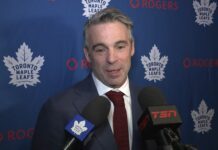
Once Chayka was apart from Pelley, he appeared more relaxed and in control in the scrum, the Real Kyper & Bourne interview, and the Friedman sit-down. He was more convincing, measured, and sharp.
Chayka identified the areas for improvement correctly: the team defended too much, they couldn’t break out, and the defense needs a makeover, including more puck-movers. He framed integrated data-backed decision-making well while acknowledging the human element and the sport’s intangibles.
When Friedman asked him specifically about improving the team, part of Chayka’s answer stood out:
Chayka: “I do think we need to do our best to change the mix on the back end. I think if you look at how this group defended, we defended too long, we didn’t break out the puck well enough, we didn’t join the rush well enough, and a lot of that starts on the back end.”
It immediately flashed us back to the first season under Craig Berube, after the Leafs signed Chris Tanev, OEL, and Jani Hakanpaa:
Berube: “We upgraded our D core by adding three big defensemen back there. We are a lot bigger back there. I think it is really important to have big D who get in the way and check, be hard at your net, penalty kill, and all of those sorts of things.”
Berube has made no secret about this. Simon Benoit played 73 games this past season, and Philippe Myers featured in 39 — far too many for both, considering their quality of play. He was loath to try alternatives with any semblance of skill all season, and even when the team got healthy, he strangely moved away from the defense pairings that were working, jamming square pegs into round holes after the Olympic break.
Regardless of what Berube might say now, the track record is too significant to believe he’s really changed. When Berube was hired, we flagged that he wanted nothing to do with Vince Dunn in St. Louis, and the trend has only continued since. It can be fairly argued that the Leafs’ blue-line personnel group wasn’t good enough — it wasn’t — but it was full of the type of players Berube covets, and they played the style Berube wanted to play.
How, then, can we square Chayka’s goals for improvement and what we know of Berube’s recent history? The two don’t jive at all. Indeed, the first big litmus test of Chayka’s ability to back up his words with actual actions, or perhaps of his real autonomy level under Pelley, is this Berube decision.
Chayka talked about many players underperforming relative to their historical contributions this past season, the inability to break out, defending too much, defensive regression, and the lack of team speed. Add in the fact that Chayka is well-versed in the analytics, and there is very little ground to stand on for retaining Berube, besides possibly this: he either might not want to spend a coaching-change bullet already, or ownership/Pelley do not want to pay another coach and/or have a particular fondness for Berube.
On the coaching-change bullet point, the timeline reality with Auston Matthews — Chayka acknowledged a need to sell him on the vision and the ability to win relatively soon, with Matthews signed for just two more years — and Chayka believing there is an opportunity to win with the “world-class,” prime-aged centrepieces already in place, would not align with simply burning an evaluation season in which we find out if Berube can change his spots.
If the reason for potentially keeping Berube is that ownership and Pelley won’t sign off on Chayka’s wish to bring in his own coach, that’s a whole other kettle of fish — non-hockey people dictating important hockey decisions — and it means this new era is doomed for certain failure.
Needless to say, the upcoming Berube decision will tell us a lot.