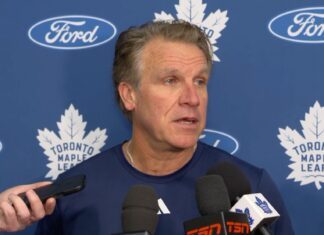



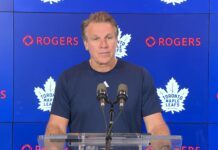








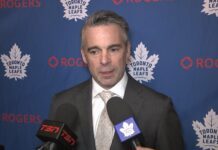








On their first day as the new leaders in hockey operations for the Maple Leafs, John Chayka and Mats Sundin joined Real Kyper & Bourne to discuss their process of assessing the organization, charting a path forward, the culture they’re seeking to build, and whether Auston Matthews and William Nylander are “untouchables.”
How did the press conference feel for you both personally? How does it compare to what you’ve experienced in the past?
Chayka: Well, I was the GM in Arizona. I was going to make the quip earlier about the difference in the number of cameras, relatively speaking, but I don’t know if it was the right forum. No, I loved my time in Arizona — passionate fan base, for sure — but it is not the same as Leafs Nation.
So, it felt good. I think it was important for us to try to articulate a vision to tell the fans where we feel we are today, where we are headed, and answer any questions as honestly and truthfully as we could. In that regard, I thought it went well.
You weren’t nervous, were you, Mats?
Sundin: No, I knew it was coming. I was even more prepared than Johnny, haha.
No, it is great to be back. I lived 13 years in Toronto. I understand the demands of the fan base, but it is also the best place in the world to be a hockey player. It is great to be back.
Keith Pelley briefly mentioned your connection going back to 2012. Talk about your relationship, where it formed, how it grew, and how it ultimately got the two of you together today.
Chayka: Yeah, we met at the Memorial Cup in London. I was going to school at the Ivey Business School there. The Memorial Cup was happening, and Mats was there to watch it. I was kind of the stats guy, doing something different. Mats is obviously an iconic player. We talked shop and kind of exchanged notes. Whenever I was out scouting or watching the Leafs, we just kept in contact.
The real thing we’re after — and this is a big challenge, obviously, and no one knows it better than Mats — is the ability to have a tandem approach. Really, that is how we’re going to approach this: collaboration. I bring certain things to the table. Obviously, Mats brings an incredible wealth of knowledge from being the captain of the Maple Leafs, having success, and knowing what it is like to deal with the media and be in that locker room.
The idea here is that we can share experiences and do everything in the best interest of the Toronto Maple Leafs.
You mentioned the process was exhausting and exhaustive at the same time. What did that look like? Did you have to bring forth a formal vision of what it would look like if given the opportunity?
Chayka: Yeah, there were several layers to it all. Initially, it was about getting to know each other and sharing ideas; seeing if I am interested, and seeing if there is interest on the other side. And then there were other layers of meeting other people in the organization, all the way up to Edward Rogers, of course. Along the way, I had my presentation of what I felt.
Honestly, at one point, they put together a list of 20 questions. It was an assignment, and I had 24 hours to give them feedback on all of the things they were interested in. It was very thorough. It was probably the most thorough process I’ve been a part of, and I’ve been through a few now. Ultimately, I understood the weight of the decision.
Mats, from the first meeting with John Chayka and understanding what kind of hockey mind he had, what was the ultimate deciding factor that he was someone you want to work with and try to win the Stanley Cup with?
Sundin: I met Keith for the first time and had breakfast with him a year and a half ago. We stayed in contact. John’s name came up.
I obviously know he is very smart and hard-working. We talk about data-driven when we talk about John, but he has broad knowledge of the game — not only the data — and a clear view and vision of what a winning team looks like, which I share with him.
With my experience, knowing what John brings to the table, I think it was a perfect match for me to join and try to help out.
When it comes to making decisions, how much will you run things by each other? What if one of you wants to trade for a guy, and the other one isn’t sure about him? What will those conversations look like?
Chayka: I think we’ve had those conversations kind of academically, of course. As we get to work together on different opportunities, I think that will flesh itself out even further.
Ultimately, what we are trying to do is build an entire organization and front office that has different perspectives and different inputs. Ultimately, we all put the best information on the table, and someone has to make a judgment call. You can have the best data, but that doesn’t mean there is a conclusion. Someone has to read the data, interpret it, and make a decision. That will be our collective decision. I am very comfortable that, as Mats said, we have an aligned vision and a common goal.
I hope there are a lot of people in the organization who bring other ideas that aren’t ours. That will force us to make good decisions that maybe didn’t come from our thought process.
What Leafs fans want to know most is not necessarily the details of the plan but how quickly the plan can come into effect here. Are we talking about a team that they can look forward to challenging for a playoff spot as early as next season? Is there a thought that this could turn into a 2-4 or 3-5 year plan? Are you prepared for both?
Chayka: As I think about building out an organization, I think about two tracks.
There are the foundational pieces: amateur scouting, player development, sports science, R&D, and the list goes on. These are things that will hopefully sustain the Leafs for a long time and hopefully, beyond my years. That is the goal. I think those things are daily things; everyone in the organization, every day, is going to be committed to doing that again, again, and again until we have a real player development machine. If we can do that, we will put ourselves in a really good position.
The other track on that is that every season is an opportunity. Every season is sacred for this organization, the fans, the owner, and for ourselves. We owe it to give it everything we’ve got and to put the best team on the ice.
I think we have some world-class talent. That is a good starting point. I think there is a gap, as I said. We’re realistic. We know what our record is coming in, and we know we need to get further.
Certainly, as Mats and I sit here and think about what we need to do to get to the next level and get some momentum back… Remember, this is a team that has been good for a long time — not great yet, but good. There is some pride there. This is the first time they’ve missed in a long time. The players will come back and dictate what the next season looks like.
There will be a lot for you to catch up on. Mats, where do you focus in the day-to-day now? Are you looking at player personnel immediately, or where are your priorities to start?
Sundin: I think there is value to bringing in experience that has lived it and been there. We went to the Conference Finals a couple of times in my era. Doug Gilmour and Wendel Clark were at the press conference. They had some good runs. Earlier generations of the Maple Leafs have been in the locker room and seen what has been good when you have those runs — when you actually have a team, in terms of the culture, what kind of people are in the room? — but also the things that have gone bad.
I hope I’ll be able to support John and the management, but also the coaches and players. I think, with my experience, I have a good view on what kind of character and what kind of vision needs to be in the locker room if you want to be on the winning team that is successful in the playoffs. Hopefully, I’ll be able to contribute on all of those pieces there.
Culture is a term used a lot around our game. Some understand it better than others. A lot was made out of Radko Gudas going after Auston Matthews and the lack of response. If you were in the position of Brad Treliving last season, how would you have portrayed that? What kind of message would you have delivered to the players the following day after watching it?
Chayka: How I’d think about that is more on the proactive side. It is all the stuff Mats was talking about. How can you build an environment where players feel supported and really have each other’s backs, and we have their backs as a front office? Culture is a big word, but whether it is communication, the resources we’re supporting them with, or how Mats can support them, our goal is to build up a great locker room.
Once you’re reacting to something like that, it is challenging. I can’t speak to what Brad did exactly — I wasn’t there, and I don’t know — but in those scenarios, you have to address things and be direct and honest. I think the team expects that of leadership. That’s what I’d do.
Sundin: You said it all, but people don’t really know until you’re in a great locker room with a winning culture and you actually feel it, right? The game has changed from when we played, and even if you go back five or 10 years. But certain things are the same.
I know culture is a wide thing to talk about, but when you have that group that is so tight and everybody is committed to a bigger goal and is trying to be better, it can help to get to the vision we want to get to as a team. That is not automatic. You need everyone to buy in within the dressing room, and not only the players; it’s everybody who works around it. When you get to that, I think you can create great things.
This is the biggest and at times most scrutinized market in the hockey world. There is a balancing act between protecting players and holding them accountable.
Sundin: Absolutely. I couldn’t agree more.
We never got to win the Stanley Cup, but even when you go to the Conference Finals, you have some of that great stuff going on where players are also holding each other accountable, right? Management and coaches can only do so much. At the end of the day, it has to be the group of players that are eventually taking charge of it and holding each other accountable, too.
Winning always helps with culture. You’ve spoken about the gap between where you are and where you want to go, and maybe selling Auston Matthews on making sure he wants to be a part of the program in the years ahead. How do you close that gap? What are the steps to getting to a John Chayka-style team?
Chayka: I’d start with the internal. This is a team that did underperform. There are a lot of players who have some latent upside and have performed historically, but didn’t do that this year. I am an outsider — I can guess — but I am going to get inside, and with Mats, we will have a lot of conversations and try to understand that, first and foremost.
To Mats’ point about a common vision — and this is not a new idea — having elite goaltending, having top-echelon puck-moving and skating defensemen, and having the game-changers up front is the equation.
Where we see opportunities is in how we defend, how we exit the zone, and how we move through the neutral zone. Those are areas where we have historically done a better job as a team. We think there are some opportunities as well.
Leon Draisaitl made it clear that Edmonton is on the clock for two years. They have to get something done in two years with Connor McDavid. Auston Matthews was non-committal in his exit meetings. You mentioned a bit of a sales job for a program he can believe in. How big a concern is it for Leafs fans that Auston is on the clock?
Chayka: Sales job is maybe not the right word, but any time you have world-class players who are driven to win, you have an obligation, as an organization, to fulfill a plan.
I think a lot of Auston’s comments are totally fair. If I were in his shoes, I would be thinking about it the same way. He is in the prime of his career. He is the best goal-scorer. He is the captain here and is expected to lead. We have to find a common vision and a common goal to get the job done.
There are some things we have to do as an organization, and we will outline those for him. I think there are some things that he has thought of or ways we could be better. I think we need to be responsive to that.
I think it is a partnership, ultimately. When you get into those levels of players, it is a partnership with the organization. We have our job to do, and he has his, but there is a real synergy as to how he sees the game. He has lived it. He is the captain. It is his room. What can we do together to take this to the next level? That is the conversation we intend to have.
In terms of a time frame, you have to make some hard decisions rather quickly. Can Leafs fans expect that you might make a decision on Craig Berube as early as a week from now? Does everybody get the benefit of the doubt of a clean slate? Morgan Rielly is another name that a lot of fans are saying, “It is time for a change.” Does he get a clean slate at training camp as well?
Chayka: I don’t think there are any deadlines on anything. There is the regular calendar of the NHL, but there will be no internal deadlines in terms of how we build out our process.
But in regard to your question — and it is a good one — there is a timeline, and the timeline is tight. We have a lot of ground to cover and a lot of important decisions to make. That is not a bias to say we will make those decisions in any one way or another.
Craig, in your example, is a great head coach. Morgan Rielly is the longest-tenured Leaf and a good defenseman. These aren’t easy decisions, or something we will just make a decision on to get a decision done. We want to make the right decisions for the organization in the short and long term.
John, there is this idea that you are an analytics guy. What does that mean? In what capacity will you use that information in a way that would be different than someone who is a “hockey guy?”
Chayka: The way I think about this job is that it is a leadership position. I’ve learned it more and more as I’ve done it. It is right in the title: General Manager.
You are trying to find competitive advantages, and I think that is the role of a GM: What is our right to win? What is our edge? How can you define that so that you are not doing the same thing as everyone else and hoping that the lottery balls fall for you, or something like that?
I think there are advantages in data and advantages in sports science and a lot of these emerging technologies and fields. How do we integrate that into the fundamentals? The fundamentals are always going to be the fundamentals. If you can do that successfully, those are the teams that win. If you do one or the other, you are probably beta and always scrapping it out.
Our vision and goal are to leverage new methods and ways of doing things, integrating them in a very thoughtful way. If you can do that, you’ll have success.
The data on the team from last season shows them dead last in almost every category: outshot, out-chanced, and expected goals. It was a disaster, frankly. Is that up to you to decide now if it was coaching or player personnel?
Chayka: I think we’re going to go diagnose that.
I will say this, too. Data is a part of the picture. There are a lot of things at play — injuries, underperformance, and whether there are culture issues or not; I don’t know, but those are the other kinds of intangibles that you want to go through, understand, and weigh properly. I don’t think it is fair to just hang numbers on someone. That is not how I’d do it.
Certainly, I think it does provide some kind of a hypothesis to say, “Why are these numbers the way they are?” You create an action plan to go fix it.
In terms of the structure, the Leafs have been known to have multiple assistant GMs. There are still people under contract. Do you decide the structure now? Does it fall under your responsibility, from the medical team to the pro and amateur scouting?
Chayka: Mats and I will go through that process. Again, it is step by step. We will put together our core group of executives in the front office, and then we’ll make decisions as it relates to medical, scouting, or pro scouting. It is a group approach, always, but ultimately, Mats and I will agree on what that looks like on the go-forward.
It is a big night with the draft lottery on Tuesday. You will find out if you have the first, second, fifth, or no pick in the first round. Do you have a preference depending on where you’re picking, or are you going to go to the scouts and ask them what they’ve been working on?
Chayka: My preference is to draft number one. If we could have the number-one pick…
The amateur scouts have been working all year on their draft lists, and I’ve already had some conversations. They have a fulsome list. It is not five or 10 guys. It’s A-to-Z in all of the leagues. We definitely aren’t short on resources to make sure we have a book on everybody.
The balls will fall where they will. We don’t have any control over that. What we can control is making sure we make the best possible pick when we do have a pick. I know we are in a really good spot there.
There has been a lot of talk and rumours about Brad Treliving and the Leafs being open to exploring a range of possible moves, including some big names. At times, we use the word untouchable. We certainly get the sense that Auston Matthews and William Nylander aren’t going anywhere, and you are only interested in building around them. Is that fair?
Chayka: That’s a fair assessment, yep.
We are talking about world-class players. You can talk about no one being untouchable, but you are trying to get better. Moving world-class players makes it hard to get better. I would not anticipate that it is something that makes sense.
The point is not to make a move to make a move. You are trying to improve your roster. When you are talking about players of that calibre, it is a challenge, of course. And that is a good problem to have.
Similarly, there are a lot of other great players on the roster. Hypothetically, you could talk about what the value is, etc., but there are a lot of other players who fall in the category of “hard to move” because you like them, they add value, they’re good players, and they’re on good contracts.
We’ll go through all of that, but I think it is a fair assessment.
Mats, do you have a plan to talk to the players and staff? Everyone gets nervous when there is a new boss and wants to know what is happening. What is the plan?
Sundin: I think we’re going to try to meet everybody. You’ll get great information from everybody. We need to meet everybody, evaluate, and see what is going on.
When everyone on the outside was speculating about potential roles and titles, President was brought up. Is there a reason you steered away from that particular title?
Sundin: I think I am old enough to recognize my strengths and weaknesses, and what I can do and contribute.
For me, knowing that John was taking the role, I think it is a perfect match. I think we can complement each other. I know things, with my experiences of 18 years in the league, watching international hockey, and even following the prospects for the last three or four years in Europe. I thought it was a perfect combination to come in with John. I think we’re going to complement each other very well.
Do you anticipate bringing anyone back into the fold from your time playing for the Leafs, knowing some of those relationships?
Sundin: I think it is way too early. We have a lot of work to do with these assessments. We have been watching the team from the outside. There is a lot of work ahead. We’ll see what happens.
Still, it was great that you mentioned the alumni in the press conference. There are a lot of great minds there you could lean on.
Sundin: Yeah. I think great organizations need to learn from what has gone on. John mentioned wanting to build something that is a lasting, great organization for the future. There are mistakes that have been made in my era and great things that have happened. You just want to learn from that so that you don’t have an organization that keeps making the same mistakes.
Does that include involvement in the business facets?
Sundin: It is going to be really great for me to be beside John. There is a lot I am going to learn. I am sure I am going to be able to help him with stuff going on in the room that actually is important if you’re going to have a winning culture there. I think there is going to be a good collaboration there.